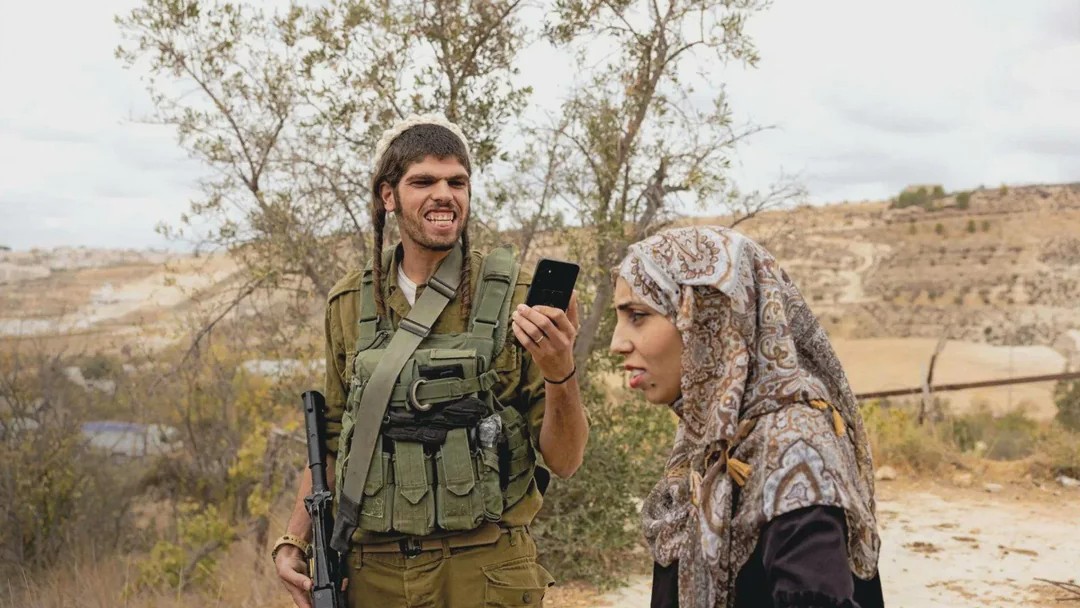
In October 2025, a routine land defense action during olive harvest season in the occupied West Bank turned into a viral international incident that has reignited global scrutiny of escalating Israeli settler violence against Palestinian communities. The incident, captured in a candid photograph and full video footage, has pitted an Italian news magazine against the Israeli government, while giving a human face to a years-long crisis of displacement and intimidation in the region.
The central figure in the controversy is 35-year-old Meead Abu al-Rub, a Palestinian lawyer working with the Colonization and Wall Resistance Commission. On 12 October, Abu al-Rub joined a group of fellow activists and local farmers in the Suba area of Idhna, a region southwest of Hebron, to peacefully oppose the proposed confiscation of Palestinian agricultural land and support local landowners during the critical annual olive harvest. What began as a calm gathering of olive picking, traditional dabke dancing, and folk singing quickly escalated when more than 20 armed settlers, escorted and protected by over 30 Israeli soldiers, arrived at the site.
In an exclusive interview with Middle East Eye, Abu al-Rub recounted the chaotic confrontation that unfolded. “Some of the settlers were wearing military uniforms and carrying weapons,” she said. “They threatened us, insulted us, and filmed us. The settler who was filming me with his phone was threatening to arrest us all, even though we had not done anything wrong and they were the ones who attacked us.” The settlers, backed by Israeli military forces that fired tear gas at the gathering, threatened to detain participants and transfer them to Al-Moskobiya, an infamous Israeli detention facility. Abu al-Rub recalled that organizers made the difficult decision to withdraw, a choice she says likely saved lives. “If we hadn’t cancelled the event and withdrawn, the settlers wouldn’t have hesitated to shoot us directly,” she explained. “They had their weapons ready, and there was no one to protect us.”
The photograph of the confrontation, captured by award-winning Italian photographer Pietro Masturzo, was selected as the cover image for an issue of major Italian current affairs magazine L’Espresso, headlined “L’Abuso” (The Abuse). The cover text accompanying the image drew a direct connection between the harassment in the West Bank and broader regional Israeli military actions: “The occupation of the West Bank was carried out with the help of soldiers collaborating with settlers. Gaza was destroyed. Expansion in Lebanon was carried out. The borders in Syria were violated. Iran was attacked. Ethnic cleansing and massacres were committed. This is how the Zionist right wing is shaping Greater Israel.”
The image quickly spread across global social media platforms, prompting an immediate sharp rebuke from Israeli officials. Jonathan Peled, Israel’s ambassador to Rome, condemned the cover, claiming it “distorts the complex reality” of the region and perpetuates harmful stereotypes and hatred against Jewish people. Israeli officials further accused the magazine of publishing a doctored, artificially generated image designed to defame the country.
Masturzo moved quickly to debunk these claims, releasing the full unedited video footage of the entire incident to coincide with the magazine’s publication. In an Instagram post addressing the growing controversy, the photographer confirmed: “Many are asking if this image was created using artificial intelligence, while others are pointing to posts claiming so. Well, no, the image in question is not a product of artificial intelligence.” L’Espresso also stood by its reporting, publishing the full clip to confirm the authenticity of the cover photograph.
For Abu al-Rub, the sudden global attention has come with heavy personal cost. As a mother of four children, ranging in age from 18 months to seven years, she now lives in quiet fear of reprisal from settlers and Israeli security forces, a reality shared by thousands of Palestinian land defenders across the West Bank, where Palestinian communities receive little to no protection from aggressive settlers, who operate with open backing from the Israeli military.
“I wasn’t afraid of them during the event, but now, after the photo’s widespread circulation, fear has crept into my heart,” Abu al-Rub said. “I’m a mother of four children… They’re making me afraid of the photo’s massive spread and the possibility of being forcibly separated from them.”
Despite this anxiety, Abu al-Rub says she has found renewed motivation in the support of her family and the international attention that has brought the crisis of settler violence to a global audience. Her own children have told her they are proud of her work, and their friends have expressed admiration for her courage standing up for Palestinian land rights. “My father instilled in me a love for my land, and I’m happy that I’ve passed this on to my children, who share the same love and sense of belonging,” she said. “When I go out to events, they ask to come with me and say, ‘We’re Palestinians too, just like you.’ This proves that our cause isn’t forgotten by the young, as Israel hopes, but is far too deeply rooted to be forgotten.”
The viral incident comes amid a documented sharp escalation in settler violence across the occupied West Bank and East Jerusalem in 2026. Data published by the United Nations Office for the Coordination of Humanitarian Affairs (OCHA) confirms that more than 580 settler attacks resulting in Palestinian casualties, property damage, or both have been recorded across 190 Palestinian communities since the start of the year. Between 31 March and 6 April alone, OCHA documented at least 47 separate attacks targeting 36 distinct communities.
Displacement from settler aggression and Israeli access restrictions has also accelerated dramatically this year. As of 6 April, more than 1,800 Palestinians have been newly displaced from their land in 2026 – a total that already exceeds the full-year displacement figure recorded for 2025. Abu al-Rub noted that thousands of Palestinian farmers are already blocked from accessing their own agricultural land during key harvest seasons, a deliberate pattern of displacement designed to clear land for expanding Israeli settlements.
The Palestinian ambassador to Italy has contacted Abu al-Rub to confirm the scale of global reaction to the photograph and video, noting that the incident has laid bare the daily reality of life under occupation for millions of Palestinians for an international audience that has increasingly turned its attention to the humanitarian crisis in the region.