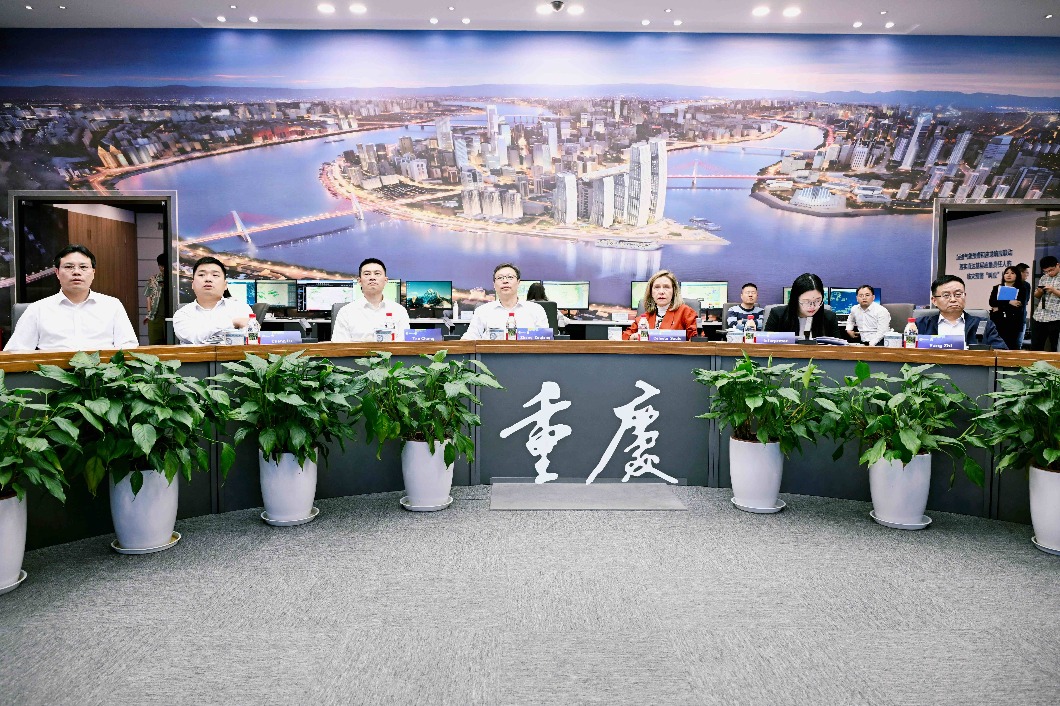
During an official two-day visit to southwest China that concluded on April 16, Celeste Saulo, Secretary-General of the United Nations World Meteorological Organization (WMO), has publicly lauded Chongqing’s innovative modernized meteorological infrastructure, calling the megacity’s work a replicable global benchmark for extreme weather management in dense, complex urban environments.
Saulo made her remarks following an inspection tour of the Chongqing Meteorological Bureau, where she reviewed the city’s end-to-end early warning system for meteorological disasters. “I was impressed by many elements of the early warning system here,” she stated. “What Chongqing can bring to the world is a valuable example of how to manage extreme events, and develop early warning systems in complex environments such as megacities.”
Saulo specifically highlighted the city’s successful fusion of cutting-edge digital innovation and traditional local climate knowledge, aligned with a core people-centered approach that matches the United Nations system’s own global priorities. “Protecting people should be at the center of what we do as part of the United Nations system. We have an obligation to global society and to the global population,” she added.
As China’s largest megacity by both land area and population, Chongqing holds unique geographic and administrative significance. Designated the country’s fourth direct-controlled municipality in 1997 (after Beijing, Shanghai and Tianjin), it serves as a key gateway to China’s inland regions and a major national manufacturing hub. Spanning roughly 82,400 square kilometers — an area comparable to the entire nation of Austria and five times larger than Beijing — it is home to more than 32 million residents, making disaster preparedness and public safety a uniquely challenging governance priority.
During her visit, Saulo also toured two additional key sites: the Chongqing Digital Urban Operations and Governance Center, and a grassroots community in Shapingba District. The trip was organized to allow the WMO chief to assess Chongqing’s on-the-ground implementation of the UN’s global initiative for universal early warning coverage, giving her firsthand insight into how digital meteorological tools are strengthening megacity governance and improving grassroots disaster warning coordination.
Per the Chongqing Meteorological Bureau, the city’s decades-long push for meteorological modernization has yielded a series of groundbreaking practices tailored to its unique terrain and population size. These include integrating artificial intelligence and big data-powered meteorological solutions into urban governance, rolling out all-encompassing public early warning services, and developing targeted digital flood risk management strategies.
Today, Chongqing operates a fully integrated cross-agency warning network, built in partnership with 10 local government departments spanning emergency management, water resources, and transportation. Focused on the three deadliest meteorological threats facing the region — heavy rainfall, extreme heat, and low-temperature snow and ice events — the system represents a major evolution from outdated single-factor weather alerts to comprehensive, actionable risk warnings that enable faster, more coordinated emergency response.
Critically, the city has achieved unified, seamless dissemination of warning information across all communication channels. Its robust distribution network reaches more than 1 million registered emergency responders, and the public coverage rate for life-saving early warning information now exceeds 99.9 percent, ensuring nearly all residents receive timely alerts to prepare for oncoming extreme weather.