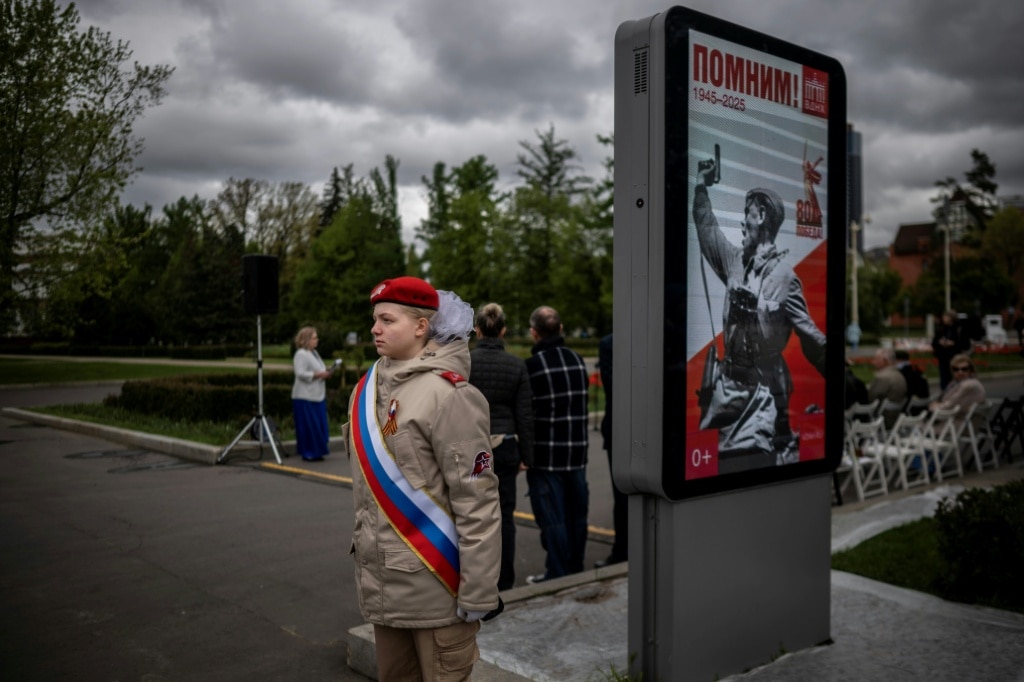
Since launching its full-scale invasion of Ukraine in 2022, the Russian Kremlin has expanded its efforts to shape domestic public opinion from traditional offline spaces into the digital realm, with a new, targeted focus on cultivating a new generation of pro-war content creators. Through specialized youth camps and national competitions, teenage influencers are receiving formal training to spread the Kremlin’s hardline anti-Western narrative and build broader support for its military offensive across younger Russian demographics.
This ideological campaign is no grassroots initiative — it is directed from the very highest levels of the Russian government. In a 2023 televised press conference, Russian President Vladimir Putin publicly framed youth education as a core pillar of Russia’s national strategy, quoting 19th-century Prussian statesman Otto von Bismarck to emphasize his priorities: “Wars are not won by generals, but by schoolteachers and parish priests.” He went on to stress that “educating young people in the spirit of patriotism is crucial” — a statement that laid out the clear mission of the nationwide youth outreach effort.
To carry out this mission, the Kremlin has revived and expanded Soviet-style state-aligned youth organizations, including the Young Army (known as Yunarmiya in Russian) and the Movement of the First. The Movement of the First alone claims 14 million online members and more than 1,100 regional projects across the country, giving the state extensive reach into teenage communities. At a Young Army content creation camp held in Moscow this past April, more than 120 teenagers dressed in matching green sweaters and red berets gathered for days of instruction from sitting soldiers and veteran state media journalists. Trainees learned core technical skills: how to shoot engaging short-form videos, leverage artificial intelligence for content production, and grow social media audiences to maximize their reach.
Vladislav Golovin, a former soldier who serves as chief of the Young Army’s general staff, framed the initiative as a values-building project. “We have created a huge team of kids, who understand how to broadcast government values and our organisation’s values,” he said in an official statement from the movement. Promotional footage from the camp shows teenagers cheering on a speed competition, where a cadet and Golovin raced to reload a sniper rifle — blending digital content training with explicit military-themed ideological engagement. Parallel to the Young Army camps, the Movement of the First runs national competitions that award prizes to teenagers who produce the top pro-Kremlin blogs and build the largest online followings for their content.
Independent analysts who study Russian disinformation and ideological strategy warn that this targeted campaign carries significant long-term risks. Keir Giles, director of the UK-based Conflict Studies Research Centre, describes the initiative as a “concentrated campaign to restore the prestige of the Russian military.” He notes that teenagers aged 14 to 16 currently growing up in Russia have never experienced any political system outside of Putin’s governance, making them particularly receptive to the state’s messaging. “This is their reality, and so we should not be surprised if these new efforts to spread information reflect that reality,” Giles explained to AFP.
Veronika Solopova, an artificial intelligence and disinformation researcher at the Technological University of Berlin, points out that social media platforms are uniquely suited to the Kremlin’s outreach goals. Platform algorithms are designed to deliver tailored content that sparks emotional engagement, creating an ideal environment for the state to push its narrative to young users. “Young people are famously easy to radicalise, easy to jump to conclusions on the nature of injustices, which, for Russia, is then all conveniently converted into army enrolments,” Solopova added.
Data from independent Russian pollster Levada Centre backs up the focus on social media: a March 2024 poll found that more than half of Russians between the ages of 18 and 24 rely on social media as their primary source of daily news. Giorgi Revishvili, a former Senior Advisor to the National Security Council of Georgia, argues that the format of short-form digital content is inherently well-suited to shaping youth opinion. Young people’s “shorter attention spans, combined with the effortless shareability of clips and reels, make digital content an exceptionally powerful tool,” Revishvili noted.
Dietmar Pichler, a disinformation and propaganda analyst at the European research network INVED, added that the content produced by these young influencers does not always take an overtly pro-war tone. Some content is “direct and radical,” while other pieces are “very subtle, aimed not at generating support for Russia, but at decreasing solidarity with Ukraine” among global audiences, he explained.
For the teenagers participating in the program, the training has already shaped their understanding of their own role in spreading the Kremlin’s message. In one promotional clip published by camp organizers, a female teenage trainee summed up the core of what she had learned: “When you are the one behind the camera filming the entire process, making audiences happy, you realise … you are the one who has aroused these emotions in people. The truth lies in a frame, and we are operating the camera.”