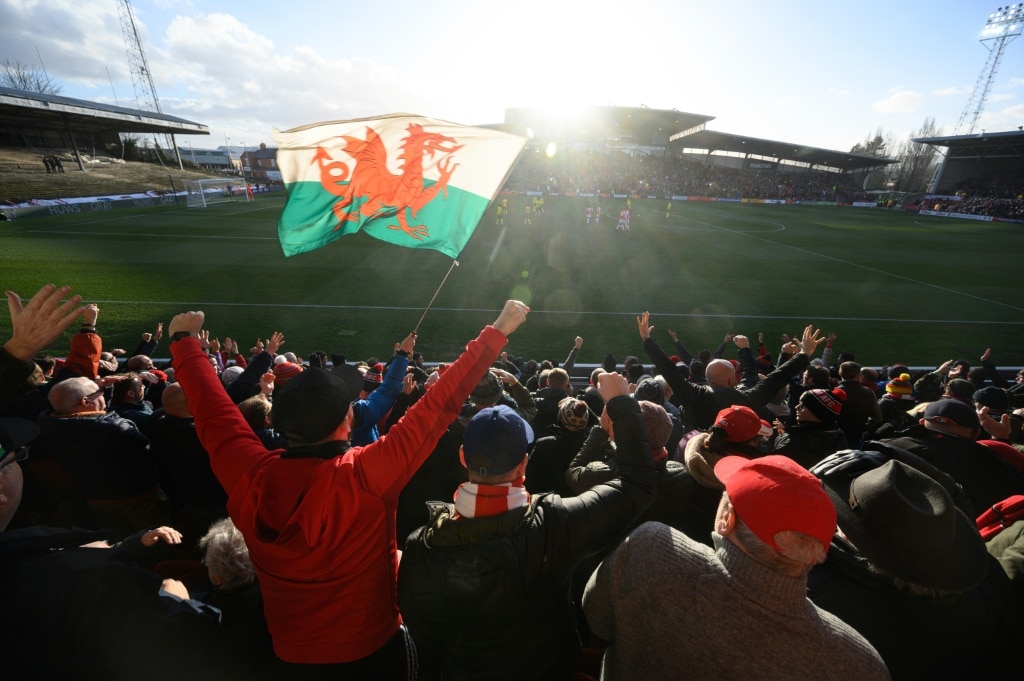
Five years ago, the small northern Welsh city of Wrexham was best known for a struggling football club mired in the fifth tier of English football, with a stagnant local economy and little global recognition. That all changed in 2020, when Hollywood A-listers Rob McElhenney and Ryan Reynolds completed their takeover of Wrexham AFC — and set in motion a transformation that has reshaped the club, the city, and even the wider region.
What began as an unconventional celebrity investment has turned into a modern fairytale, with success stretching far beyond the white lines of the pitch. On the field, Wrexham has secured three consecutive promotions, climbing from the depths of non-league football to the Championship, England’s second tier. With just four matches left in the current season, the side sits just one spot outside the playoff places, narrowly vying for a historic fourth promotion and a spot in the Premier League. Even in defeat, the club has captured global attention: earlier this season, they pushed top-flight Chelsea to the brink of an upset in the FA Cup, earning widespread praise for their grit and underdog spirit.
Off the pitch, the impact has been even more dramatic. The hit Disney+ documentary series *Welcome to Wrexham*, which chronicles the club’s rebuild and the new owners’ journey into lower-league football, has ignited a surge of interest across North America, drawing tens of thousands of international visitors to the city each year. Tourism data confirms the boom: annual tourism income in the area has doubled to £200 million ($271 million), and local industry leaders say that figure may be a conservative estimate.
Sam Regan, owner of Wrexham’s popular Lemon Tree hotel and restaurant and chair of local tourism board This is Wrecsam, says international visitors now make up a core part of local business. “Year round now about 20 percent of my accommodation is filled with American and Canadian guests, but when the home games are on, pretty much 80 percent is international visitors,” Regan explained. On match days, iconic local spots like The Turf pub, located steps from Wrexham’s Racecourse Ground, fill with fans drawn from across the Atlantic — from Virginia to Vancouver — all eager to experience the club’s magic in person.
Unlike some rapid tourist booms that spark local resentment, the “Rob and Ryan effect” has been widely embraced by long-time Wrexham residents and lifelong fans. James Townshend, a 30-year-old sales trainer and lifelong Wrexham supporter, says the entire local community has benefited from the renewed energy. “Every business around here now feels the buzz of Wrexham,” Townshend said. “Wrexham wouldn’t be where they are now without them, so we have to embrace and appreciate what these fans are bringing to the area.”
That affection for the city is shared even by new international fans, many of whom had never heard of Wrexham before watching the documentary. Becki Hendricks, a 51-year-old programme analyst from Virginia, has now visited Wrexham seven times since first watching the show — and she and her husband are even considering relocating permanently to the city. “We started with the documentary, yes. My life-long friends are here now,” Hendricks said. “Wrexham is a part of our hearts and part of our souls now.”
While a fourth consecutive promotion may prove out of reach this season, the club is already investing heavily for long-term growth, in anticipation of eventually reaching the Premier League. A new 7,500-seat state-of-the-art stand is currently under construction at the Racecourse Ground, set to open next year and bring the stadium’s total capacity to 18,000. The expanded facility will also allow Wrexham to once again host Wales international matches, bringing more visitors and revenue to the region.
Club CEO Michael Williamson told AFP the transformation runs far deeper than commercial growth. “This has had an impact that goes beyond just football. It has had an impact on the entire community,” Williamson said. “It has helped create jobs and opportunities within the community, but it’s also more importantly just inspired people and reestablished hope.”
For long-time observers who lived through 15 years of the club languishing in the fifth tier, the most visible change is a new wave of local civic pride. Richard Williams, a journalist who has covered the club for 20 years, notes the shift in how the city sees itself. “Just the fact that you go around the town and it used to be little kids in Manchester United, Liverpool, Arsenal shirts. Now it’s Wrexham, Wrexham, Wrexham everywhere,” Williams said. “So, the vibe, the feel-good factor around the town, it’s just absolutely phenomenal.”
The success of Reynolds and McElhenney’s experiment has also sparked a wider trend, with other American celebrities jumping to invest in lower-tier English football. Rapper Snoop Dogg now holds a minority stake in Swansea City, while NFL legend Tom Brady is an investor in Birmingham City — who even defeated Wrexham in an exhibition match last weekend.
Local councillor Nigel Williams says the Wrexham model has set a new benchmark for celebrity overseas investment, proving that it can deliver broad, shared benefits rather than just personal branding. As tourism board leader Regan puts it, the city’s reputation has been completely remade: “Before people knew Wrexham for problems like anti-social behaviour,” Regan added. “Now we are known worldwide and people are proud to be from here.”