BANGKOK, Thailand — In a clemency announcement tied to Myanmar’s traditional New Year celebrations, ousted former President Win Myint, a close ally of deposed civilian leader Aung San Suu Kyi, has been released from prison as part of a mass prisoner amnesty ordered by newly inaugurated military head Min Aung Hlaing, state-run media confirmed Friday.
The pardon covers more than 4,500 incarcerated people overall, including 4,335 domestic detainees and nearly 180 foreign nationals who will be deported after their release. However, officials have offered no confirmation that the 80-year-old Suu Kyi, Myanmar’s pre-coup civilian leader, will be included in the full pardon. Under accompanying sentence adjustments announced alongside the amnesty, Suu Kyi’s existing 27-year combined sentence will be reduced by four and a half years, leaving her with 22 and a half years remaining to serve. An anonymous senior military official based in Naypyitaw, speaking to the Associated Press on condition of anonymity because he was not cleared to share the information, added that Suu Kyi will be transferred from prison detention to house arrest as part of the clemency measures. She has already been moved to house arrest at least once earlier this April while serving her sentence at an undisclosed location in the capital.
Win Myint, a steadfast loyalist of Suu Kyi’s National League for Democracy party, was elected to the presidency in 2018. He was taken into custody on February 1, 2021, the same day the Myanmar military seized power in a coup that ousted the elected civilian government and detained both Win Myint and Suu Kyi. He was ultimately convicted on multiple counts carrying a combined 12-year prison term, a sentence that was already reduced to eight years in 2023. State-run MRTV television confirmed that Win Myint, who was held at a prison in Bago Region’s Taungoo township, had received the amnesty and was released.
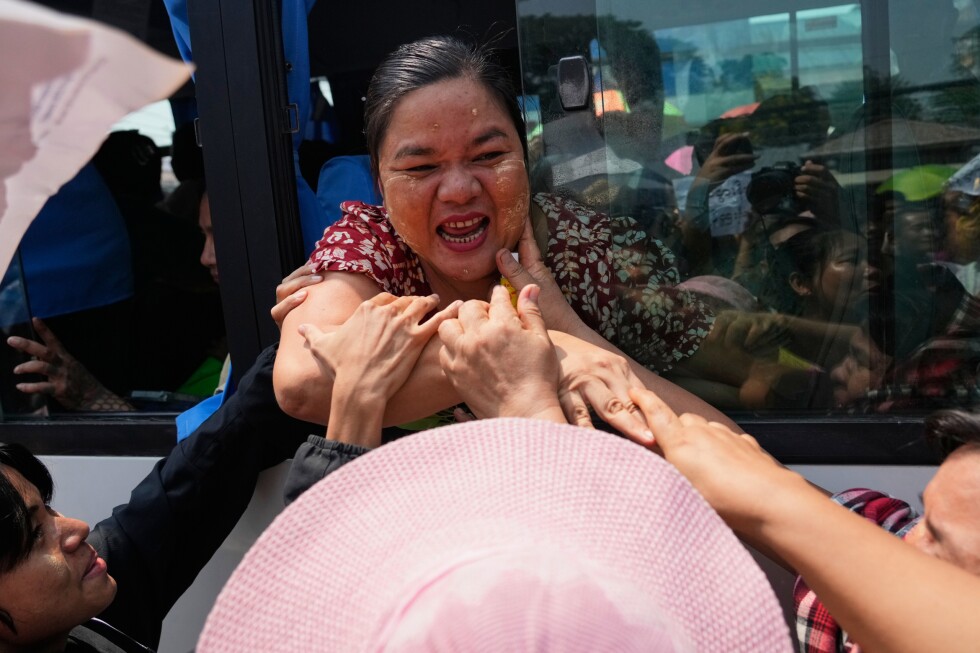
Outside Yangon’s Insein Prison, a major detention facility for political detainees, crowds of relatives and friends gathered from pre-dawn to greet buses carrying newly freed prisoners. Among those released was prominent filmmaker Shin Daewe, who had been sentenced to life imprisonment under Myanmar’s controversial counterterrorism law just months earlier in January 2024.
The mass amnesty comes exactly one week after Min Aung Hlaing was sworn in as president, following an election that critics across the international community have widely denounced as neither free nor fair, designed explicitly to cement the military’s authoritarian hold on national power. In his inauguration address last week, Min Aung Hlaing framed the planned amnesties as a step toward advancing national social reconciliation, justice, and peace, and supporting broader development across the country.
Mass prisoner releases during major national holidays and state events are a long-standing tradition in Myanmar. However, the clemency announcement comes amid a protracted nationwide conflict that has followed the 2021 coup. According to the Assistance Association for Political Prisoners, an independent human rights monitoring group that tracks political detentions and casualties, nearly 8,000 civilians have been killed since the military takeover, and roughly 22,170 political detainees — including Suu Kyi — remain behind bars. Independent estimates put the total death toll from ongoing conflict across the country far higher.
Many detainees are held on vague incitement charges, under a law routinely weaponized to target critics of the military-led government that carries a maximum three-year prison sentence. Others have been prosecuted under the counterterrorism statute, which allows for the death penalty and has been used to target political opponents, armed resistance members, journalists, and other dissidents. All released detainees are subject to a key release condition: if they commit any new offense after being freed, they will be required to serve the full remainder of their original sentence in addition to any new penalty handed down for the later crime. The amnesty also included broader sentence adjustments for all remaining detainees: all death sentences were commuted to life imprisonment, life sentences were reduced to fixed 40-year terms, and any prison term shorter than 40 years was cut by one-sixth of its original length.