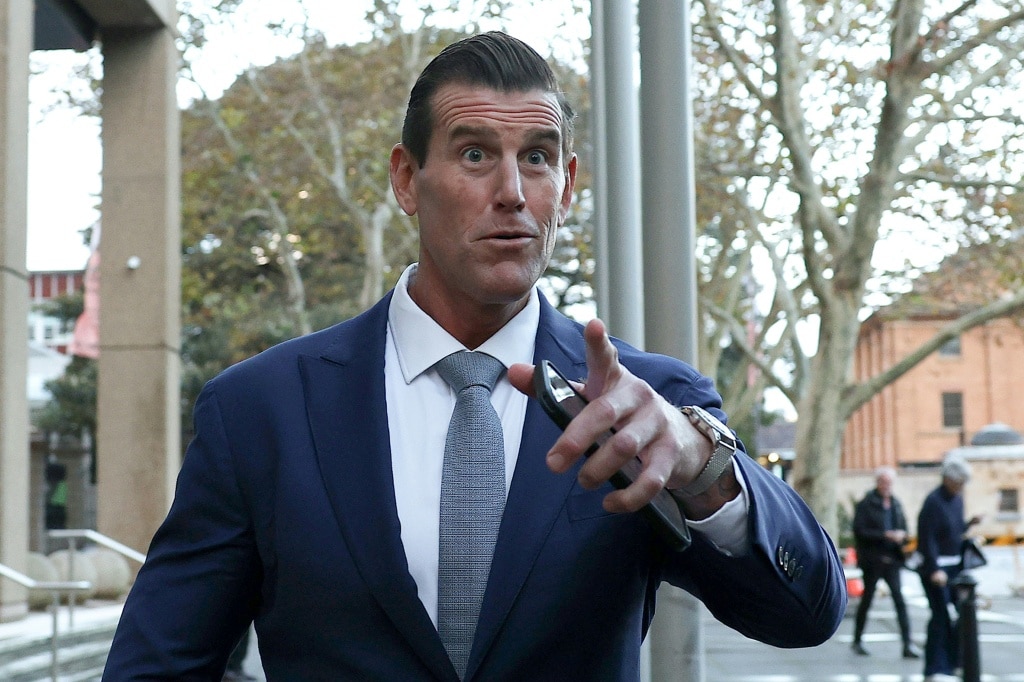
In a high-profile development that has rocked Australia’s national security and military establishment, a once-revered former Australian special forces soldier, Ben Roberts-Smith, has been granted bail by a Sydney court more than a decade after his alleged unlawful killings of unarmed detainees in Afghanistan. Once one of Australia’s most decorated war heroes, Roberts-Smith has now gone from being celebrated as a national icon to standing as a defendant in one of the most consequential war crimes cases in the nation’s history.
Roberts-Smith first became a household name across Australia in 2011, when he was awarded the Victoria Cross – the country’s highest honor for wartime gallantry, reserved only for acts of extraordinary courage in combat. In the years that followed, his fame extended far beyond military circles: he met Queen Elizabeth II, his portrait was hung in the Australian War Memorial, and he was even named Australia’s “Father of the Year” in 2013.
But cracks in his public reputation began to emerge in 2018, when two major Australian publications, *The Age* and *The Sydney Morning Herald*, published a series of investigative reports linking Roberts-Smith to systemic war crimes in Afghanistan. The outlets alleged that between 2009 and 2012, during Australia’s deployment to the country as part of the US- and NATO-led counter-terrorism mission, Roberts-Smith participated in multiple unlawful killings of unarmed captives. The most shocking claims included that he kicked an unarmed Afghan civilian off a cliff before ordering his subordinates to shoot the man, and that he and other soldiers used the prosthetic leg of a man killed by machine gun fire as a drinking trophy.
Roberts-Smith has consistently denied all allegations against him from the moment they were first made public. In response to the 2018 reports, he launched a multi-million dollar defamation suit against the two newspapers, seeking to clear his name. However, the legal backfired dramatically: in 2023, a judge ruled that the core claims made by the journalists were “substantially true”, in a civil ruling that severely undermined his public defense. That civil proceeding carried a lower standard of proof than the criminal charges Roberts-Smith now faces.
The broader context for these charges stretches back to 2020, when a landmark independent public inquiry into Australian military conduct in Afghanistan – the Brereton Report – exposed a pattern of systemic abuse among elite special forces units deployed to the country. The report detailed grave accusations of torture, extrajudicial summary executions, and even “body count” competitions, where competing units sought to kill more unarmed detainees than one another. Over two decades of deployment, Australia sent 39,000 troops to Afghanistan to fight against the Taliban and other militant insurgent groups.
Earlier this month, Australian prosecutors formally charged Roberts-Smith with five counts of war crime murder, alleging he was complicit in a string of unlawful killings between 2009 and 2012. After spending 10 days in pre-trial detention, the former soldier was granted bail on Friday, in a ruling delivered by Judge Greg Grogin. Grogin noted that the complex nature of the case means Roberts-Smith would face “years and years” of pre-trial detention before the case ever goes to a jury trial, a factor that weighed heavily in the court’s bail decision.
Roberts-Smith appeared before the court via video link, dressed in a green prison tracksuit, and showed no visible reaction to the bail ruling. His defense lawyer, Slade Howell, had argued that detaining his client for years while the case wound through the overloaded court system was fundamentally unjust. “It will take many, many years and will have many twists and turns,” Howell told the court.
Prosecutors had pushed back against the bail application, arguing that the extreme gravity of the alleged crimes required strict conditions for release. Prosecution lawyer Simon Buchen told the court: “The applicant is accused of either killing or directing his subordinates to kill unarmed detainees in the custody of Australian armed forces.”
If he is ultimately convicted on all charges, Roberts-Smith faces the possibility of a life sentence in prison. The case has already forced a long-overdue national reckoning over Australia’s military conduct in Afghanistan, and the final criminal trial is expected to draw international attention as it unfolds over the coming years.