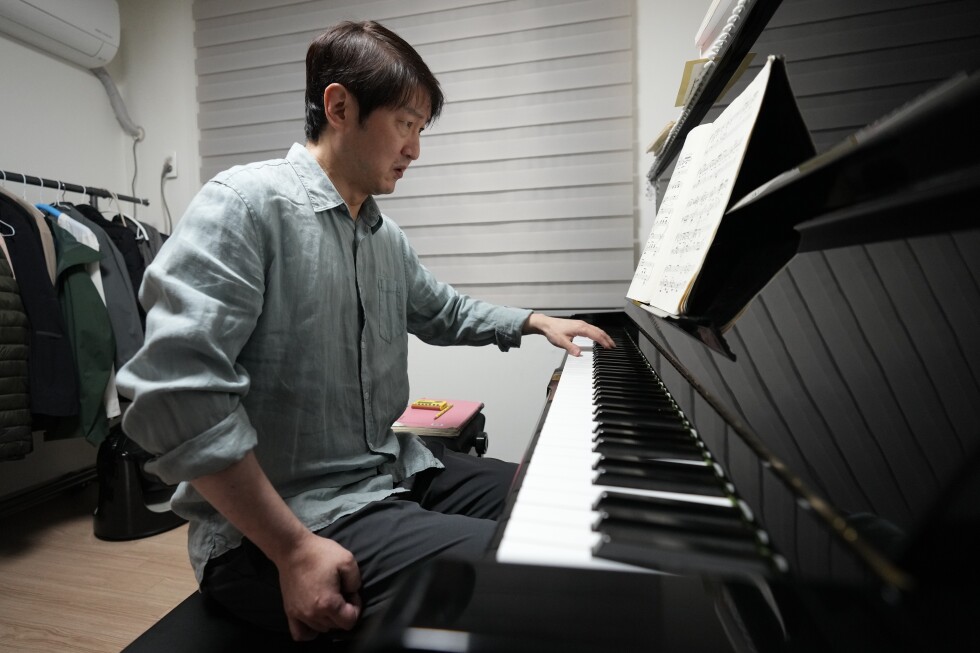
Twelve years ago, a devastating stroke upended the life and career of South Korean pianist Lee Hun, leaving him paralyzed on his right side and uncertain he would ever regain the ability to walk, let alone return to the instrument he devoted his life to. Today, the 54-year-old artist stands on the cusp of his biggest milestone since his life-altering injury: making his first debut with a full orchestra at next month’s Icheon Young-Artist International Music Festival, a performance that represents far more than a new artistic challenge for the nation’s only professional left-hand-only pianist.
In August 2012, when the stroke struck, Lee was a doctorate candidate in music at the University of Cincinnati, building the career he had spent decades working toward. He collapsed suddenly at his home, and while emergency life-saving surgery saved his life, the stroke damaged roughly 60 percent of his brain’s left hemisphere. The damage left him unable to move his right arm and leg, and he also experienced temporary aphasia that robbed him of the ability to communicate clearly. He was transported back to his home country of South Korea in a wheelchair, and his father — legendary South Korean baseball player Lee Hae Chang — later recalled that his own son could not recognize him when he arrived home.
In the immediate aftermath of the stroke, Lee’s priorities were drastically different from the musical ambitions that once defined his life. “After the stroke, I didn’t even imagine playing the piano. I only thought about whether I could stand on my feet again,” Lee shared in a recent interview with the Associated Press at his Seoul home. The road to recovery was grueling not just for Lee, but for his family, who stepped in to provide daily care. His mother, Poong Ok Hee, recalled frequent conflicts sparked by Lee’s intense mood swings as he adjusted to his new reality, with Lee often pushing back against her offers of help and guidance.
The turning point came in 2013, when Lee shared a meal with his former piano mentor, Chun Yung Hae, a former dean of the College of Music at Seoul’s Kyung Hee University. Chun shared a life-changing piece of information that rekindled Lee’s dormant passion for performance: there are more than 1,000 published compositions written exclusively for the left hand. That night, Lee sat back at the piano bench for the first time since his stroke and began to practice.
After years of relentless, exhaustive training, Lee made his formal debut as a one-handed pianist in 2016 at Seoul St. Mary’s Hospital, the same facility where he had completed his stroke rehabilitation and treatment. His program included Camille Saint-Saëns’ iconic *6 Etudes for the Left Hand Alone*, followed by a duet of *Amazing Grace* with Chun — Lee playing the melody with his left hand, Chun accompanying with her right. At least one attendee was moved to tears by the performance. Chun, who encouraged Lee to return to music to pull him out of his deep despair, never imagined he would reach such heights so quickly. “He is a pianist so he must play the piano. He was completely hopeless and in despair, so I tried to give him some hope. But I didn’t expect him to play as well as this,” the former educator said.
In the years since his debut, Lee has steadily built a career as a working concert artist, giving solo recitals across the country, appearing on national television programs, and even publishing a memoir chronicling his recovery. Through years of physical therapy and determination, he has regained the ability to walk unassisted and communicate clearly in Korean, a milestone many never expected he would reach. Local media outlets have dubbed him “Korea’s Paul Wittgenstein,” a nod to the iconic Austrian pianist who pioneered left-hand solo piano repertoire after losing his right arm in World War I. It was Wittgenstein who commissioned Maurice Ravel’s famous *Piano Concerto for the Left Hand* — the very piece Lee will perform with the festival orchestra on May 2.
Speaking about the upcoming performance, Lee admitted he is overwhelmed by nerves: “I’m so, so nervous I could die. It’s just one concerto but working with an orchestra has its own difficulties.” Even so, the challenging composition has been a long-held dream for Lee, according to Chung Eun-hyon, head of his management agency Tool Music. “He has told me it’s his dream to play the concerto,” Chung said. “I feel deeply emotional as I help make his dream come true.”
Lee Eungkwang, head of the cultural foundation that organizes the Icheon festival, says Lee’s music resonates with audiences in a way that transcends technical skill. “Before becoming a one-handed pianist, Lee said he focused on how to perfect skills to wow audiences. Now, he agonizes over how to convey his emotions and interpretation of music to people,” he explained. “He plays a sort of music that truly touches the heart of people and it’s not about finger dexterity.”
For Lee, the milestone of performing Ravel’s concerto is not the end of his journey. He still holds onto the hope of one day making a full two-handed comeback to performance, a goal he got a glimmer of hope for when he successfully pressed a single piano key with his right hand during a concert in November 2024. Medically, his doctor Koo Jaseong of Seoul St. Mary’s Hospital says the odds of a full recovery are extremely low, but that does not diminish what Lee has already achieved. “I still would like to give him a round of applause for his efforts. Though rare, there have been reports of miraculous recoveries too,” Koo said. When asked about his dream of returning to two-handed performance, Lee simply said, “I’m really curious what it was like when he played with both hands.”