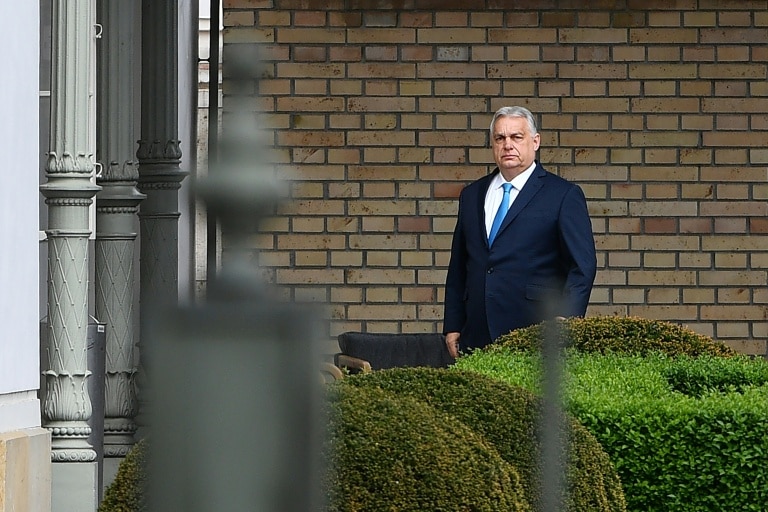
After 16 consecutive years at the helm of Hungarian politics, nationalist outgoing Prime Minister Viktor Orban has publicly called for a full overhaul of his long-ruling Fidesz party, just days after a landslide defeat to pro-European political newcomer Peter Magyar.
Magyar, a conservative newcomer who rose rapidly to challenge Orban’s nationalist agenda, secured a two-thirds parliamentary majority in Sunday’s general election, a contest that saw a record voter turnout across the central European nation. The upset result brought an end to one of the longest-serving administrations in modern European history.
In his first public remarks since the defeat, broadcast live on the YouTube channel Patriota, Orban acknowledged that the old governing model could not continue. “We cannot continue the way we have been operating until now,” he stated. “A complete renewal is needed, and this applies not only to Fidesz, but to the entire national conservative bloc.”
The former prime minister admitted he was still processing the scale of the loss, saying he was “trying to somehow come out of this shock” and accepted full accountability for the defeat in his role as party leader.
Orban outlined two immediate priorities moving forward: first, overseeing a smooth transition of power to the incoming administration, a process he confirmed is already underway. Second, he has begun convening party governing bodies, including a delegate national assembly and full party congress, to carry out the planned renewal process, with preliminary work already in motion.
In a related announcement Thursday, Hungarian EU Minister Janos Boka confirmed on Facebook that Orban will skip next week’s informal EU heads of state summit in Cyprus, scheduled for April 23–24, to focus on the government handover. The summit would have forced Orban into a potential high-stakes confrontation over his ongoing veto of a €90 billion ($106 billion) EU macro-financial assistance package for Ukraine, a policy that has been a major point of friction between Budapest and Brussels for months.
Orban’s longstanding close ties to Russian President Vladimir Putin and former U.S. President Donald Trump, paired with policies widely criticized as democratic backsliding, have put his administration at repeated odds with the European Union. Brussels previously froze billions in allocated cohesion funds for Hungary over rule of law concerns that went unaddressed during Orban’s tenure.
Since his election victory, Magyar has pledged to dismantle the core structures of Orban’s nationalist administration and reset Hungary’s strained relationship with the EU, a move that would unlock the frozen billions in European funding for the country.
Within 24 hours of Orban’s post-defeat remarks, EU officials confirmed that a preliminary negotiating delegation will travel to Budapest Friday to open talks with the incoming Tisza party government. EU spokeswoman Paula Pinho noted that the early talks are designed to avoid delays, saying: “These are preliminary talks that are taking place in order to make sure that once the government is in place, really, action can be taken if appropriate, and that we do not waste any time.”
Magyar’s ‘regime change’ agenda accelerated further Thursday, when the Tisza party leader announced a symbolic break from Orban’s governance style: his administration will not occupy the Carmelite Palace, a hilltop monastery compound overlooking Budapest that Orban converted into his prime ministerial office in 2019. “Under the TISZA government, the prime minister’s office will not be located in the Carmelite Palace, but in a ministry building near the parliament,” Magyar wrote in a Facebook post.
Orban’s 2019 move to the former monastery, located in Budapest’s historic Castle District, drew widespread criticism from opponents, who condemned the millions in public funds spent on renovations and the heavy security perimeter that restricted public access to the landmark, which the government appropriated for state use back in 2014.
Magyar has also promised to suspend biased coverage from state-run media outlets, which opponents have long described as a propaganda mouthpiece for Orban and Fidesz. On Thursday, staff at Hungary’s state-owned national news agency MTI released an open letter calling for the immediate restoration of editorial autonomy, with one senior editor telling AFP that staff had “had enough of unlawful, external political interference” in newsroom operations.