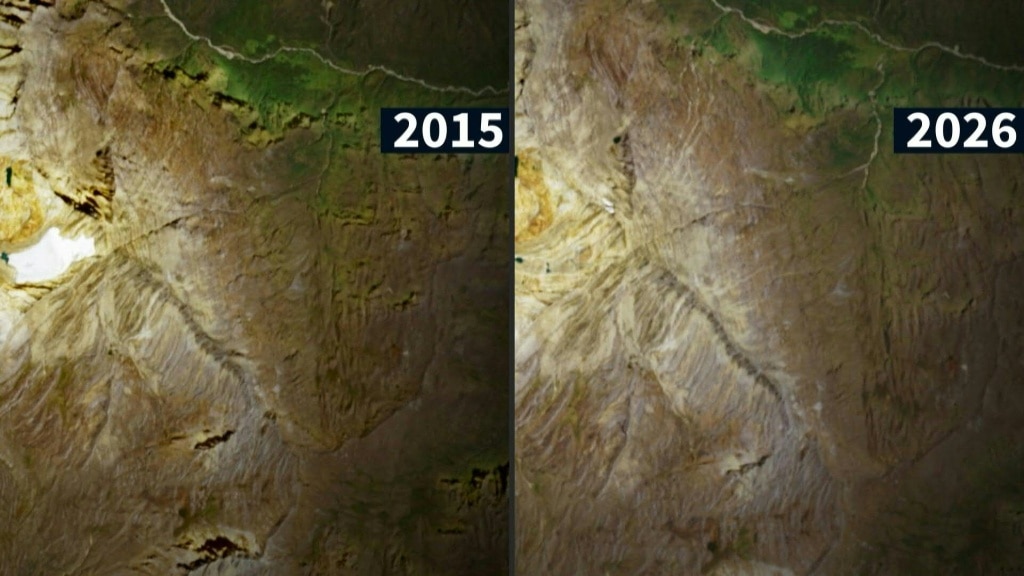
A stark visual testament to the accelerating impacts of human-caused climate change has emerged from the Colombian Andes, where the Cerros de la Plaza glacier has been officially declared completely vanished after more than a century of gradual retreat driven by rising global temperatures.
New satellite composite imagery compiled from 2026 Copernicus Sentinel data illustrates the dramatic transformation: in late December 2015, the mountain peak still retained a visible layer of permanent ice and snow, but by the end of February 2026, no frozen cover remained, leaving only exposed bedrock where the glacier once stood. Official confirmation of the glacier’s total disappearance came last week from Colombia’s Institute of Hydrology, Meteorology and Environmental Studies (IDEAM), the government agency tasked with monitoring the country’s changing natural landscapes.
Historical data compiled by IDEAM underscores the scale of the loss: at its peak in the 19th century, Cerros de la Plaza spanned 5 square kilometers (1.93 square miles) across the high peaks of the Sierra Nevada del Cocuy range in northeastern Colombia, where summits rise more than 5,000 meters above sea level. Decades of rising temperatures pushed the glacier into steady retreat, with the ice sheet shrinking incrementally from 2015 until it vanished entirely by March 2026.
IDEAM’s official statement framed the loss as a tangible warning of climate change’s irreversible impacts. “Climate change is a reality that is already transforming our territories. And what is at stake is not only the landscape, but the very balance of these ecosystems,” the agency said.
The Colombian Andes are recognized as one of the world’s most biodiverse mountain regions, hosting iconic threatened species including Andean condors and the rare spectacled bear, a mammal endemic to South America’s high altitude ecosystems. The Sierra Nevada del Cocuy glacial system is already one of only six remaining glacial networks left in Colombia, and national environment ministry data shows the country’s total glacial ice coverage has plummeted by 90% since the 19th century.
Beyond biodiversity, the loss of Andean glaciers carries direct consequences for human communities across the region. Glacial melt feeds critical freshwater sources that sustain mountain ecosystems, and underpin key human activities ranging from agricultural crop irrigation to commercial and subsistence fishing.
The disappearance of Cerros de la Plaza aligns with broader global climate trends: both the European Union’s Copernicus Climate Change Service and U.S.-based non-profit research organization Berkeley Earth have confirmed that the past 11 years are the warmest ever recorded on Earth. A landmark 2023 study published in the *Science* journal projected that even if all nations meet their Paris Agreement commitments to limit global warming to 1.5 degrees Celsius above pre-industrial levels, half of the planet’s total glacier mass will have melted by the end of the 21st century.