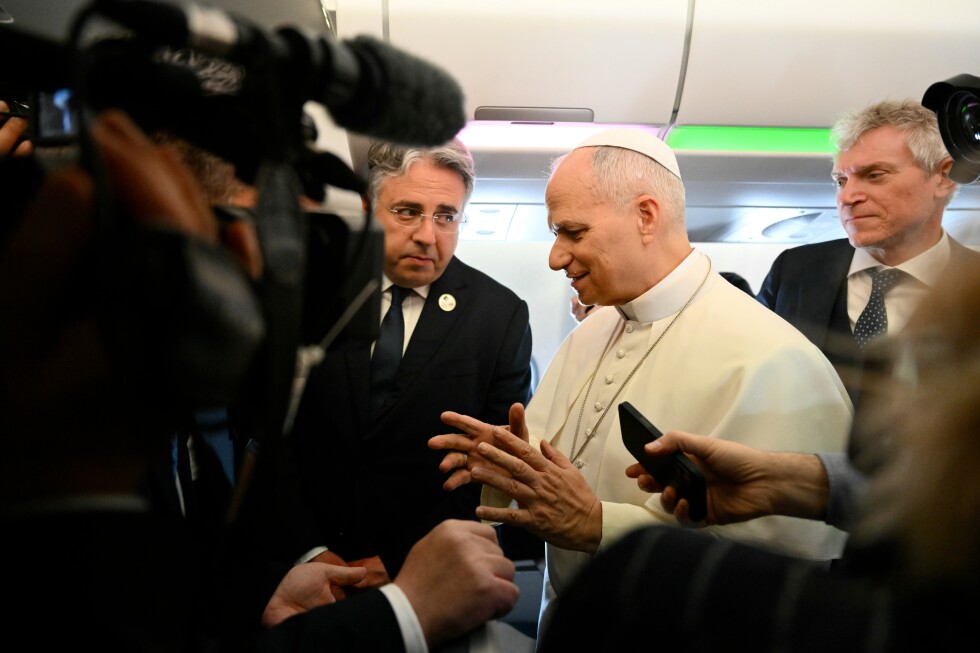
Traveling with the Vatican press pool while covering Pope Leo XIV comes with a unique, almost secluded experience. Chaperoned between stops by police motorcades that cut through even the gridlock of the busiest urban centers, this exclusive press access offers no shortage of perks for working journalists. But during Leo XIV’s landmark four-nation tour of Africa, life inside the carefully managed Vatican “bubble” has taken on a surreal edge, as an unprecedented public exchange of words plays out across continents between the first American pope in history and U.S. President Donald Trump.
Every morning of this tour, the roughly 70 accredited reporters traveling with the papal delegation wake to new overnight developments out of Washington, and one set of questions hangs over the entire press corps: Will Pope Leo engage directly with the latest attacks? How, if at all, will he address Trump’s criticism while staying focused on the pre-planned pastoral and diplomatic agenda he set for his African trip?
That dynamic was on full display Wednesday, when the pontiff, his Vatican entourage and the traveling press pool boarded an ITA Airways charter for the second leg of Leo’s 11-day journey: a flight from Algiers, Algeria bound for Yaounde, Cameroon.
Early in the trip, the pope had already delighted reporters by confronting Trump head-on. Shortly after departing Rome for Algiers on April 13, Leo stopped to answer press questions about a Truth Social post Trump had published the day prior, in which the U.S. president accused the pontiff of being soft on crime, aligned with progressive U.S. political factions, and even claimed Leo owed his election as pope to his own administration’s influence.
Trump’s original criticism came in response to comments Leo made regarding the ongoing conflict between the U.S. and Iran, where the pope had called for urgent peace and labeled Trump’s threat to annihilate Iranian civilization “truly unacceptable.” Aboard that first flight, the pope told reporters his calls for peace and rejection of war were nothing more than a straightforward articulation of Gospel values, and that he held no fear of the Trump administration.
On Wednesday, however, Leo chose not to take new questions from reporters, and directed his brief on-plane remarks to his just-concluded visit to Algeria — the first papal visit to the North African nation in history — where he honored the legacy of St. Augustine of Hippo, his own reported spiritual inspiration. While he made no explicit mention of the Iran conflict or Trump’s latest attacks, his choice to deliver the entire address in English, a break from his usual multilingual remarks on the trip, left little doubt that the overnight broadsides from Washington had not gone unheard. In the hours leading up to the flight, Trump had renewed his criticism on Truth Social, while U.S. Vice President JD Vance — a convert to Catholicism — publicly warned the pope to “be careful” when discussing theological matters.
In his remarks, Leo highlighted the “goodness,” “generosity,” and “respect” extended by the Algerian government during his visit, noting the honor of a full military aerial escort that accompanied the papal plane through Algerian airspace. He also reflected on his historic stop at Algiers’ Great Mosque, framing the visit as a powerful demonstration that even with differing religious beliefs, worship practices and ways of life, diverse communities can coexist peacefully. He added that St. Augustine’s core message — of seeking God and truth, building cross-community bridges, and working toward unity — is a lesson the modern world desperately needs to hear, and one the apostolic trip would continue to lift up through his papal witness.
Beyond the high-profile transatlantic tension, the papal traveling press pool operates by its own set of rules. Like other heads of state, the pope travels internationally with both an in-house Vatican media team and a cohort of reporters from external global news organizations, which pay substantial fees to secure a spot on the papal plane and gain exclusive access to the pontiff’s events.
Life inside the Vatican bubble carries clear journalistic tradeoffs. On one hand, reporters get unrivaled access to the pope and his delegation, travel under the protection of the Vatican’s robust security apparatus, and face none of the logistical hurdles that come with independent international reporting: the Vatican handles advance visa processing, secures local SIM cards, arranges accommodation and ground transportation, freeing journalists to focus on reporting rather than planning. Reporters also receive advance copies of the pope’s speeches, occasional off-the-record access to senior Vatican officials, and real-time updates from the Vatican spokesman.
For most news organizations, however, the primary draw of investing thousands of dollars per reporter for a single papal trip is the chance to be present for impromptu on-board press briefings, the only setting where popes regularly take unscripted questions from reporters while cruising at 35,000 feet. One of the most iconic papal quotes of modern history came from exactly this setting: Pope Francis’ famous “Who am I to judge” remark, made during his 2013 maiden papal trip to Rio de Janeiro when asked about a reportedly gay priest.
The downside of the bubble, however, stems from the same perks that make it appealing: it deliberately separates reporters from the on-the-ground reality of the countries the pope visits, whether that’s Algeria or any other nation, leaving little time for the independent grassroots reporting that creates balanced, nuanced news coverage. Large news organizations with sufficient resources often offset this gap by deploying separate reporting teams on the ground to produce local context, or allow bubble-based reporters to break away for independent trips, resulting in a mix of official Vatican access and on-the-ground insight.
But when the biggest breaking news involving the pope is unfolding thousands of miles away, across multiple time zones, life inside the bubble becomes a distinctly jarring experience. The story every news outlet is chasing is not always the formal pastoral agenda the pope has laid out for the trip. Even so, for a historic trip that marks the first visit by an American pope to Africa, the bubble has offered unrivaled front-row access to a moment that will shape both Vatican-U.S. relations and the pope’s global legacy.
This reporting on religion from the Associated Press is supported through a collaboration with The Conversation US, with funding provided by Lilly Endowment Inc. The AP retains full editorial responsibility for all content.