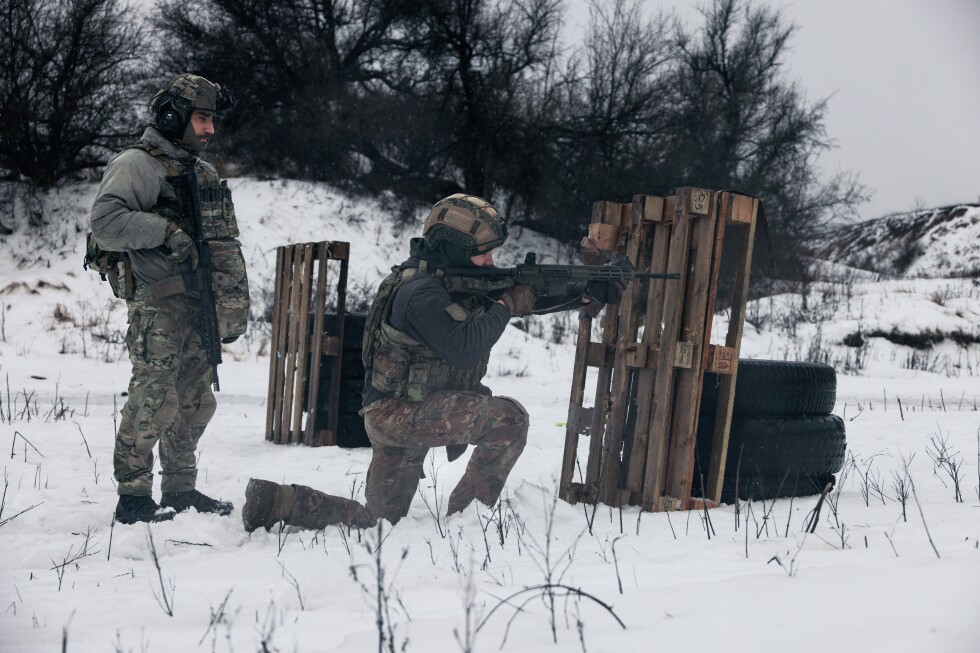
In the chaotic opening weeks of Russia’s full-scale invasion of Ukraine in 2022, a Ukrainian agricultural tycoon gathered 30 volunteers to form a small self-defense unit. He had no guarantee he would survive to see the group’s future, let alone watch it grow into one of Ukraine’s most capable and innovative fighting forces. Today, that small contingent has expanded into the 40,000-strong Khartiia Corps, a core component of Ukraine’s official defense structure that is leading a quiet revolution in the country’s military, breaking from decades of rigid Soviet-era doctrine.
Vsevolod Kozhemyako, founder of the unit and now a senior adviser to the corps’ commander, framed the group’s mission around a core truth for Ukraine: the nation’s ultimate security guarantee lies in building a modern, effective army of its own. “Ukraine needs to have an effective modern army. And this is our number one guarantee of the country’s security,” Kozhemyako said. “We have kids, we have grandkids, and we will stay on this territory. The future of this country depends on us.”
Khartiia’s rapid rise comes as Ukraine navigates stalled peace talks, shifting global attention away from the conflict to other global hotspots, and a decades-long struggle to shed Soviet military traditions that have plagued its forces for years. After the collapse of the Soviet Union, Ukraine inherited a massive military arsenal and force structure, but decades of underinvestment, corruption, and unaddressed institutional weakness were laid bare in 2014, when Russia annexed Crimea and launched its full-scale invasion of the Donbas. That shock sparked the first wave of volunteer mobilization and long-delayed military reforms, changes that helped Ukraine fend off Russia’s 2022 full-scale invasion. But as the war dragged into its third year, old flaws reemerged: rigid top-down command, crippling bureaucracy, and a culture that punishes bad news rather than encouraging honest problem-solving, all with tangible costs on the front line.
From its founding, Kozhemyako said Khartiia was built to reject that outdated model. As a service member who had fought since 2014, he knew first-hand the shortcomings of Ukraine’s post-Soviet force structure, and many of his earliest volunteers were veterans who refused to serve in traditional army units, but were eager to defend their country. Many of those early recruits came from civilian business backgrounds, bringing with them a mindset focused on initiative, adaptability, and results rather than rigid formalities.
The corps built its doctrine from the ground up, adapting U.S. Army planning frameworks to Ukraine’s battlefield realities. It integrated Western protocols including Troop Leading Procedures (TLP) and After Action Reviews (AAR), refining the systems through in-house expertise rather than forcing rigid adherence to external models. TLP empowers lower-level units to plan operations far faster than traditional top-down structures, a critical advantage for seizing fleeting tactical opportunities on dynamic front lines. AAR requires troops to systematically debrief every mission, identifying what went wrong, why, and how to improve — a practice the corps has applied with particular rigor to its rapidly evolving drone and robotics program.
Khartiia’s pioneering work with battlefield technology has even drawn international attention from U.S. military leaders. In an article published in Military Review, the U.S. Army’s official professional journal, Major General Curtis Taylor highlighted Khartiia’s December 2024 drone assault on Russian positions near Kharkiv as a milestone: the first fully robotic offensive against enemy positions in modern warfare. For the U.S. Army, Taylor argued, the operation is a critical wake-up call to rethink how traditional armored formations must adapt to survive on future battlefields.
Today, robotics and autonomous systems are a routine part of Khartiia’s daily operations, used for everything from front-line supply deliveries to casualty evacuation. One 23-year-old platoon commander, who transferred to the corps from a traditional army unit and spoke on condition of anonymity per Ukrainian military rules, said he was immediately struck by how little emphasis the unit placed on unnecessary rigid formalities that had defined his previous posting — from strict, combat-irrelevant dress codes to repetitive administrative busywork.
“People understand why we are here, and they don’t overload us with unnecessary tasks,” he said, noting he had just patrolled his position in a pair of soft blue house slippers. He also pointed to a starkly different command culture: unlike traditional units, where a rigid hierarchy and fear of punishment discouraged honest communication between junior troops and senior officers, Khartiia’s structure is built on mutual trust.
“When officers look at you from above, like in rear units, they become almost like enemies to you,” he said. “In Khartiia, relationships are different. When you go on a mission, you trust the people giving you orders.”
That cultural and doctrinal shift has delivered tangible battlefield results. In December 2025, Khartiia led a major counteroffensive in the Kupiansk direction, liberating multiple villages north of the city and pushing Russian forces back to the Oskil River. The Washington-based Institute for the Study of War noted that seizing control of Kupiansk had been a top Russian priority since mid-2025, and after months of sustained assaults, Russian forces had failed to secure any significant gains in the sector. The think tank assessed that the operation proved Ukraine’s military remains fully capable of pulling off successful counterattacks and securing tactically important gains, particularly when Russian forces are overstretched across multiple front sectors. Like military forces on both sides of the conflict, Khartiia does not disclose public casualty figures, and has not suffered any major operational setbacks to date.
Beyond its battlefield successes, Khartiia has also revolutionized how Ukrainian military units handle recruitment, outreach, and internal management. Operating largely on independent recruitment and private fundraising, the corps built a professional human resources system and a strong public brand, leveraging YouTube and social media, partnering with public figures, and simplifying online donations to expand its support base. A senior Ukrainian Ground Forces officer noted that the Third Army Corps and Khartiia were the first Ukrainian units to build distinct public brands, a model that other formations are now actively studying as the entire army faces ongoing pressure to recruit new troops.
“The approaches that work in the commercial sphere translate perfectly here — only you are competing not for profit, but for people, equipment and attention of the volunteers,” the officer said.
Inside one of Khartiia’s underground frontline command posts near Kharkiv, the unit’s philosophy is on full display: large screens stacked wall-to-wall display real-time reconnaissance footage from the front, overseen by a former bodybuilding coach who rose through the ranks from ordinary soldier to senior commander, dressed in a Khartiia hoodie with an energy drink at his keyboard. The command post feels more like a high-tech gaming facility than a traditional military headquarters, a reflection of the corps’ informal, results-first culture.
“One of our secrets is that we don’t spare people during training — we train them constantly,” the commander said. “But during combat, it’s the opposite. People come first. We don’t save drones or equipment at the expense of our people.”
Khartiia is now working to spread its model across Ukraine’s military, forging formal partnerships with other reform-minded formations. Most recently, Khartiia and the Third Army Corps, another leading new-wave formation, launched a joint training initiative to share resources, tactics, and expertise to standardize their modern fighting approach across units. For the two corps’ commanders, who are adjacent on the front line, the initiative grew from a shared practical observation: the biggest gap across Ukraine’s wider military is the urgent need to overhaul outdated basic combat training for troops, non-commissioned officers, and junior commanders.
Khartiia commander Ihor Obolienskyi estimates that roughly 300,000 Ukrainian troops are deployed along the entire front line, with Khartiia and the Third Army Corps accounting for around 80,000 of that total — a large enough force to drive meaningful institutional change, even within a military system that remains inherently resistant to rapid overhaul. Commanders from other traditional army units have already reached out to study Khartiia’s model, a sign of growing demand for reform across the force. Still, it remains unclear whether Ukraine’s senior military command will be willing to fully abandon the Soviet legacy that has shaped the force for decades.
Andrii Biletskyi, commander of the Third Army Corps, said during a joint briefing with Khartiia that the goal of the initiative is simple: to deliver a proven, tested reform tool to Ukraine’s General Staff. “Whether they accept it or not — that is their decision,” Biletskyi said.