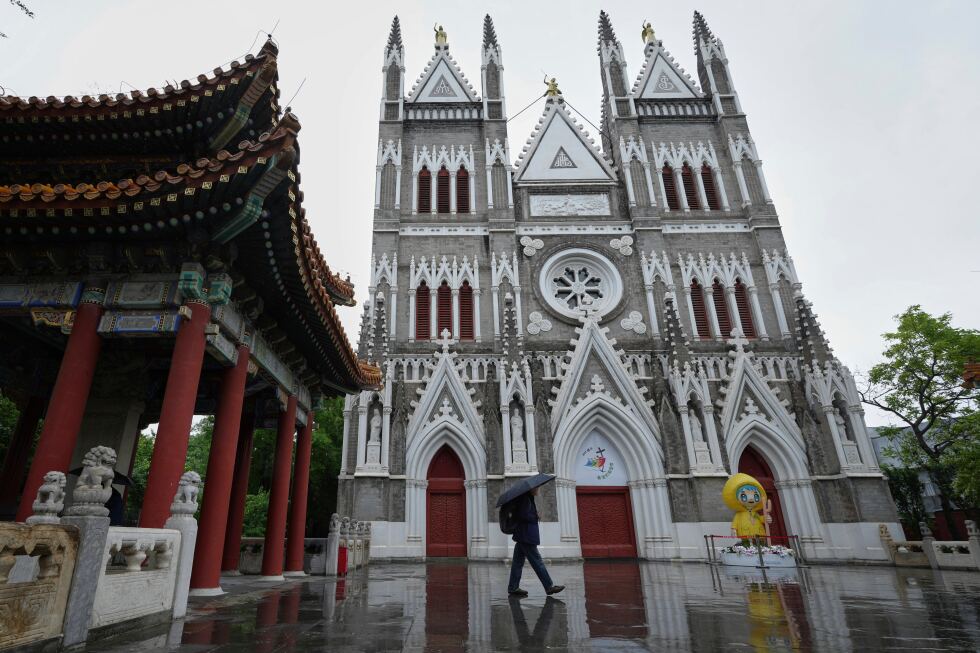
In a detailed new report released Wednesday, New York-based international rights organization Human Rights Watch has documented a sharp escalation in pressure from Chinese authorities on underground Catholic communities to align with the state-controlled official church, alongside expanded surveillance and movement restrictions targeting China’s estimated 12 million Catholic believers. The report frames the intensifying crackdown as an extension of a 10-year government campaign designed to enforce the loyalty of all religious groups and independent religious communities to the officially atheist Chinese Communist Party.
For decades, China’s Catholic population has been split along two distinct paths: the state-sanctioned Chinese Catholic Patriotic Association, which does not recognize the Vatican’s papal authority, and an underground network of congregations that have maintained unbroken loyalty to Rome even amid sustained persecution. In 2018, Pope Francis brokered a landmark agreement with Beijing aimed at easing decades of bilateral tensions between the Vatican and China. Under the terms of the deal—whose full text has never been disclosed to the public—Beijing puts forward candidates for bishop positions, while the Pope retains the power to veto unacceptable nominees, a departure from centuries of tradition that gave the Vatican exclusive control over bishop appointments.
Despite the 2018 accord, Human Rights Watch senior China researcher Yalkun Uluyol emphasized that Catholics across China continue to face mounting repression that systematically violates their fundamental right to religious freedom. The organization is calling on Pope Leo XIV, who assumed the papacy last year, to launch an urgent full review of the agreement and pressure Beijing to end ongoing persecution and intimidation targeting underground clergy, church leaders and ordinary worshippers.
Since the 2018 deal was signed, Human Rights Watch found, Chinese authorities have used a range of coercive tactics to force underground Catholic communities into joining the state-controlled Patriotic Association. These tactics include arbitrary detention, enforced disappearances, and long-term house arrest targeting underground Catholic bishops and priests. The report also notes that ideological control and digital surveillance have been tightened within the official state-approved church, alongside new restrictions on religious activities and foreign connections. A regulatory change adopted last December now requires all Catholic clergy to obtain explicit state approval before traveling abroad.
Because Human Rights Watch researchers are barred from entering mainland China, the organization based its findings on firsthand accounts from individuals with direct knowledge of Catholic life inside China who now reside outside the country, as well as input from leading experts on religious freedom and Chinese Catholicism. Specific testimonies included in the report are attributed to anonymous sources who left China to avoid government retaliation.
Pope Leo made his first appointment of a Chinese bishop under the 2018 agreement just one month after taking office last year, and in subsequent public comments, he confirmed he would maintain the agreement “in the short term.” “I’m also in ongoing dialogue with a number of people, Chinese, on both sides of some of the issues that are there,” Leo stated in an interview. “It’s a very difficult situation. In the long term, I don’t pretend to say this is what I will and will not do, but after two months, I’ve already begun having discussions at several levels on that topic.” As of Wednesday, Vatican spokesman Matteo Bruni had not issued any immediate response to requests for comment on the Human Rights Watch report, and China’s Foreign Ministry also declined to immediately answer queries from the Associated Press on the findings.
The broader crackdown on Catholic communities is part of a larger national policy launched by Chinese President Xi Jinping in 2016, centered on the “Sinicization” of all religion. The policy seeks to expand state oversight and ideological control to bring all religious practice into alignment with Communist Party ideology and leadership. Under this campaign, Human Rights Watch found, authorities have demolished hundreds of church buildings and crosses, banned gatherings at unregistered unofficial churches, restricted access to religious texts including the Bible, and seized unauthorized religious materials. The Sinicization drive has already led to severe repression of other religious communities, including Tibetan Buddhism and Uyghur Islam, according to the report.
The escalating pressure on independent religious groups extends beyond Catholic communities. Last October, Pastor Ezra Jin Mingri, leader of one of China’s largest unregistered underground Protestant congregations, Zion Church, was detained at his home in Guangxi Zhuang Autonomous Region, alongside dozens of other unregistered church leaders across the country, according to his family and China-based religious monitoring groups. In April, U.S.-based religious freedom advocacy group ChinaAid called on former U.S. President Donald Trump to demand Jin’s release during a planned scheduled meeting with Xi Jinping in May. Bob Fu, president of ChinaAid, argued that the Chinese Communist Party has accelerated its systematic campaign to eliminate independent religious life entirely, and called on the U.S. government to impose tangible consequences rather than only issuing expressions of concern.