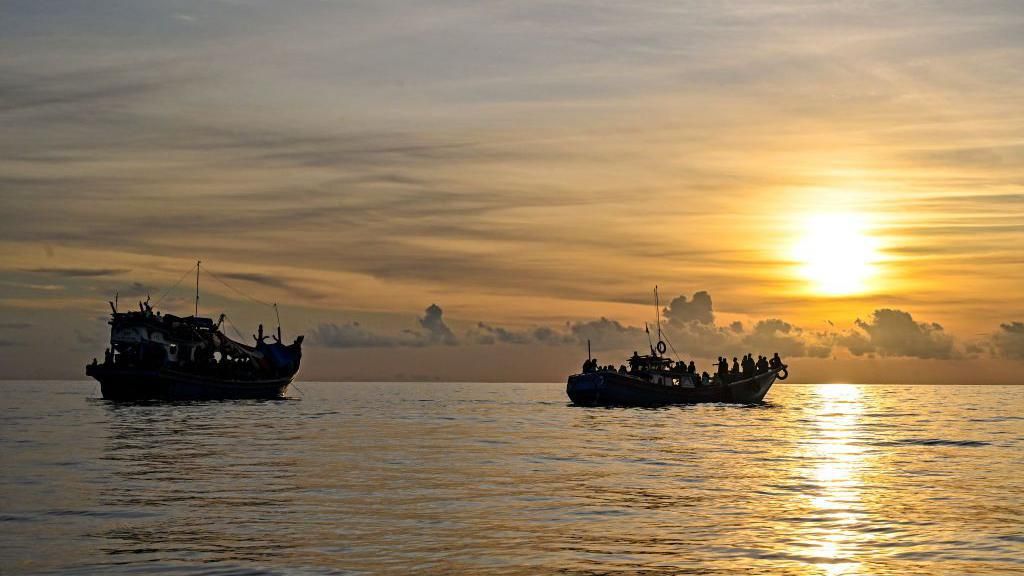
A devastating maritime disaster off the coast of Southeast Asia has left around 250 people, including dozens of children, unaccounted for after an overloaded migrant trawler sank in the Andaman Sea last week, United Nations agencies for refugees and migration confirmed in a joint statement. The vessel, which departed from southern Bangladesh with the final destination of Malaysia, capsized amid heavy wind and rough sea conditions, a disaster exacerbated by the extreme overcrowding on board, according to the agencies.
The Bangladesh Coast Guard told AFP that one of its patrol vessels pulled nine survivors from the water on April 9, though the exact timing of the capsizing remains unconfirmed. One of the survivors, 40-year-old Rafiqul Islam, described his harrowing experience of drifting adrift for nearly 36 hours before rescue, saying he suffered severe burns after being exposed to oil that leaked from the sinking vessel. He told reporters that the prospect of securing stable employment in Malaysia was the key factor that convinced him to undertake the risky crossing.
This tragedy comes amid a years-long humanitarian crisis that has forced hundreds of thousands of Rohingya, a predominantly Muslim ethnic minority from Myanmar, to flee their homes. Since a brutal military crackdown in 2017, more than 700,000 Rohingya have crossed the border into Bangladesh, where they are hosted in sprawling refugee camps. Rohingya people are constitutionally denied citizenship in Myanmar, a Buddhist-majority nation, leaving them effectively stateless with no access to basic rights or protection in their home country.
While Bangladesh has provided refuge to the displaced population, dire living conditions in the overcrowded camps, combined with shrinking international humanitarian funding and ongoing violence in Myanmar’s Rakhine State, have eliminated most hope of a safe voluntary return home in the near future. These pressures have pushed growing numbers of refugees to attempt dangerous irregular sea crossings to neighboring Malaysia, which many see as a potential safe haven in the region.
Irregular migrant vessels operating this route are almost always small, severely overcrowded, and lack basic necessities including clean drinking water, sanitation, and emergency safety equipment. The crossings are consistently deadly: many vessels never reach their destination, with passengers dying of exposure, dehydration, or shipwreck. Those who do complete the crossing are often detained and deported, while many others are turned away by authorities or coastal communities in Malaysia and Indonesia. Most recently in January 2025, Malaysian authorities turned away two boats carrying approximately 300 refugees after providing only limited emergency food and water.
One Rohingya refugee based in Bangladesh’s Cox’s Bazar, the site of the world’s largest Rohingya refugee camp, previously explained to Reuters the desperate logic driving these journeys. “People are dying in the fighting, dying from hunger. So some think it’s better to die at sea than to die slowly here,” they said.
In their joint statement, the UN High Commissioner for Refugees (UNHCR) and the International Organization for Migration (IOM) framed the Andaman Sea disaster as a tragic symptom of a larger unresolved crisis. “This tragic incident reflects the dire consequences of protracted displacement and the absence of durable solutions for the Rohingya,” the statement read. The agencies called on the international community to immediately increase and sustain funding to support Rohingya refugees and their host communities in Bangladesh, and renewed calls for urgent action to address the root causes of displacement inside Myanmar. As Bangladesh prepares to mark its new year, the agencies said the disaster is a stark reminder of the urgent need to create conditions that allow Rohingya refugees to return to their home country voluntarily, safely, and with dignity.