The ongoing US-Israel conflict with Iran has sparked fierce debate over the trade-off between short-term global economic stability and long-term international security, as the International Monetary Fund (IMF) has laid out stark worst-case projections that could tip the world into recession for the first time since the COVID-19 pandemic.
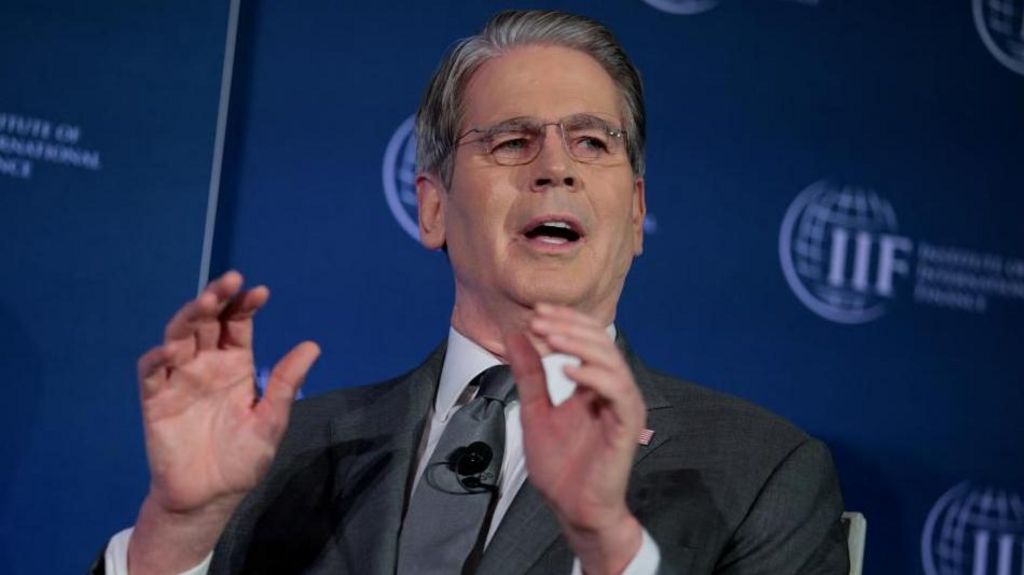
In an exclusive interview with the BBC, US Treasury Secretary Scott Bessent argued that a modest period of near-term economic hardship is a necessary sacrifice to eliminate what he frames as a growing Iranian threat to Western capitals. “I wonder what the hit to global GDP would be if a nuclear weapon hit London,” Bessent said. “I am saying that I am less concerned about short-term forecasts, than I am about long-term security. The biggest risk you can take is one you don’t know you were taking.” He claimed that recent US and Israeli strikes have eliminated the so-called “tail risk” of Iranian nuclear strikes against Western nations, noting that Iran had enriched uranium to 60% purity—close to the level required for a functional nuclear weapon—at the start of the conflict. He also pointed to Iran’s strike on Diego Garcia as evidence the country already possesses mid-range intercontinental ballistic missiles capable of reaching the United Kingdom.
However, multiple official sources have pushed back on Bessent’s framing. The BBC has previously confirmed that the threat of an Iranian ballistic missile strike on London remains extremely remote, and Iran does not currently possess a nuclear weapon. A spokesperson for the UK government added: “There is no assessment Iran is trying to target Europe with missiles. But we have the military capability we need to keep Britain safe from any kind of attacks, whether it’s on our soil or from abroad. We are ready to defend the country, whatever the threat.”
In its latest World Economic Outlook report, the IMF detailed the severe economic risks the conflict poses six weeks after it began in late February 2026. The closure of the strategic Strait of Hormuz, a critical chokepoint for global energy shipping, and the collapse of US-Iran peace talks have sent energy prices soaring, with crude prices peaking near $120 a barrel before moderating to $95 per barrel as of Tuesday.
The IMF laid out two core scenarios for global growth. In the most severe outcome, if energy and food prices spike and remain elevated through 2027, global growth will drop below 2% in 2026—an outcome the IMF calls a near-certain global recession, a situation that has only occurred four times since 1980. Under this scenario, oil prices would average $110 per barrel in 2026 and rise to $125 in 2027, pushing global inflation as high as 6% next year and forcing central banks to implement aggressive interest rate hikes to cool price growth. IMF chief economist Pierre-Olivier Gourinchas warned that a prolonged conflict would trigger spiraling inflation, rising unemployment, and widespread food insecurity in vulnerable nations, noting that even an immediate end to the conflict would leave an economic impact comparable to the 1970s oil crisis. Still, he added that the global economy is far less dependent on fossil fuels today than it was 50 years ago, softening the blow for consumers.
In the more optimistic baseline scenario, where the conflict is resolved within the next few weeks and energy exports and production return to normal by mid-2026, global growth will slow to 3.1% this year—down just 0.2 percentage points from the IMF’s January forecast—before rebounding to 3.2% growth in 2027, a projection that remained unchanged from earlier estimates.
The report also breaks down the uneven economic impact of the conflict across major economies and regions. Among advanced economies, the UK is projected to bear the brunt of the energy shock, with its 2026 growth forecast cut from 1.3% to 0.8% before a 1.3% recovery in 2027. Most Gulf energy exporting nations face steep slowdowns or outright contraction this year: the IMF projects Iran’s economy will shrink by 6.1% in 2026, before a 3.2% rebound in 2027 if the conflict ends soon—a projection that remains highly uncertain following US President Donald Trump’s recent announcement of a full blockade on Iranian port exports to halt all Iranian oil shipments. Qatar, home to the world’s largest liquefied natural gas refinery at Ras Laffan, faces an 8.6% contraction this year after the facility was struck by Iranian drones and missiles, leaving it non-operational for the foreseeable future. Iraq, Iran’s neighboring state, will see growth slow by 6.8% in 2026 before bouncing back to 11.3% growth in 2027.
The IMF notes that national economic resilience depends on key factors including infrastructure damage, reliance on the Strait of Hormuz, and access to alternative export routes. For example, Saudi Arabia’s East-West pipeline, which can carry up to 7 million barrels of oil per day from the Persian Gulf to the Red Sea, allows the kingdom to avoid the worst disruptions. The IMF still projects 3.1% growth for Saudi Arabia in 2026, followed by 4.5% expansion in 2027, in line with broader forecasts for a regional upturn next year if energy markets normalize. The IMF cautioned, however, that this optimistic outlook could be revised downward if the conflict drags on and infrastructure damage worsens.
Globally, the IMF cut its 2026 growth forecast for China to 4.4%, down 0.1 percentage points from January, while leaving its 2027 projection of 4% growth unchanged. One major beneficiary of the surge in global energy prices, the IMF found, is Russia, which has been under sweeping Western sanctions since its full-scale invasion of Ukraine four years ago. The IMF now projects 1.1% growth for Russia in both 2026 and 2027, up from earlier forecasts of 0.8% and 1% respectively, after Trump lifted all restrictions on Russian oil exports and temporarily unfroze 140 million barrels of Iranian oil for 30 days to curb global price spikes.
European officials have pushed back against the easing of sanctions, warning that Russia is positioned to emerge as a winner from the conflict. “Energy prices are up, and that gives additional revenues for Russia’s war machine,” European Commissioner for finance Valdis Dombrovskis told reporters on the sidelines of the IMF summit in Washington. “Now is not the time to ease the pressure on Russia.”