Rising geopolitical friction between the United States and Iran has reached a dangerous new flashpoint in the Strait of Hormuz, after former U.S. President Donald Trump announced a full naval blockade of the critical global waterway over the weekend, followed by stark threats to destroy any Iranian craft approaching the enforcement line. The escalation, which comes six weeks after the two nations launched an undeclared conflict in the region, has put major energy and trade supplies at risk and drawn pushback from global powers including China, while experts warn the standoff could freeze all maritime traffic through the strait entirely.
Trump first outlined the blockade order on his Truth Social platform Sunday, framing the move as a response to Iran’s earlier partial closure of the strait, which Tehran implemented after the outbreak of hostilities. The U.S. leader accused Iran of engaging in “world extortion” by claiming potential unreported mines in the waterway and demanding tolls from passing vessels. “I have also instructed our Navy to seek and interdict every vessel in International Waters that has paid a toll to Iran. No one who pays an illegal toll will have safe passage on the high seas,” Trump wrote in his post, adding that U.S. forces would begin clearing mines laid by Iran and that any Iranian attack on U.S. personnel or civilian ships would be met with devastating force.
On Monday, Trump doubled down on the aggressive posture, threatening that any Iranian vessels that “come anywhere close” to the U.S. blockade would be “immediately ELIMINATED” using the same lethal tactics his administration has deployed against suspected drug trafficking boats in international waters. He characterized the tactic as “quick and brutal,” and noted that 34 vessels passed through the strait on Sunday, the highest daily volume since Iran’s initial closure.
Parallel to the U.S. escalation, Iran has issued its own firm warnings to Washington, vowing to respond with unforeseen military capabilities if conflict expands. A spokesperson for the Islamic Revolutionary Guard Corps (IRGC) told the IRGC-affiliated Tasnim News Agency that if hostilities continue, Tehran will unveil new warfare capacities that enemy forces have no knowledge of, and that these methods will be largely difficult for the U.S. to counter. Iranian Lt. Col. Ebrahim Zolfaqari clarified Iran’s position, stressing that vessels affiliated with the U.S.-led blockade have no right to transit the strait now and in the future, while neutral civilian ships can still pass in compliance with Iranian armed forces regulations. Zolfaqari also warned that if the security of Iranian ports is jeopardized, no ports across the Persian Gulf or Sea of Oman will remain safe.
The escalating confrontation has already split global powers, with NATO members confirming on Monday they would not participate in Trump’s blockade. China, which maintains active trade and energy agreements with Tehran, has openly defied the U.S. order. Chinese Defense Minister Dong Jun confirmed that Chinese commercial and military vessels continue transiting Hormuz waters in accordance with bilateral agreements with Iran, saying “We will respect and honor them and expect others not to meddle in our affairs. Iran controls the Strait of Hormuz, and it is open for us.”
Maritime analysts warn the dual, competing blockades from the U.S. and Iran could create an unprecedented logjam in one of the world’s most critical energy chokepoints. Salvatore Mercogliano, a maritime historian at Campbell University in North Carolina, told Al Jazeera that he expects U.S. naval forces to turn away exiting vessels while staying out of range of Iran’s coastal missiles and drones, resulting in two overlapping blockade operations. This scenario, Mercogliano noted, carries a serious risk of freezing all incoming and outgoing shipping through the strait entirely, a disruption that would send shockwaves through global energy and commodity markets.
To back up his threat against Iranian vessels, Trump highlighted his administration’s ongoing campaign of lethal airstrikes against suspected drug trafficking boats in international waters, a policy that has already killed more than 170 people and drawn widespread condemnation from human rights groups and international legal experts as extrajudicial killing. On the same day Trump issued his Hormuz threat, U.S. Southern Command (SOUTHCOM) carried out a new strike on a vessel in the eastern Pacific, which the command claims was operated by groups linked to narco-trafficking. No publicly released evidence has been provided to support the accusation, and the strike killed at least two people. The attack came just days after separate April 11 strikes on two other Pacific boats that left at least five more dead.
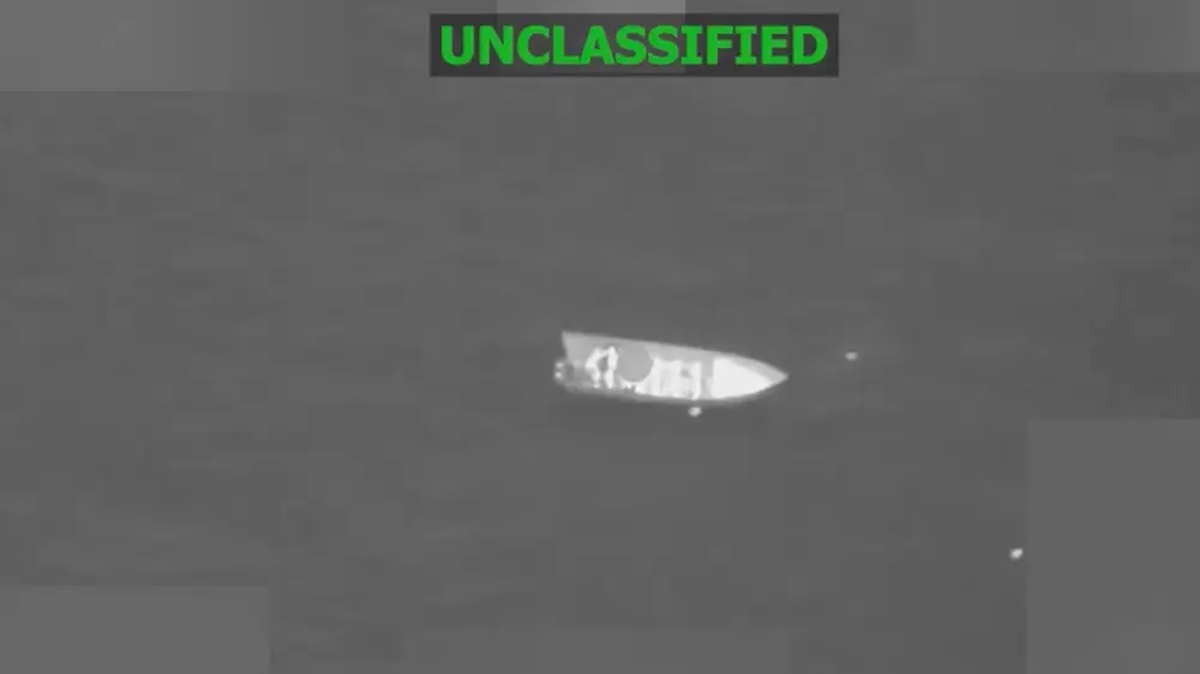
Following the latest strike, SOUTHCOM published unclassified footage of the bombing on social media, labeling it a “lethal kinetic strike on a vessel operated by Designated Terrorist Organizations”—a move that critics say is part of a pattern of publicizing lethal operations without justifying their legality. Brian Finucane, senior adviser to the U.S. Program at the International Crisis Group, pointed out that the Trump administration has been eager to post graphic footage of these strikes online but has refused to defend the legal standing of the attacks in international waters.
United Nations experts and multiple human rights organizations have formally condemned the boat bombing campaign as extrajudicial killing and murder, arguing that officials who ordered and carried out the strikes should face prosecution for homicide. Investigative journalist Nick Turse of The Intercept reported hours before Monday’s strike that the Trump administration is actively pressuring the Inter-American Commission on Human Rights to shut down a potential inquiry into the illegal strikes across the Caribbean and Pacific. Last month, the commission held a public hearing where legal experts testified to the unlawful nature of the strikes. Angelo Guisado, senior staff attorney at the Center for Constitutional Rights, told the commission that “The administration’s desire to play imperial superpower in the region cannot be a reason to completely displace the foundations of international law.”
As of Monday, the standoff in the Strait of Hormuz shows no signs of de-escalation, with both sides holding firm to their competing blockade claims and raising the risk of an accidental clash that could spiral into full-scale open conflict across the Middle East.