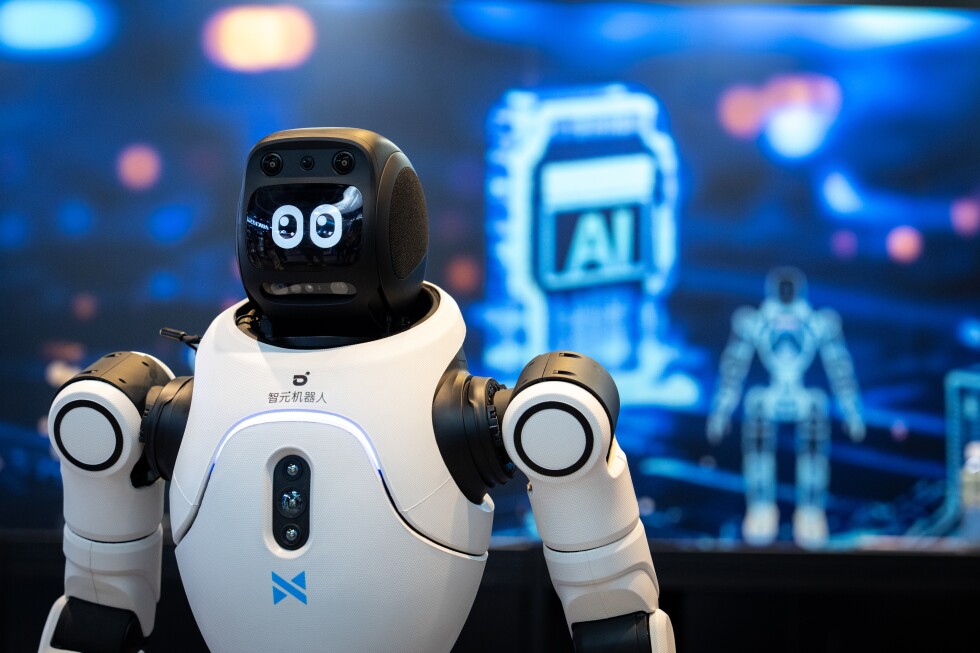
The Hong Kong Convention and Exhibition Center opened two major robotics exhibitions Monday, drawing global attention to the booming humanoid robot sector led by Chinese manufacturers, with over 100 cutting-edge robotic systems on public display.
Among the standout exhibits was the X2 Ultra, developed by leading Chinese humanoid robot maker AGIBOT Innovation (Shanghai) Technology Co. Standing roughly the size of an elementary school student, this responsive humanoid wowed crowds with its versatile capabilities: it performed songs, communicated fluently in both Mandarin and English, accurately answered audience questions, and even identified people and objects in its surroundings. When asked about its personal interests, the robot rattled off a range of hobbies from sports and dancing to technology exploration and music listening.
Calvin Chiu, chief operating officer of Novautek Autonomous Driving, AGIBOT’s Hong Kong-based regional agent, explained that the X2 Ultra is designed to do more than complete functional tasks. It can deliver emotional companionship through natural conversation, act as a personalized learning companion for children and an educational guide for older adults, and can be custom-programmed to take on unique personalities. “It would be like a friend,” Chiu noted.
The exhibition comes as China’s humanoid robot industry has emerged as a global leader, positioned at the forefront of the country’s tech development strategy amid shifting global tech competition. Beijing’s 2026–2030 five-year plan explicitly prioritizes breakthroughs in cutting-edge science and technology, with accelerating the development and commercial application of humanoid robots listed as a core strategic goal. Official industry data from 2025 shows China is now home to more than 140 humanoid robot manufacturers producing over 330 distinct models.
A recent global industry assessment from London-based research and advisory firm Omdia ranked three Chinese firms — AGIBOT, Unitree Robotics and UBTech Robotics Corp. — as the world’s only first-tier humanoid robot vendors by shipment volume. The report confirmed all three shipped over 1,000 units of general-purpose embodied intelligent robots last year, with AGIBOT and Unitree Robotics each surpassing 5,000 units. The technology has already entered mainstream public consciousness in China: in February 2025, a collaborative martial arts performance featuring child performers and humanoid robots was one of the most viral highlights of China’s annual CCTV Spring Festival Gala, the most-watched Lunar New Year television broadcast in the country.
Exhibitors at the Hong Kong event showcased the wide range of capabilities already available in Chinese-made robots, from natural conversation and creative sand painting to acrobatic backflips and public security patrol operations where robots can apprehend suspects with nets. Shenzhen-based firm EngineAI brought its PM01 mobility robot to demonstrate its advanced agility, including impressive front flips. Robert Chan, the company’s global strategy officer, announced plans to open two new mass production facilities in China later this year to meet growing demand.
Chan highlighted the structural advantages that have allowed China’s robotics sector to grow faster than many Western competitors. Beyond access to low-cost engineering talent that keeps production costs competitive, China’s industry benefits from open knowledge sharing between companies, a model that contrasts with the tightly guarded proprietary technology cultures common among U.S. and European firms.
Looking ahead, Chan predicts the next era of robotic innovation will center on human-centric design that prioritizes more natural, emotionally connected interactions between robots and people. This shift will see robots develop increasingly human-like physical features, nuanced facial expressions, and even life-like biological cues such as simulated breathing, all aimed at closing the gap in cross-species interaction. “We need to build warmth and emotional exchange between robots and humans, beyond just functional help to make decisions and complete tasks,” Chan explained.
One exhibitor is already turning this vision into reality. In a corner booth, three human-like figures greeted attendees from a distance; up close, visitors discovered they were hyper-realistic humanoid robots built for customer service and cultural tour guiding roles. Wang Zuhua, business director at Shenzhen’s DX Intech Technology Co., the developer of these robots, said the company has already sold over 400 models featuring soft synthetic facial tissue and feminine design features. Many of these units are already deployed in mainland Chinese museums and government venues, where they guide visitors to facilities, lead venue tours, and answer public queries.
Russel Lupang, a visitor from Malaysia, expressed awe at how closely the robots resembled living humans, even as he noted the subtle difference in presence. “It’s beautiful, but not real feeling,” Lupang said. The exhibit nonetheless offered a clear preview of how rapidly humanoid robot technology is advancing, with Chinese manufacturers leading the global race to bring human-like interactive robots to commercial markets.