A high-stakes public clash between history’s first U.S.-born pontiff and sitting U.S. president has erupted over the ongoing U.S.-Israel war in Iran, with Pope Leo XIV rejecting Donald Trump’s harsh attacks and reaffirming his commitment to the Catholic Church’s longstanding call for global peace.
The confrontation unfolded after Leo delivered a pointed message during a Saturday prayer service at St. Peter’s Basilica, held the same day U.S. and Iranian negotiators sat down for face-to-face talks in Pakistan amid a fragile ceasefire. Though the pope did not name Trump or U.S. officials directly, he criticized what he called the “delusion of omnipotence” that fuels ongoing conflicts worldwide — a remark widely interpreted as a rebuke of the Trump administration’s framing of the Iran war, which has been justified through appeals to U.S. military superiority and religious endorsement.
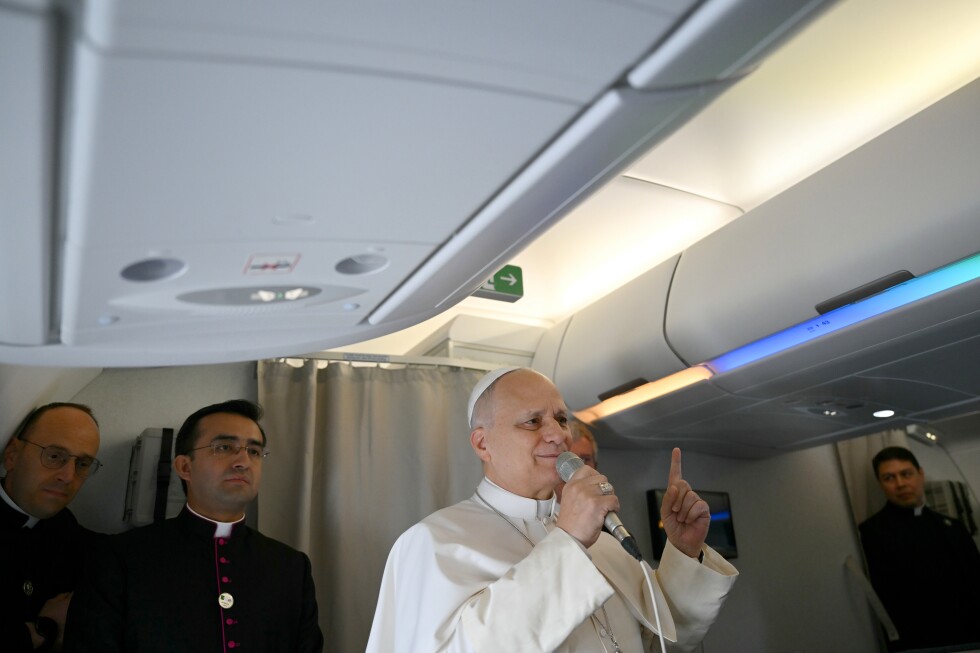
Leo doubled down on his position Monday while speaking to reporters aboard the papal plane, midway through the first leg of his 11-day trip to Africa. He pushed back against Trump’s weekend broadside, emphasizing that the Vatican’s appeals for peace and reconciliation are rooted in Gospel teachings, not political opposition to the U.S. president.
“To put my message on the same plane as what the president has attempted to do here, I think is not understanding what the message of the Gospel is,” Leo told The Associated Press. “And I’m sorry to hear that but I will continue on what I believe is the mission of the church in the world today.”
The pontiff stressed that his general calls for peace are not direct attacks on Trump or any other political leader. He noted he has no intention of engaging in a public political debate, and will not step back from his core mission of spreading the Gospel’s call for peacemaking.
“I will not enter into debate. The things that I say are certainly not meant as attacks on anyone. The message of the Gospel is very clear: ‘Blessed are the peacemakers,’” Leo said. “I will not shy away from announcing the message of the Gospel and inviting all people to look for ways of building bridges of peace and reconciliation, and looking for ways to avoid war any time that’s possible.”
When asked about the Trump administration’s criticism, he added simply: “I have no fear of the Trump administration.”
Trump first launched his extraordinary attack on Sunday, during a trip from Florida back to Washington. In a lengthy social media post and subsequent remarks to reporters on the tarmac, the president said he “is not a fan of Pope Leo” and claimed the pontiff “is not doing a very good job” as leader of the Catholic Church. He labeled Leo “a very liberal person” and accused him of catering to the U.S. radical left, going far beyond his criticism of the pope’s comments on the Iran war.
In his social media post, Trump argued he did not “want a Pope who thinks it’s OK for Iran to have a Nuclear Weapon,” a claim Leo has never publicly made. He also criticized Leo for opposing the Trump administration’s January ousting of Venezuelan President Nicolás Maduro, writing: “I don’t want a Pope who thinks it’s terrible that America attacked Venezuela, a Country that was sending massive amounts of Drugs into the United States.”
Trump went so far as to claim that he was directly responsible for Leo’s ascension to the papacy, writing: “If I wasn’t in the White House, Leo wouldn’t be in the Vatican.” He added that “Leo should get his act together as Pope, use Common Sense, stop catering to the Radical Left, and focus on being a Great Pope, not a Politician. It’s hurting him very badly and, more importantly, it’s hurting the Catholic Church!”
He repeated the false claim that Leo supports Iran’s nuclear program in subsequent comments to reporters, and added the unfounded assertion that Leo “likes crime I guess.” Later that day, Trump also posted an altered image portraying him with saint-like healing powers comparable to Jesus Christ, showing him in a biblical-style robe laying hands on a sick man, surrounded by onlookers, American symbols, and religious imagery.
The conflict has drawn reactions from religious and political leaders on both sides of the Atlantic. Archbishop Paul S. Coakley, president of the U.S. Conference of Catholic Bishops, issued a statement saying he was “disheartened” by Trump’s comments. “Pope Leo is not his rival; nor is the Pope a politician. He is the Vicar of Christ who speaks from the truth of the Gospel and for the care of souls,” Coakley said.
Across the Atlantic, Italian political leaders from all ideological factions have expressed solidarity with Pope Leo. Italian Prime Minister Giorgia Meloni publicly voiced support for his peace mission, while Elly Schlein, leader of Italy’s main opposition party, called Trump’s attacks “extremely serious.”
The public clash comes amid a uniquely polarized religious and political landscape in the U.S. AP VoteCast data from the 2024 presidential election shows Trump won 55% of the Catholic vote, but his administration maintains extremely close ties to conservative evangelical Protestant leaders, who have publicly claimed the war on Iran has heavenly endorsement. Defense Secretary Pete Hegseth has urged Americans to pray for victory “in the name of Jesus Christ,” and when asked whether he believes God approves of the war, Trump responded: “I do, because God is good — because God is good and God wants to see people taken care of.”
Prior to the current ceasefire, when Trump publicly warned of mass strikes against Iranian civilian infrastructure that would wipe out “an entire civilization,” Leo called the remarks “truly unacceptable.” The pontiff has previously doubled down on his anti-war stance, citing Old Testament scripture to argue that “God does not listen to the prayers of those who wage war, but rejects them.”
While disagreements between sitting popes and U.S. presidents are not unheard of, direct, public confrontation of this intensity is extremely rare for both sides.