# Fragile Orthodox Easter Truce Collapses Within Hours in Kharkiv, Ukraine
More than four years into Russia’s full-scale invasion of Ukraine, a bilateral agreement for an Orthodox Easter truce came into force across frontlines on a Saturday afternoon. Just 38 minutes after the ceasefire took effect, wailing air raid sirens cut through the quiet of northeastern Ukraine’s Kharkiv region, shattering any immediate hope of a lasting pause in fighting.
Since that first alarm, Ukrainian officials and military commanders have confirmed dozens of ceasefire violations along active contact lines, though no long-range missile or drone strikes have been recorded in the immediate hours after the truce began. The 32-hour cessation of hostilities was meant to stretch through Easter Monday, offering civilians and soldiers alike a rare, desperately needed break from four years of constant conflict.
In a public post on X ahead of the truce, Ukrainian President Volodymyr Zelenskyy emphasized that Easter should stand as a season of safety and peace, while warning that Ukrainian defense forces would respond “strictly in kind” to any hostile action by Moscow. Across Kharkiv, widespread skepticism of any Russian commitment to peace runs deep, with public trust in the temporary truce hovering near zero.
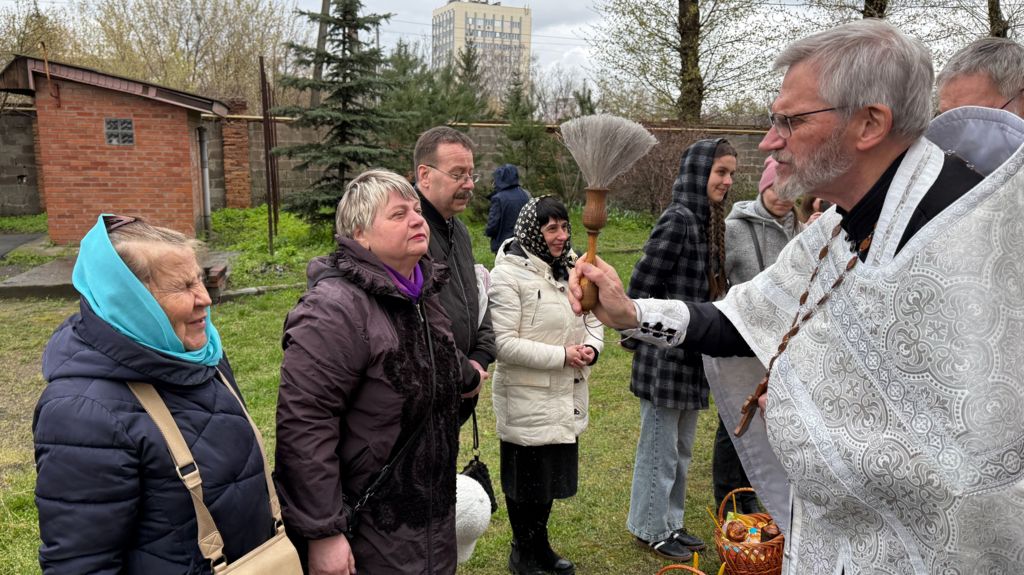
Moments before the ceasefire was scheduled to begin at 4 p.m. local time, scores of local families gathered at St John the Theologian Church for the traditional annual blessing of Easter fare. Carrying wicker baskets heaped with glazed sweet Easter cakes, hand-painted dyed eggs, and cured sausage, worshippers formed a line wrapping around the church building to receive a sprinkling of holy water from the parish priest.
This year, the service was moved from its traditional midnight timing, which includes a ceremonial procession around the church grounds, to mid-afternoon to comply with local curfew orders imposed to reduce civilian risk from Russian attacks. The church itself suffered significant damage in the opening weeks of the full-scale invasion, and one entire wall of its windows remains covered with plywood boarding.
When asked about the meaning of the Russian-proposed ceasefire, parish priest Fr Viktor questioned the very premise of trusting Moscow’s commitments. Parishioner Larisa echoed his caution, noting that past Russian truces have only been followed by more intense offensives. “Maybe there will be a short pause,” she told reporters, “but then Russia will only launch even more intense attacks. We’ve seen that before.”
Roughly 12 miles from the Russian border, at a rural military training ground, members of the Yasni Ochi strike drone unit—part of Ukraine’s Khartia Corps—spent the holiday weekend testing new explosive drone systems destined for the frontlines. The troops loaded newly delivered kamikaze drones with ordnance and practiced precision diving attacks on ground targets, their training proceeding even as the truce was announced.
Unit commander Heorhiy issued orders for his troops to hold their positions during the 32-hour truce unless directly attacked, but he says he fully expects Russian forces to break the agreement. “Russia says one thing, then does the other. So you have to be ready,” he explained. For troops on rotating rest, the unit has been dropping care packages of Easter cake and alcohol-free wine to frontline positions via drone delivery.
The small village the unit now uses for training was occupied by Russian forces in 2022 before being recaptured by Ukrainian troops, and nearly every residential structure in the area lies in crumbled ruins. While open discussion of large-scale territorial recapture, such as the entire Donbas region south of Kharkiv, has become rare among frontline troops, Heorhiy insists Ukraine cannot pause fighting until it secures favorable terms for peace negotiations with Russia.
“We need real peace talks,” the commander said, adding that he has been encouraged by growing international demand for Ukraine’s drone expertise spurred by new conflicts in the Middle East, where Ukraine is able to share its years of frontline experience and drone technology. However, the US-led peace process for Ukraine has stalled in recent months, with US President Donald Trump’s diplomatic envoys reallocated to handle escalating tensions with Iran.
Ukraine continues to push for concrete long-term security guarantees from its Western backers, specifically clarity on what support the US would provide if Russia launches another full-scale invasion in the future. “It’s not our choice. I don’t like war, my guys don’t like it. We used to have good civilian life,” Heorhiy said, noting that several members of his unit worked as DJs in Dnipro’s underground electronic music scene before the invasion. “Now we do what we need to do.”
Back within Kharkiv’s city limits, the main regional ring road is now being draped in anti-drone netting, designed to catch and entangle incoming Russian unmanned aerial vehicles before they can strike vehicles traveling below. But little can be done to protect residential neighborhoods from incoming missile attacks: with Russian positions so close to the city, there is barely enough warning time for air defenses to engage incoming threats.
In one Kharkiv suburb, entire sections of five-story apartment blocks have been reduced to rubble by recent strikes, while dozens of surrounding buildings remain boarded up and uninhabitable. Last month, an early morning Russian missile strike on the neighborhood killed 11 residents, wiping out an entire wing of a residential building. Walking through the ruins, visitors can still spot a bright red rug pinned to what remains of a living room wall, with portraits of two killed residents laid on the rubble at its base.
Olha, a neighbor who survived the strike, described huddling in the building’s central corridor with her elderly mother as the missile hit. She shared phone footage showing the building across the street engulfed in bright orange flames, and her own apartment reduced to splinters and debris. Unsurprisingly, she says she craves any break from the constant threat of death. “This truce is only one and a half days. But at least we can rest a bit, because here, you expect to die every second,” she said. “We really want peace. Not for one and a half days. For good.”
Weeping quietly, Olha questioned the cost of holding the last remaining sliver of Ukrainian-held Donetsk Oblast, saying it is not worth the mass loss of civilian life. “There were children killed in that strike, wonderful people. Will it ever stop?” she asked.
Zelenskyy has said he is open to turning this flawed temporary truce into a permanent ceasefire, followed by structured peace talks with Russia to reach a lasting settlement. But the Kremlin has already rejected the proposal, confirming that full-scale offensive operations will resume on Monday when the temporary truce is set to expire.