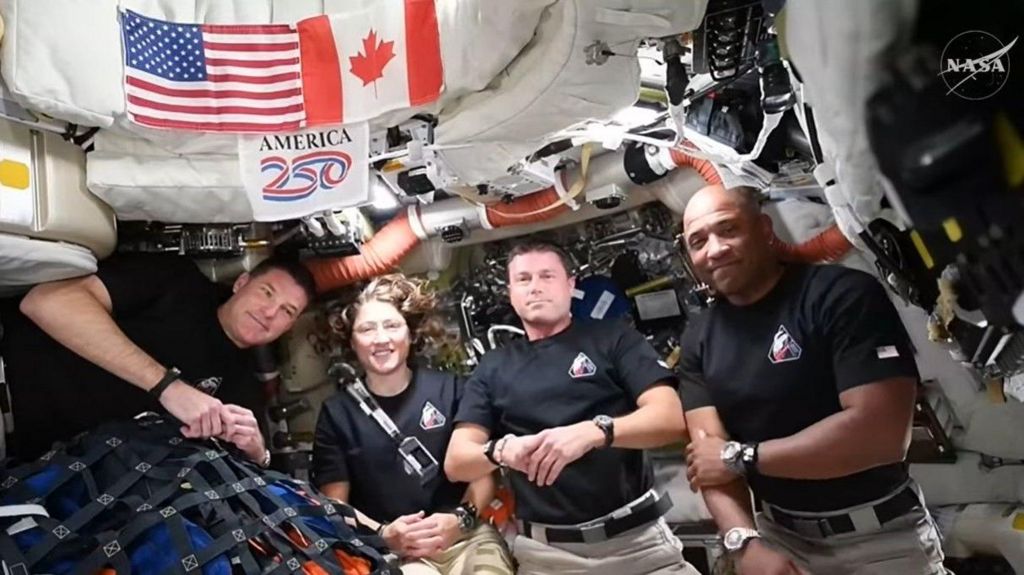
After a groundbreaking journey that pushed the boundaries of human space exploration, the four-member Artemis II crew has completed their mission and splashed down safely off the coast of California, re-entering Earth’s atmosphere at a blistering speed of 25,000 miles per hour (40,000 kilometers per hour). This mission marks a historic milestone: the crew traveled farther into deep space than any human group before, surpassing the 1970 Apollo 13 record of 248,655 miles by more than 4,000 additional miles.
During their lunar fly-by, the crew carried out a rare, unforgettable observation: using specialized eclipse viewers to watch a solar eclipse from their unique vantage point in space, capturing stunning images of the Moon backlit by the Sun from NASA’s Orion spacecraft. Even before their landing, the crew connected with audiences back on Earth, holding conversations with reporters, their families, and former U.S. President Donald Trump while still in orbit.
For astronauts, space travel remains the defining peak of their professional lives, despite the unique hardships that come with extended time off-planet. Mission specialist Christina Koch noted ahead of splashdown that even minor inconveniences – from freeze-dried meals to limited private facilities for hygiene – were a small price to pay for the opportunity to explore deep space. The four crew members, commander Reid Wiseman, mission specialists Christina Koch and Victor Glover, and Canadian astronaut Jeremy Hansen, now begin their transition back to life on Earth, following a standard post-mission protocol.
Immediately after splashdown, the crew was retrieved by a waiting U.S. warship, where medical teams conducted urgent initial health assessments. They were then airlifted by helicopter to shore, before transferring to NASA’s Johnson Space Center in Houston for further evaluation. Extended time in microgravity inevitably causes physiological changes: without Earth’s gravitational pull, muscle and bone mass deteriorate, particularly in the postural muscles of the back, neck, and calves. Even with the crew’s rigorous in-orbit exercise routine, some muscle loss is unavoidable, with up to 20% mass loss possible over just two weeks. However, NASA experts note the Artemis II mission’s relatively short duration means long-term health impacts are expected to be minimal. Compared to the five to six month typical stays on the International Space Station, the Artemis II crew’s time in space aligns with the short two to three week missions of the 1981-2011 space shuttle era, putting them at far lower risk of severe physiological degradation.
Psychologically, returning to Earth brings a mix of emotions for the crew, all seasoned, highly trained space explorers selected for their emotional stability. Koch already shared from orbit that she will deeply miss the close teamwork and shared sense of purpose that defines life on a deep space mission. Like many astronauts before them, the Artemis II crew gained a profound new perspective on Earth from space: seeing the planet hanging in the black void of space reinforced how interconnected all humanity is, and how fragile our shared home is. “It truly emphasized how alike we are, how the same thing keeps every single person on planet Earth alive,” Koch explained. While many astronauts report being reluctant to leave the excitement and purpose of space work, the crew expressed immense excitement to reunite with their loved ones after the high-risk mission.
For Wiseman, who lost his wife to cancer in 2020 and has raised their two teenage daughters as a single father, the reunion holds particular weight: he had prepared his daughters for the worst-case scenario before launch, showing them where his will was kept in case of a fatal accident. For Hansen’s family, the anticipation has been building for months. “Our two daughters and son were so, so excited to see their dad living his dream,” Dr. Catherine Hansen, Jeremy Hansen’s wife, told BBC World Service’s Newsday. “When Jeremy is back safely, we will absolutely come together. First just the five of us in a quiet environment to hear some of those private stories, and then we will absolutely celebrate with the world.”
Looking ahead, the Artemis II crew’s futures remain tied to NASA’s ambitious lunar exploration program. While NASA does not disclose private details of crew members’ post-mission plans, the three NASA-affiliated astronauts remain active members of the agency’s astronaut corps, and all four Artemis II crew members are eligible to fly on future Artemis missions. The program is already gearing up for Artemis III, currently scheduled for 2027, and Artemis IV in 2028 – with Artemis III marked as the mission that will return human boots to the lunar surface for the first time since Apollo 17 in 1972, though industry analysts widely expect the landing date to be pushed back.
One confirmed upcoming engagement is a visit to the White House: former President Trump, who first established the Artemis program during his first term in 2017, called the crew while they were in space to extend an invitation for a formal reception in the Oval Office. “I’ll ask for your autograph, because I don’t really ask for autographs much, but you deserve that,” Trump told the crew, adding that he planned to give them “a big salute on behalf of the American people and beyond that.” It remains unclear whether Canadian astronaut Jeremy Hansen will join the Washington visit.
The biggest change the crew can expect after their mission is a sharp rise in public profile. Unlike many recent astronaut crews, the Artemis II four have captured global public attention, with round-the-clock news coverage and viral social media content turning them into household names. Adjusting to this new level of fame will likely be one of the biggest transitions they face as they settle back into life on Earth.