NASA’s Artemis II mission has made history, delivering a flawless 10-day mission that carried four astronauts on a circumlunar flight around the Moon’s far side and returned the crew safely to Earth. The Orion spacecraft exceeded performance expectations throughout the journey, and the stunning high-resolution imagery captured by the crew has reignited widespread public excitement, particularly among young people, about the future of human deep-space exploration. But this milestone immediately raises a pressing question: will the children now captivated by Artemis actually get to see humans live and work on the Moon in their lifetimes, or even travel to Mars, as the broader Artemis program promises? While it may sound pessimistic, the reality is that a single circumlunar loop was always the relatively straightforward step. The massive, unprecedented engineering and logistical challenges that come next leave the answer to that question very much open: it could happen, or it might not.
This is not the first time the world has stood on the cusp of a new era of lunar exploration. When Neil Armstrong and Buzz Aldrin became the first humans to walk on the Moon in July 1969, widespread public expectation held that this was just the beginning, that permanent lunar outposts and regular crewed missions to deep space would follow quickly. That future never materialized, because the Apollo program was never rooted in a long-term commitment to exploration—it was a product of Cold War geopolitics, designed explicitly to prove U.S. technological superiority over the Soviet Union. Once that goal was achieved with Armstrong’s iconic “one small step,” the program lost its political momentum. Just a few years after the first landing, public interest plummeted, television viewership for subsequent Apollo missions dropped off sharply, and all remaining planned lunar landings were canceled mid-program.
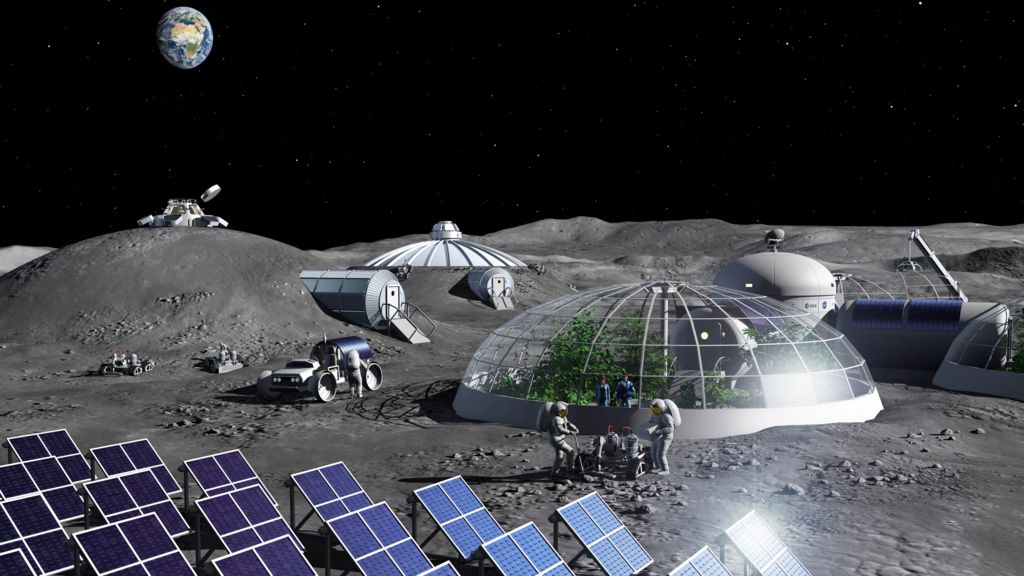
Today, NASA says its ambitions are fundamentally different. Under current administrator Jared Isaacman, the agency has laid out an ambitious roadmap: the first crewed Artemis lunar landing will take place in 2028, followed by one landing per year after that. By the fifth Artemis mission, scheduled for the end of 2028, NASA plans to begin assembling the first long-term lunar base, developed in partnership with international space agencies including the European Space Agency (ESA). Josef Aschbacher, ESA’s Director General, frames this long-term vision as a scientific and economic certainty. “The Moon economy will develop,” he says. “It will take time to set up the various elements, but it will develop.”
Yet for all the grand plans, the program already faces significant headwinds, to paraphrase the famous line from Apollo 13’s commander: “Houston, we’ve had a problem.” To put the first boots back on the lunar surface since 1972, NASA relies on two private contractors to build next-generation lunar landers: Elon Musk’s SpaceX, which is developing a 35-meter tall lunar variant of its Starship rocket, and Jeff Bezos’s Blue Origin, which is building the more compact but equally ambitious Blue Moon Mark 2 lander. Both programs are running well behind their original schedules, according to a stark March 10 report from NASA’s own Office of Inspector General.
The report found that SpaceX’s lunar Starship is at least two years behind its original delivery target, with additional delays widely expected. Blue Origin’s Blue Moon is no less troubled: it is already at least eight months behind schedule, and nearly half of the design issues flagged in a 2024 review remain unresolved more than a year later. These new landers are a world away from the tiny Apollo-era Eagle module that carried just two astronauts to the lunar surface in 1969, only large enough for a short surface stay to collect rock samples before returning to Earth. The new generation of landers must carry massive amounts of infrastructure: scientific equipment, pressurized rovers capable of supporting long-duration exploration, and the core initial components for the lunar base itself.
Moving this much mass to the lunar surface requires unprecedented amounts of propellant—far more than can be launched on a single rocket. To solve this problem, the Artemis program plans to build an orbital propellant depot in Earth orbit, which would be refilled by more than 10 separate tanker rocket launches over the course of months. The concept is elegant on paper, but executing it is extraordinarily difficult. Keeping super-cold liquid oxygen and methane stable in the vacuum of space, then transferring them between multiple spacecraft, is one of the most demanding engineering challenges in the entire program.
Dr. Simeon Barber, a space scientist at the Open University, notes that Artemis II itself was delayed twice this year before launch, all due to problems with fueling on the ground. “If it’s difficult to do on the launch pad, it’s going to be much more difficult to do in orbit,” he points out. The next major milestone, Artemis III, is scheduled for mid-2027, and is designed to test how the Orion crew capsule docks with one or both landers in Earth orbit. But given that SpaceX’s Starship has yet to complete a successful orbital test flight, and Blue Origin’s heavy-lift New Glenn rocket has only managed two launches to date, Barber describes the 2027 target as “a very steep ask.”
NASA’s decision to stick to a 2028 target for the first crewed landing is partially driven by political considerations. The deadline now aligns with the current U.S. administration’s space policy, which requires an American crew back on the lunar surface by 2028, a timeline that falls within the current presidential term. Independent analysts almost universally reject the 2028 target as unrealistic, but Congress has backed the date with billions of dollars in taxpayer funding, in large part because of a new geopolitical competitor in lunar exploration: China.
Over the past two decades, China has emerged as a global economic and military superpower, and its space capabilities have expanded at a dramatic pace. China has publicly committed to landing its own taikonaut on the lunar surface by around 2030, with a far simpler technical approach than NASA’s plan: China uses two rockets, carrying a separate crew module and lander, and avoids the complex in-orbit refueling that is a core part of the Artemis architecture. If Artemis slips as widely expected, China could beat the U.S. back to the lunar surface.
Beyond the Moon, the long-term goal of sending humans to Mars looms large. Elon Musk has publicly said he intends to put the first humans on Mars before the end of the 2020s, but most independent experts agree that the earliest feasible timeline for a human Mars landing is the 2040s. The challenges of a Mars mission dwarf even the hardest problems of lunar exploration: the journey alone takes seven to nine months, exposing the crew to lethal levels of deep space radiation with no possibility of a rescue mission if something goes wrong. Mars’s thin, unpredictable atmosphere makes landing a full-sized crewed spacecraft, then launching it back to Earth, an engineering problem of almost unimaginable complexity.
Even with all these delays and challenges, Artemis II has indisputably put human deep-space exploration back on the global agenda. Private space companies are building new rockets and landers with unprecedented urgency, and international partners are actively debating the depth of their long-term engagement. A drive around the Kennedy Space Center following the Artemis II launch makes that shift tangible: new facilities built by Blue Origin, ongoing construction of SpaceX infrastructure, all clustered near the historic NASA centers that sent the first Apollo missions to the Moon. This new public-private partnership marks a fundamental shift in how human spaceflight is organized, and even if timelines slip, it has already restored NASA’s pioneering momentum that faded after the Apollo era.
As ESA astronaut Alexander Gerst told Aschbacher after returning from a mission on the International Space Station, the view of Earth from space changes everything. Gerst said he wished every one of the eight billion people on Earth could go to space just once, to see the small, fragile, beautiful blue planet that we all share, and recognize how poorly we have cared for it. As Aschbacher put it: “That would create a very different life on planet Earth.”