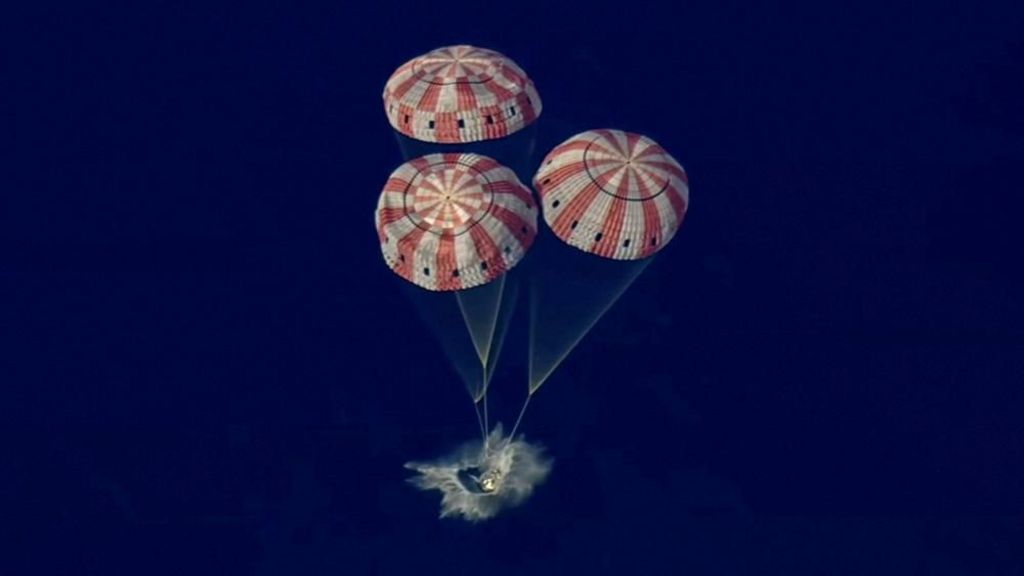
After a landmark 10-day journey around the Moon, the four-person crew of NASA’s Artemis II mission has successfully completed their voyage and returned safely to Earth, capping off a critical milestone in humanity’s push to return humans to the lunar surface. The final phase of the mission unfolded in a carefully choreographed sequence that space agencies and space enthusiasts around the world watched in real time.
Before the crew could touch down back on our planet, the spacecraft first executed its planned separation maneuver, detaching the crew capsule from the service module that had supported the vehicle through its deep space voyage. This separation is a critical step that clears the way for the capsule’s atmospheric entry, and mission controllers confirmed the maneuver happened exactly as planned.
Following separation, the capsule entered the period of communications blackout that is standard for all atmospheric re-entry from deep space missions. As the vehicle streaks through Earth’s atmosphere at hypersonic speeds, friction with atmospheric particles creates an intense layer of ionized gas around the capsule that blocks all radio signals, leaving mission controllers on the ground waiting anxiously for contact to be restored. For those watching the live broadcast of the mission’s conclusion, this 10-minute period of silence built palpable tension, even though engineers had run countless simulations to confirm the capsule’s heat shield could withstand the 2,800-degree Celsius temperatures generated during re-entry.
When the blackout ended and signals from the capsule reconnected with ground control, the room at NASA’s mission control center erupted in applause. The capsule then deployed its parachute system in stages, slowing from hypersonic speed to a gentle descent before making a smooth splashdown in the Pacific Ocean, as planned. Search and rescue teams were already on station to retrieve the crew and the capsule, and initial reports confirm all four astronauts are in good health.
This mission marks the first crewed voyage around the Moon in more than 50 years, since the final Apollo mission in 1972. It serves as a final full test of NASA’s Space Launch System rocket, Orion capsule, and all supporting systems before the Artemis III mission, which is planned to land the first woman and first person of color on the lunar surface. Data collected during Artemis II will help engineers refine designs for future lunar landings and lay the groundwork for long-term lunar exploration and eventual human missions to Mars.