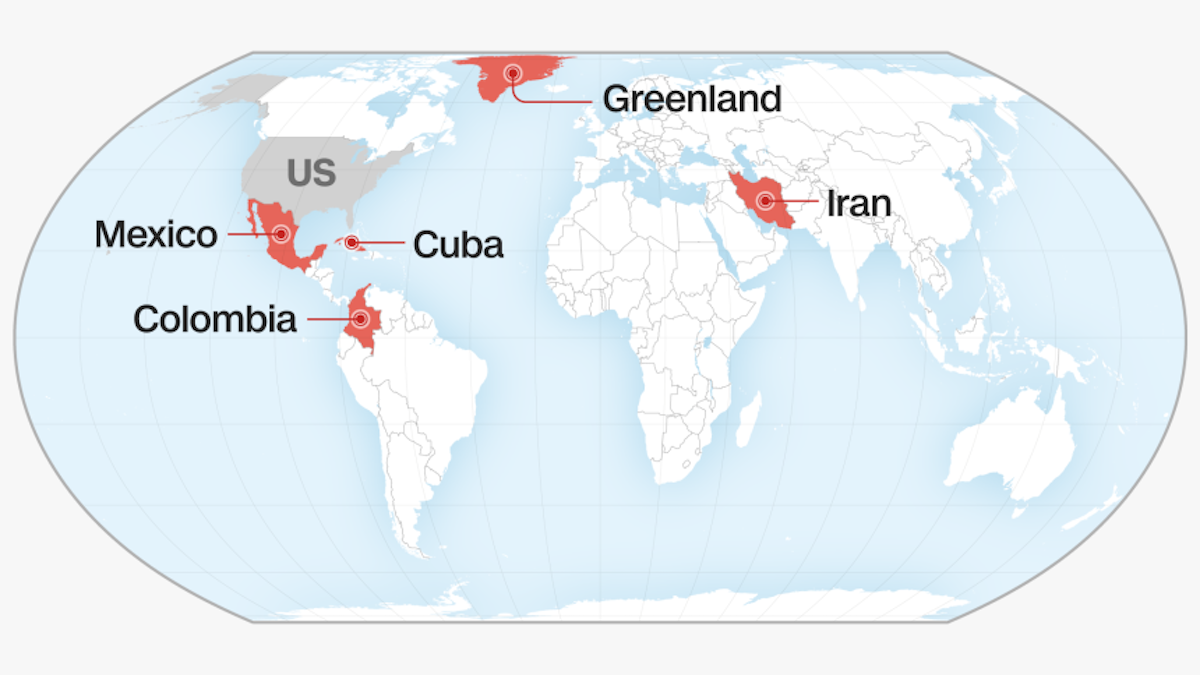
Six weeks after former U.S. President Donald Trump partnered with Israeli Prime Minister Benjamin Netanyahu to launch a military conflict that has left the Middle East mired in deadly violence, the commander-in-chief has stoked global alarm with a provocative late-night boast that the U.S. military is already eyeing its “next conquest.”
The controversial remark came in a Wednesday evening post to Trump’s Truth Social platform, where he outlined that U.S. forces would remain deployed near and within Iranian territory until Washington secures what he calls a “real agreement” to end the ongoing hostilities. The timeline of the comment comes just one day after a fragile two-week ceasefire between the U.S. and Iran was announced, a truce that already hangs in the balance following Israel’s large-scale bombardment of neighboring Lebanon.
Trump doubled down on aggression in the same post, threatening that Washington would launch a “bigger, and better, and stronger” attack on Iran if negotiations fail to deliver his desired outcome. He then added that the U.S. military is “Loading Up and Resting, looking forward, actually, to its next Conquest.” The inflammatory statement has already sparked pushback even within his own administration, with multiple senior national security officials privately acknowledging that Trump’s claims of imminent victory in Iran are dangerously premature.
International relations scholars and political observers have roundly condemned the president’s remarks. Branislav Slantchev, a political science professor specializing in global affairs at the University of California San Diego, wrote in response to the post that “this depraved idiot is out of control.” Journalist Marisa Kabas echoed that outrage, adding simply, “We cannot live this way.”
Critics have long highlighted a stark contradiction in Trump’s foreign policy: despite running for office on a pledge of “no new wars,” he has ordered military strikes in more countries than any modern U.S. president in history. In his Wednesday post, Trump did not name a specific target for what he called the military’s “next conquest,” but context makes clear potential targets are no mystery. Over recent months, Trump has repeatedly issued violent threats against both Cuba and Greenland, openly threatening to seize both territories by force. In a separate Truth Social post the same night, Trump derided Greenland in all capital letters as a “BIG, POORLY RUN, PIECE OF ICE.”
Just last week, Trump submitted a formal request to Congress for a $1.5 trillion military budget for the upcoming fiscal year, a proposal that allocates tens of billions of dollars for new battleships and fighter jets. The expansionist rhetoric lines up with comments he made one month prior at a Saudi-backed investment summit held in Miami, where he celebrated past U.S. military strikes on Venezuela and Iran before bluntly declaring, “Cuba is next.” He quickly added, “Pretend I didn’t say that,” after making the remark.
Foreign policy analysts argue that Trump’s aggressive rhetoric is a reaction to a costly failure of his Iran war gambit. Brian Finucane, senior adviser to the U.S. Program at the International Crisis Group, explained that Trump is “lashing out because his war on a whim did not result in the hoped-for ‘Venezuela’ in Iran but a historic debacle instead.”
Reporting from last month by The Intercept’s Nick Turse adds context to expanding U.S. military operations even beyond the Middle East. Turse revealed that amid the ongoing Iran conflict, a top Pentagon official unveiled a new Western Hemisphere initiative dubbed “Operation Total Extermination,” targeting armed groups across the Americas. Joseph Humire, the Pentagon’s acting assistant secretary for homeland defense and Americas security affairs, told Congress that the U.S. military backed joint kinetic strikes against cartel targets along the Colombia-Ecuador border in early March. Turse’s reporting confirmed that the cross-border campaign has already spilled into Colombian territory: on March 3, a Colombian farm was hit by errant fire or a ricochet from the strikes, leaving an unexploded 500-pound bomb abandoned in the country’s border region. Since taking office for his second term, Trump has launched offensive military operations not only in Iran but also in Iraq, Nigeria, Somalia, Syria, and Yemen — most of which were long-running theaters of conflict from the post-9/11 war on terror.
Beyond his threats of new conquests, Trump has also lashed out at U.S. allies over their refusal to back his unauthorized Iran war, while simultaneously demanding they help clean up the geopolitical and economic disaster the conflict created. In his post attacking Greenland, he launched an all-caps tirade against NATO member states that declined to deploy troops to a conflict Trump launched without any prior consultation or alliance approval: “NATO WASN’T THERE WHEN WE NEEDED THEM, AND THEY WON’T BE THERE IF WE NEED THEM AGAIN.”
Just hours after that tirade, multiple sources confirmed to Bloomberg that Trump is now demanding NATO allies draft concrete plans to mitigate the crisis he created. According to Thursday’s Bloomberg reporting, Washington is pushing for “specific commitments from European allies on their pledge to help secure the Strait of Hormuz after the fighting in Iran stops,” and has given allies just days to present detailed operational plans for guaranteeing open navigation through the strategic waterway. This is not the first time Trump has pressured allies to deploy forces to the strait: last month, he attempted to strong-arm European nations into sending their navies to the region to support commercial shipping security, but every participating nation rejected the request.
Even the core objective of the ceasefire Trump announced last Tuesday remains unmet more than 24 hours later: the Strait of Hormuz, one of the world’s most critical energy chokepoints, remains completely closed to most commercial traffic, just as it has been since the war began more than a month ago. Bloomberg’s Thursday reporting confirmed that ship traffic through the strait has “remained blocked,” being “limited to a handful of Iran-linked ships, another sign that a fragile ceasefire between the US and Iran has yet to improve flows through the world’s key energy chokepoint.”
The ongoing closure has already shaken global energy markets: Brent crude futures initially dropped sharply when the ceasefire was announced, but have steadily climbed back toward the $100 per barrel mark as the closure continues.
Given that Trump has failed to deliver even the most basic outcome of his own ceasefire deal, many analysts and policymakers are questioning why U.S. allies should step in to resolve a crisis he created. Dominic Waghorn, international affairs editor at Sky News, observed that “neither a military escort nor military force can reopen the Strait, short of a full scale occupation of southern Iran – and even then insurgents could keep it closed with the threat of action.” Prominent economist Dean Baker has urged U.S. allies to outright reject Trump’s demand, writing that “The European countries should specifically commit to pay the toll Iran is requesting.” White House correspondent SV Dáte of HuffPost summed up Trump’s approach to the crisis in one blunt line: “I broke it, someone else can fix it.”