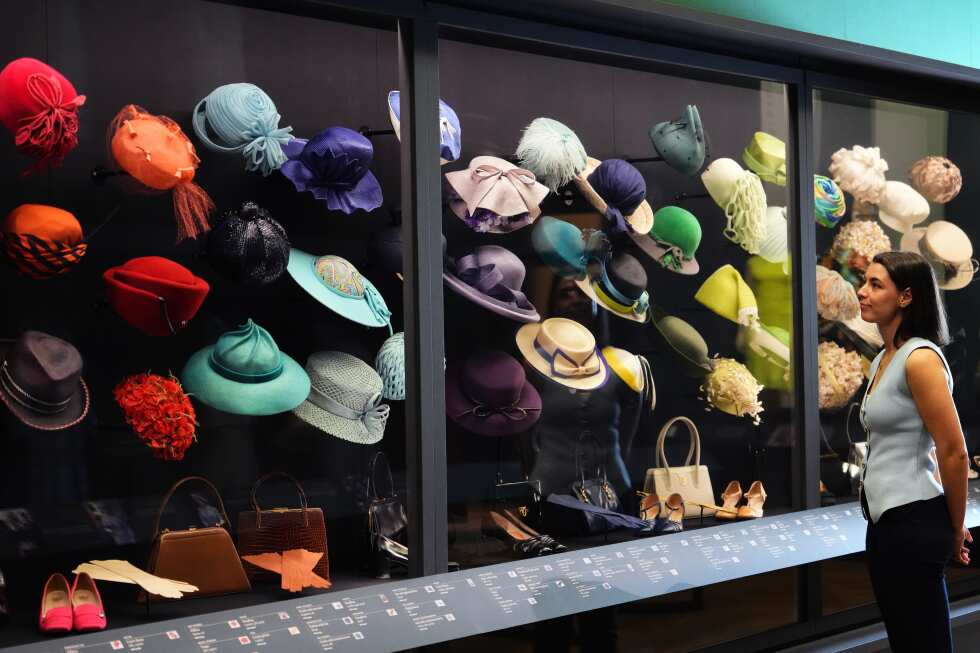
LONDON — Long before her decades-long reign as Britain’s sovereign, Queen Elizabeth II understood a core truth of constitutional monarchy: for the public to trust their monarch, they first needed to see her. Even when Britain’s notoriously unpredictable rainy weather threatened to block public view, she broke new ground by adopting a clear plastic raincoat, rather than hiding behind a thick dark umbrella that would have kept her obscured from crowds. That iconic raincoat now takes its place among nearly 300 garments and fashion artifacts opening to the public Friday at Buckingham Palace’s King’s Gallery, in the most complete exhibition of Queen Elizabeth II’s sartorial choices ever assembled. Tied to the upcoming centenary of her birth, the show traces her life from childhood to her decades on the throne, while unpacking her lasting impact on British fashion and public diplomacy.\n\nCurator Caroline de Guitaut, who organized the exhibition, notes that the late monarch had a sharp, intentional sense of what looked and felt appropriate for her role. “She absolutely knew how she wanted to appear,” de Guitaut explains.\n\nAs one of the most photographed public figures in modern history, many of the queen’s pieces are instantly recognizable to audiences around the world — but seeing her signature tweed suits, ball gowns, and patterned headscarves displayed on museum mannequins still offers a new, striking perspective for visitors. Among the collection are truly one-of-a-kind pieces with fascinating backstories, including two matching dresses crafted for the 2012 London Olympic Games opening ceremony. When the 86-year-old queen filmed her iconic skit alongside Daniel Craig’s James Bond, appearing to parachute into the Olympic stadium, a stunt double wore one version of the design — complete with matching bloomers and a large back zipper to fit a parachute harness. Moments after the stunt, the queen herself appeared in the stadium stands in an identical second dress, both created by her long-time personal dressmaker Angela Kelly. Now, the two garments are displayed side-by-side for exhibition guests.\n\nDrawn from a personal collection of more than 4,000 items once owned by the queen, the exhibition explores how the late monarch turned fashion into one of her most effective tools for public engagement and diplomacy, as she grew from a young princess into Britain’s longest-serving ruler. A perfect example of this intentional sartorial diplomacy is the green and white Norman Hartnell ball gown she wore to a 1961 state banquet during an official visit to Pakistan: she chose the design specifically to match the host nation’s colors, extending a gesture of respect before she ever spoke a word.\n\n“The queen had an intimate understanding of how fashion could lend itself to diplomacy, a trait which, while its origins certainly lay in earlier reigns, the queen developed into nothing short of an art form,” de Guitaut says. “Color or embellishment communicated messages of respect to her host nation before she had even uttered a word in her speech.”\n\nLater in her reign, she intentionally chose bright, eye-catching hues for large public gatherings, making it easy for crowds to spot her, fulfilling her core belief that the monarch had to be seen to connect with the public. The exhibition also devotes space to the queen’s off-duty wardrobe, showcasing the tweed suits she wore while staying at Balmoral Castle, the royal family’s Scottish summer retreat, alongside riding gear, hiking clothing, and outdoor apparel. Pieces range from a thick wool coat designed by Kelly to designs by iconic British brands Burberry and Hardy Amies.\n\nMany of the exhibition’s most meaningful pieces are tied to the defining milestones of the queen’s 96 years of life, stretching from a christening robe first commissioned by Queen Victoria for the baptism of King Edward VII, to the gowns she wore for her 1947 wedding and 1953 coronation. Curators have also included original design sketches and handwritten notes that reveal how closely involved the queen was in every step of creating her wardrobe.\n\nNaomi Pike, commissioning editor for Elle UK, notes that the exhibition finally gives the queen long-overdue recognition as a bona fide fashion icon, a title that was often granted to other high-profile royals during her lifetime — from her younger sister Princess Margaret to her daughter-in-law Princess Diana — while she was overlooked. “I think we’re very quick in this day and age to afford people icon status. … It’s thrown around so easily,” Pike says. “But I think in the case of the queen, she was an icon and so much of that comes down to having a very strong sense of personal style.”\n\nBeyond the iconic formal gowns that draw the largest crowds, the exhibition holds thoughtful small surprises, including a well-worn children’s fairy costume made from a tutu with cloth fairy wings. The piece is a favorite of Cecilia Oliver, a textile conservator at the King’s Gallery who spent months preparing the collection for display, who calls it “the cutest thing in the world.” “I think what I love most about it is that it was bought for Elizabeth as a child, and to think of her as this tiny little girl that then grew up into this magnificent woman with all this weight of responsibility on her shoulders, it just feels very, sort of sentimental,” Oliver says.\n\nOliver spoke of the unique privilege of working so closely with the collection, which gave her an intimate connection to a figure known to billions but understood by very few. “As a conservator, I have a really intimate knowledge of these pieces. I’ve been able to touch them. I’ve been able to smell them. I’ve been able to understand them,” she says. “And through that, I felt really close to her.”\n\nQueen Elizabeth II: Her Life in Style will run at the King’s Gallery, Buckingham Palace, through October 18.
Britain celebrates late Queen Elizabeth II as a style icon to mark her centenary