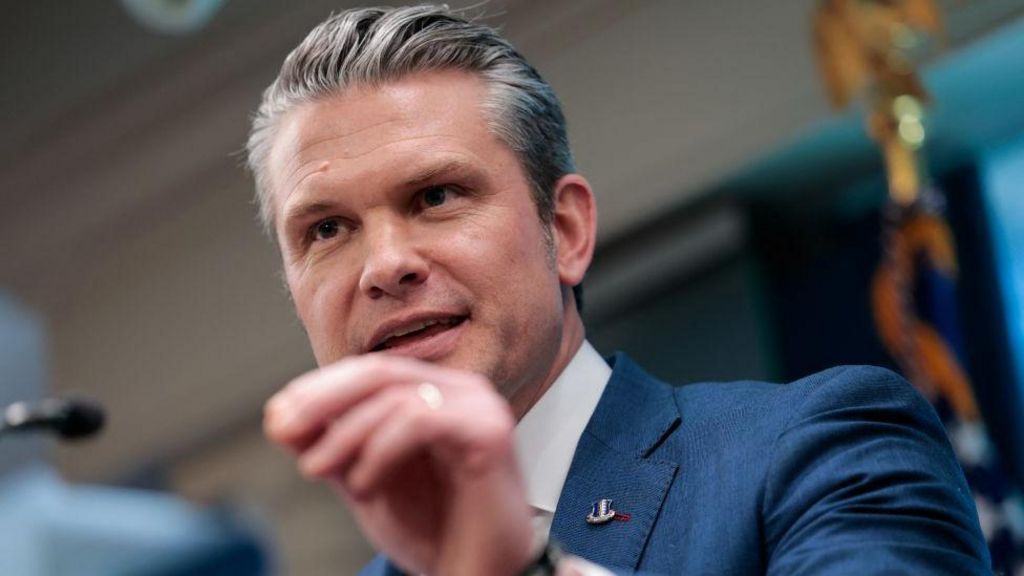
In the weeks following joint US-Israeli military strikes on Iran, a fierce battle over how the war’s trajectory is framed has unfolded inside the very heart of US military command: the Pentagon. As a reporter embedded in Defense Secretary Pete Hegseth’s press briefings since the conflict’s first days, one pattern has been impossible to miss: the former Army National Guard Major and ex-Fox News pundit has brought a distinctly televised, theatrical style to the podium, from his initial laying out of US war aims through the most recent briefing announcing a fragile two-week ceasefire.
Hegseth’s briefings have been unapologetically boastful affairs, centered on celebrating overt displays of American military dominance. Just this Wednesday, he declared the US had secured a “capital V military victory”, and in an earlier briefing, he characterized the campaign as delivering unrelenting “death and destruction from the sky all day long”. But peeling back this public messaging to uncover the real progress of the war, its human and financial toll, and its long-term strategic consequences demands far deeper scrutiny. With the already fragile ceasefire facing repeated tests, critical questions remain: what tangible gains has the US actually secured, and what costs have already been incurred to reach this point?
US President Donald Trump’s core stated war objective has long been stripping Iran of any capacity to develop a nuclear weapon – a goal Iran has repeatedly denied ever pursuing. For years prior to the current conflict, this objective was pursued through US-led diplomatic negotiations, but Trump ultimately rejected the 2015 Joint Comprehensive Plan of Action (JCPOA), the Obama-brokered nuclear deal with Iran, arguing it was too lenient on Tehran.
In his first term, Trump withdrew the US from the agreement and reimposed crippling sanctions on Iran, which had been in full compliance with the deal’s terms at the time. That move marked a clear choice to abandon diplomacy in favor of coercive force, a pattern that continued with the US assassination of top Islamic Revolutionary Guard Corps General Qasem Soleimani. For years, this pattern of alternating between tentative diplomatic outreach and sudden military action with Tehran ultimately culminated in the outbreak of the current war.
Today, even with the tentative ceasefire holding for the moment, there is little concrete evidence that Trump has achieved meaningful progress on his core nuclear goal. Last June, Trump claimed Iran’s nuclear infrastructure had already been “obliterated” by bombing raids on key sites at Isfahan, Fordow, and Natanz. But five additional weeks of open conflict later, Iran still retains its stockpile of near-weapons-grade enriched uranium, which is reported to be stored in gas cylinders hidden under rubble at targeted sites.
Rafael Grossi, head of the International Atomic Energy Agency (IAEA), the global nuclear watchdog, warned in the third week of the war that military action would never resolve the international community’s concerns over Iran’s nuclear program. While Trump has stated the US will now work with Iran to extract and remove all hidden nuclear material, Tehran has remained defiant on the issue. The question will now take center stage at upcoming US-Iran negotiations set to be held in Islamabad, and analysts warn that the attack has left Iran’s leadership even more distrustful of the US – and potentially more determined than ever to pursue a nuclear deterrent to fend off future American attacks.
When Trump first announced the war in a pre-recorded social media video from his Mar-a-Lago estate, a second stated objective was regime change in Tehran: he called on the Iranian people to overthrow their government once US-Israeli bombing concluded. Within days, he doubled down, demanding the regime’s “unconditional surrender” – a demand that has not been met. While Israeli strikes have killed senior Iranian leaders, including Supreme Leader Ayatollah Ali Khamenei, Khamenei’s son Mojtaba has already been named as his successor, leaving the regime structure intact.
Trump has claimed the new Iranian leadership is less “radicalised and far more intelligent” than its predecessor, and has expressed hope he can replicate the outcome of his 2020s intervention in Venezuela, where US forces captured President Nicholas Maduro and installed a US-aligned government in Caracas. So far, there is no indication that any such shift in power is imminent in Tehran.
On the topic of Iran’s conventional military arsenal, senior Trump administration officials have claimed the US has “obliterated” Iran’s missiles, drone fleets, launch facilities, arms factories, and naval forces. But leaked US intelligence assessments have disputed that claim, suggesting Iran still retains roughly half of its pre-war missile and drone stockpiles. The BBC has not been able to independently verify either side’s claims.
Regardless of the status of Iran’s arsenal, it is clear the Trump administration’s stated war goals have shifted dramatically since the conflict began, and the core objective of regime change has yet to materialize. The human cost for the US has already been steep: 13 American service members have been killed in action, and hundreds more have been wounded. The war has also drained US military stockpiles at an unprecedented rate, with thousands of precision munitions including large numbers of Tomahawk cruise missiles expended, putting the daily cost of the operation at more than $1 billion.
While US officials maintain that unmatched American military skill and cutting-edge technology allowed the air campaign to finish ahead of schedule, forcing Iran into the ceasefire, the political cost at home has already started to mount. Consistent public polling shows only a minority of American voters approve of the conflict, and support in Congress has broken down almost entirely along partisan lines, with most Republicans backing Trump. But in recent days, a growing number of GOP lawmakers have publicly denounced Trump’s unfiltered social media threat to “destroy a whole civilization”, breaking with the president’s position.
The rift has extended deep into Trump’s own MAGA base: high-profile movement figures including popular podcaster and journalist Tucker Carlson have openly split with Trump over the war. Marjorie Taylor Greene, once one of Trump’s most vocal supporters and a prominent MAGA leader who has since broken with the president, issued a scathing rebuke over the weekend as Trump escalated threats to destroy additional Iranian civilian infrastructure. “This is not making America great again, this is evil,” she said. So far, there is little sign these intra-Republican fractures will heal ahead of the November midterm elections.
Democrats, meanwhile, have uniformly condemned Trump’s increasingly inflammatory threats and his repeated insults of longstanding US allies. They have also demanded answers about an alleged US missile strike on a school in the Iranian town of Minab on the first day of the war, which local reports say killed at least 168 people, 110 of them children. If confirmed, the strike would rank among the deadliest incidents of civilian casualties from a US attack in the Middle East in a generation. The Pentagon says it is investigating the incident, but nearly six weeks after the attack, no findings have been released to the public.
This week, a bipartisan group of lawmakers went so far as to call on Trump’s cabinet to invoke the 25th Amendment to remove the president from power over his handling of the conflict. The White House has pushed back against all criticism, with Press Secretary Karoline Leavitt arguing that Trump’s hardline rhetoric forced Iran to agree to the ceasefire, and that “Never underestimate President Trump’s ability to successfully advance America’s interests and broker peace.”
A definitive public verdict on the war may come from American voters in November. The closure of the Strait of Hormuz, triggered by Iran’s response to the war, has already driven up gasoline and diesel prices across the US, and analysts predict those higher energy costs will soon push up grocery prices, stoking voter anger over inflation that is already expected to make this year’s midterm elections a tough fight for Trump’s Republican Party. If voter discontent over the war and its economic fallout continues to grow, Republicans could lose control of the House of Representatives and even the Senate – a heavy political price for the conflict.
Trump has already been forced to shift priorities to address the growing economic crisis: when the war began, the Strait of Hormuz was fully open, but now his top war goal has become reopening the key global oil chokepoint after Iran seized control of it. Trump has flip-flopped repeatedly on his strategy for reopening the strait: he first called on US allies to contribute to military action to reopen it, then claimed the US did not need any allied support, then reversed course again to ask for help, before dismissing longstanding allies as “cowards” for declining to join the campaign.
The conflict has also exacerbated already deep rifts within the NATO alliance, which had already been strained by Trump’s prior territorial claims on Greenland. Trump has stepped up his public attacks on the alliance, which declined to formally join the war effort. After a recent White House meeting with Trump, NATO Secretary General Mark Rutte acknowledged only that the conversation had been “very frank”, a sign of continuing tension. European allies have already started taking steps to reduce their strategic and economic dependence on what they now view as an unpredictable and unreliable US security guarantor, a shift that analysts say creates major strategic and economic opportunities for China – a development that has sparked deep alarm among Trump’s critics in Washington.
Today, the full human, political, economic, and strategic costs of the five-week war remain uncounted. If the current fragile ceasefire collapses or upcoming negotiations fail to produce a durable settlement, those costs could grow far steeper in the months ahead.