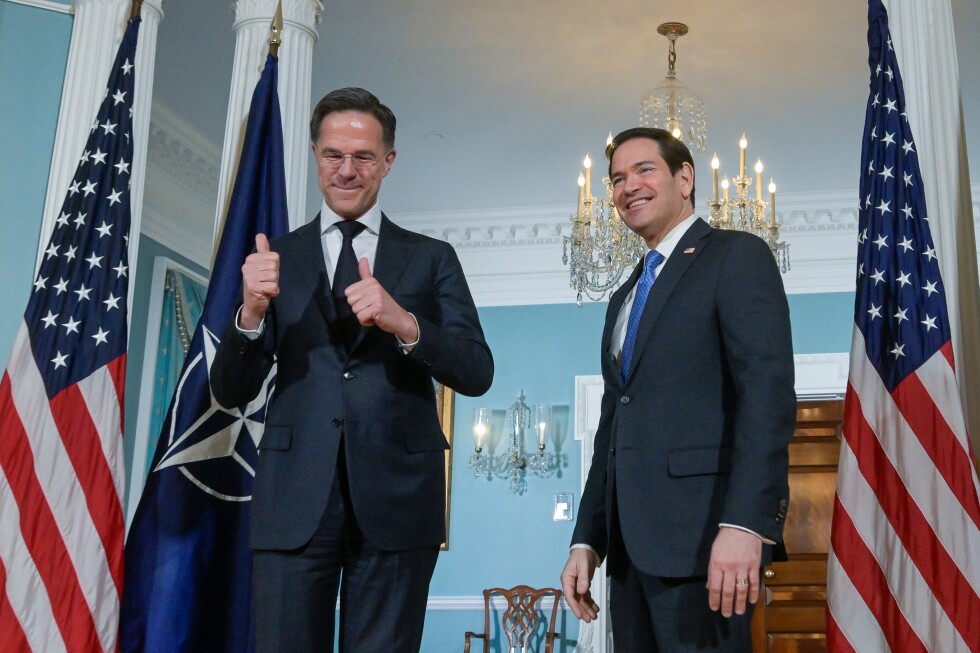
BRUSSELS – Tensions between Washington and its trans-Atlantic allies have reached a new boiling point, as NATO Secretary-General Mark Rutte finds himself once again managing diplomatic fallout from U.S. President Donald Trump’s anger over the Iran conflict – a war that the 31-nation defensive alliance was never consulted on, and which falls far outside its core defense mandate. Since the U.S.-led war against Iran began, Trump has launched a series of scathing attacks against U.S. allies, labeling many of them cowards, dismissing NATO itself as a toothless paper tiger, and drawing a damaging comparison between British Prime Minister Keir Starmer and Neville Chamberlain, the former UK leader widely associated with failed appeasement policy toward Nazi Germany. This latest confrontation only adds to a growing rift that has already been stretched thin by Trump’s repeated threats to annex Greenland, a move that has alarmed European allies and sparked fears that a unilateral U.S. power grab could unravel the alliance entirely. The current friction centers on Trump’s frustration that NATO allies refused to back the U.S. after Iran shut down the Strait of Hormuz, the strategically critical global oil and trade chokepoint. Following Wednesday’s closed-door talks between Rutte and Trump, the U.S. leader made his disappointment public in a fiery social media post, writing: “NATO WASN’T THERE WHEN WE NEEDED THEM, AND THEY WON’T BE THERE IF WE NEED THEM AGAIN.” When pressed by CNN reporters on whether Trump planned to pull the U.S. out of the trans-Atlantic alliance – a threat he first issued during his first term in 2018 – Rutte acknowledged Trump’s deep dissatisfaction, admitting “He is clearly disappointed with many NATO allies, and I can see his point.” Known widely as a skilled “Trump whisperer” who has managed to keep the mercurial U.S. leader engaged with the alliance since taking the top NATO job in 2024, Rutte has previously scored diplomatic wins: he helped broker a deal that saw European allies and Canada purchase U.S. weapons for Ukraine, keeping the U.S. invested in managing Europe’s largest armed conflict in 70 years. Keeping the U.S. anchored in NATO has become Rutte’s top priority, especially as Washington has increasingly shifted its strategic focus to other global flashpoints, from the Indo-Pacific to Venezuela and now the Middle East. To maintain goodwill, Rutte has leaned into flattery, praising Trump for pushing NATO allies to meet their mandatory 2% GDP defense spending targets, congratulated the U.S. leader on the Iran war, and refused to push back on Trump’s apocalyptic warning that “a whole civilization will die” if Iran does not reopen the Strait of Hormuz. Describing his meeting with Trump as “very frank, very open discussion but also a discussion between two good friends,” Rutte declined to confirm unreported claims that Trump is weighing pulling U.S. troops out of European nations that refuse to back the war. When asked if the world is safer following the U.S.-Iran war, Rutte replied plainly: “Absolutely.” What makes this dispute particularly unusual is that NATO has no natural role in the conflict. As a defensive alliance built to protect the collective territory of its Euro-Atlantic members, NATO only stepped in once to back member Turkey after Iranian retaliatory missile strikes targeted Turkish soil. The war itself was launched unilaterally by the U.S., a NATO member, but no attack on the alliance prompted it. Rutte has repeatedly stated NATO will not join the conflict, and there is no public evidence that the U.S. formally brought the request for alliance support to NATO’s Brussels headquarters, though informal discussions have not been ruled out. When asked about security efforts for the Strait of Hormuz, NATO declined comment, referring all questions to the United Kingdom, which is leading a standalone non-NATO initiative to secure the waterway once a ceasefire holds. Smaller NATO allies have signaled they are open to discussions if a formal request is submitted. Estonian Foreign Minister Margus Tsahkna told CNBC Thursday that “If the U.S. or any other NATO ally is asking (for) our support, we are always ready to discuss it. But for that, we need of course the official ask to discuss then what is the mission, what is the goal? If allies need our support, then we need to plan together.” Rutte has doubled down on his position that NATO will only act to defend its own territory, and will avoid entanglement in conflicts outside the Euro-Atlantic area. “This is Iran, this is the Gulf, this is outside NATO territory,” he explained. While NATO has launched out-of-area operations in the past – most notably in Afghanistan and Libya – the alliance has little appetite for new foreign deployments after the chaotic 2021 U.S.-led withdrawal from Afghanistan, which former NATO Secretary-General Jens Stoltenberg openly labeled a defeat. Much of Trump’s anger has been directed specifically at two NATO members, Spain and France, rather than the alliance as an institution. Spain has already closed its airspace to U.S. military aircraft involved in the Iran war and blocked U.S. forces from accessing shared military bases on Spanish territory. After a two-week ceasefire was announced, Spanish Prime Minister Pedro Sánchez took to social media to criticize the war, writing that his government “will not applaud those who set the world on fire just because they show up with a bucket. What’s needed now: diplomacy, international legality, and PEACE.” France has also taken a critical stance, arguing the war was launched in violation of international law and that Paris was never consulted ahead of time. While France has not issued blanket restrictions on U.S. use of shared bases or French airspace, authorities have confirmed they will review all requests on an individual, case-by-case basis.
Rutte the ‘Trump whisperer’ faces a fresh test as Trump turns on NATO over Iran