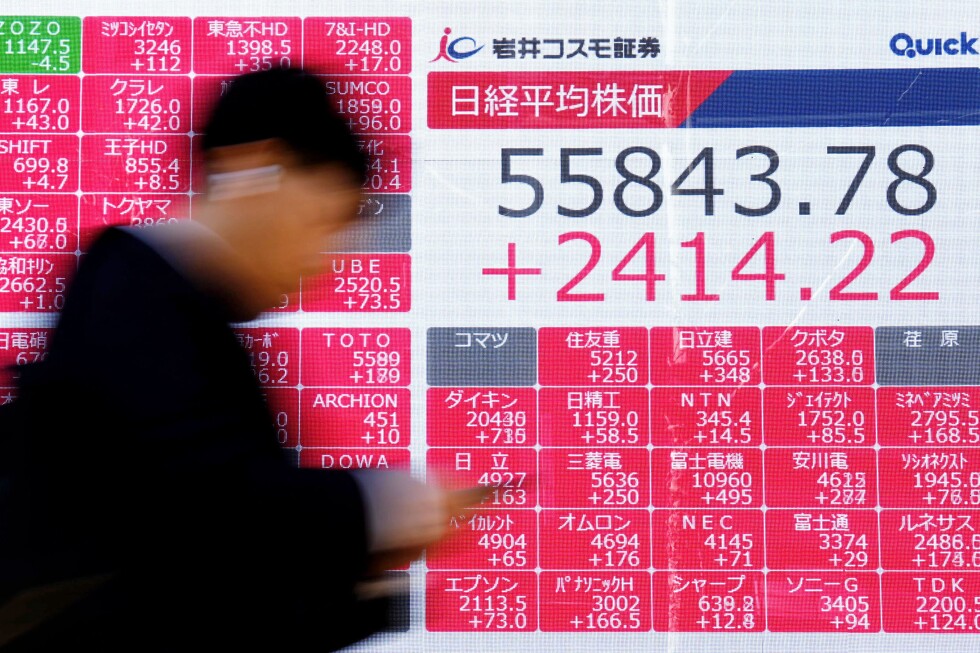
Global financial markets reacted dramatically early Wednesday, with Asian equities jumping to multi-session highs and crude oil prices tumbling double-digit dollars per barrel, following a last-minute breakthrough: the United States and Iran have reached an agreement for a 14-day ceasefire that will reopen the strategically critical Strait of Hormuz for global shipping.
In early morning trading across Asia, major benchmark indices posted double-digit percentage gains in some cases, a sharp turnaround from weeks of volatility stoked by geopolitical tensions. Japan’s Nikkei 225, the region’s most closely watched benchmark, climbed 5% to hit 56,106.18 minutes after opening. Australia’s S&P/ASX 200 notched a 2.6% rise to 8,952.30, while South Korea’s Kospi outperformed most peers with a 5.9% surge to 5,819.97. In Greater China markets, Hong Kong’s Hang Seng Index gained 2.6% to 25,767.42, and mainland China’s Shanghai Composite added a solid 1.7% to close in on the 4,000 point threshold at 3,957.55.
Crude oil markets, which had seen prices spike sharply after the conflict closed the strait to commercial shipping, saw an immediate and steep correction. Benchmark U.S. crude plummeted $16.84 to settle at $96.11 per barrel in early trading, while international benchmark Brent crude fell $14.51 to $94.76 a barrel. The sharp drop comes as no surprise to market analysts: nearly 20% of the world’s daily oil supply transits through the Strait of Hormuz, making the waterway one of the most critical energy chokepoints on the planet. For resource-import dependent economies like Japan, the reopening of the strait removes a major near-term threat to energy security.
The breakthrough followed a flurry of diplomatic activity through Tuesday evening. After Pakistan’s prime minister publicly urged U.S. leadership to extend its original deadline for reopening the strait and pressed Iranian officials to resume commercial navigation, U.S. former President Donald Trump announced late Tuesday he would pause planned strikes against Iranian civilian infrastructure, including bridges and power plants, that had been threatened in recent days. Iran’s foreign minister confirmed that the strait would remain open for all commercial shipping for the 14-day period, under supervision by the Iranian military.
Even as markets rallied, analysts struck a cautious tone. Tim Waterer, chief market analyst at KCM Trade, noted that the current market momentum is rooted in cautious optimism rather than unbridled celebration. “The ceasefire is only two weeks long, and markets will be watching closely to see whether shipping through the Strait of Hormuz normalizes as promised and whether the fragile truce can pave the way for a more durable peace agreement,” Waterer said.
The ceasefire announcement ended weeks of sustained market volatility that began when the conflict broke out in late February. On Tuesday, U.S. equities already began pricing in the potential for a diplomatic breakthrough, with the S&P 500 erasing all earlier losses to close 0.1% higher. The Dow Jones Industrial Average edged down 0.2% (a drop of 85 points), while the Nasdaq Composite also closed 0.1% higher.
Other asset classes also reflected easing geopolitical risk. In U.S. bond markets, the yield on 10-year Treasury notes eased to 4.24%, down from 4.30% earlier Tuesday as investors moved back to safe-haven assets following the news. In foreign exchange markets, the U.S. dollar softened against major peers, falling to 158.54 Japanese yen from 159.52 yen earlier in the week, while the euro rose to $1.1671 from $1.1597.
This report was contributed to by AP Business Writer Stan Choe in New York, with reporting from Yuri Kageyama based in Tokyo.