China’s national transport network has successfully navigated its first major peak travel period of 2026, with integrated air-rail and land-air intermodal services playing a key role in easing congestion amid an 842 million surge in cross-regional passenger trips over the three-day Qingming holiday, held from April 4 to 6 this year.
New data released by China’s Ministry of Transport on April 7 shows that total cross-regional trips rose 5.6% year-on-year, with railway trips climbing 8.4% to 57.7 million. Road travel retained its position as the most popular mobility option for holidaymakers, while the first day of the break alone recorded more than 62.67 million highway vehicle trips — including over 14 million trips in new energy vehicles, a clear indicator of strong, sustained growth in domestic self-drive tourism and related consumer spending.
Industry analysts note the higher travel volume this year was partially driven by overlapping spring break schedules at schools across multiple Chinese regions, which boosted demand for family getaways and short-distance leisure trips. Beyond the raw numbers, this holiday rush has also highlighted a rapid, ongoing transformation of China’s passenger transport ecosystem: national authorities are rolling out a new seamless travel model that enables single booking, unified payment, and uninterrupted journeys, anchored by the fast expansion of cross-modal connectivity between air, rail and road networks.
Transport Minister Liu Wei explained that 2026 has seen accelerated investment in improving travel convenience by expanding these integrated services and simplifying end-to-end passenger journeys. To date, more than 80 major transport hub cities and over 2,000 national routes have activated formal air-rail interconnection, with 81% of China’s largest airports offering direct rail access to city and long-distance networks. During the 2026 Spring Festival travel rush that concluded in March, dozens of key hubs also launched a pilot program for mutual security check recognition between intercity rail and urban public transit systems, cutting average transfer waiting times dramatically.
For frequent travelers, these infrastructure and service upgrades have already produced tangible changes to daily travel routines. A frequent business traveler based in Beijing, identified only as Wang, shared that he now regularly takes the subway to Beijing West Railway Station after work on Fridays, then transfers directly to a high-speed train bound for Shijiazhuang Zhengding International Airport for onward flights. “If I book my ticket far enough in advance, I can get a combined fare to Chongqing for less than 500 yuan ($73),” he explained. “Most of the time, it’s just as fast as fighting rush-hour traffic to one of Beijing’s major downtown airports, and it’s far cheaper.”
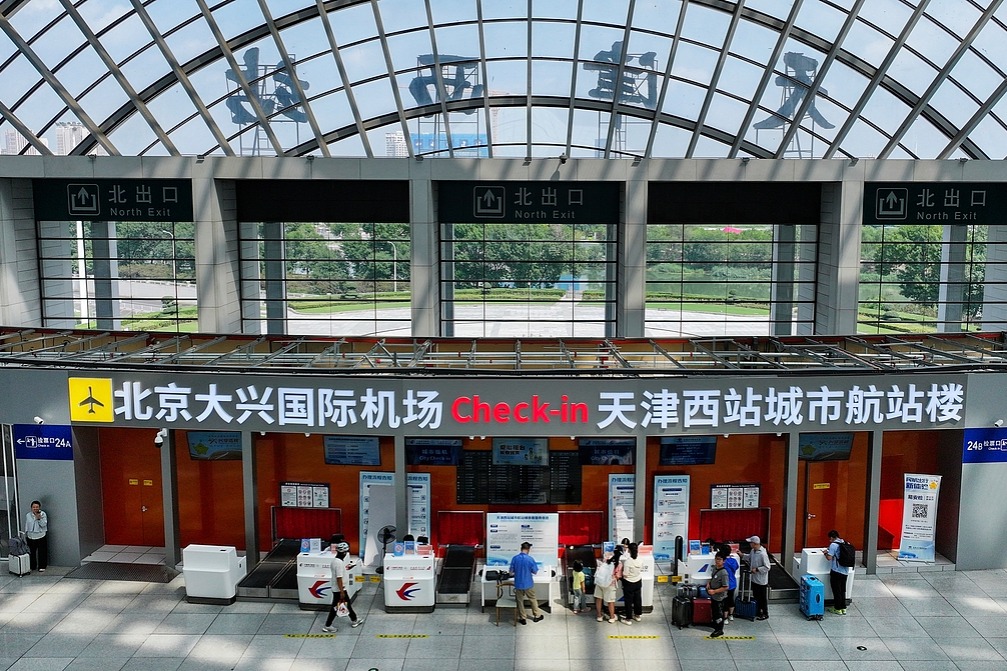
Major transport hubs are continuing to refine their intermodal services to cut friction for transferring passengers. Cui Lin, deputy Party secretary of Beijing West Railway Station, noted the hub operates 24 daily direct train services connecting to Beijing Daxing International Airport, with roughly 1,000 passengers transferring from high-speed rail to flights via the station every day. “By moving flight check-in services forward to the railway station, we aim to create a far more convenient one-stop air-rail travel experience for all passengers,” Cui said.
Chinese commercial airlines are also deepening their integration with national rail networks to streamline end-to-end journeys. Cai Yingzhu, general manager of marketing and sales at China Eastern Airlines’ Beijing branch, explained that passengers can now complete full airline check-in procedures directly at the connecting railway station via the carrier’s digital terminal system. “In the near future, travelers will be able to check their luggage at Beijing West Railway Station and only collect it again at their final flight destination after landing,” Cai said. “That will drastically cut down on travel time and improve overall journey efficiency.”
Currently, passengers can already book combined “flight + high-speed rail” tickets in a single transaction through China Eastern’s official digital platform, with the system automatically matching the fastest and most convenient connecting options. “What used to require multiple independent searches and separate bookings on different platforms can now be completed in one step,” Cai added. “For families traveling together, we also offer more flexible offline seat arrangement services to meet group needs.”