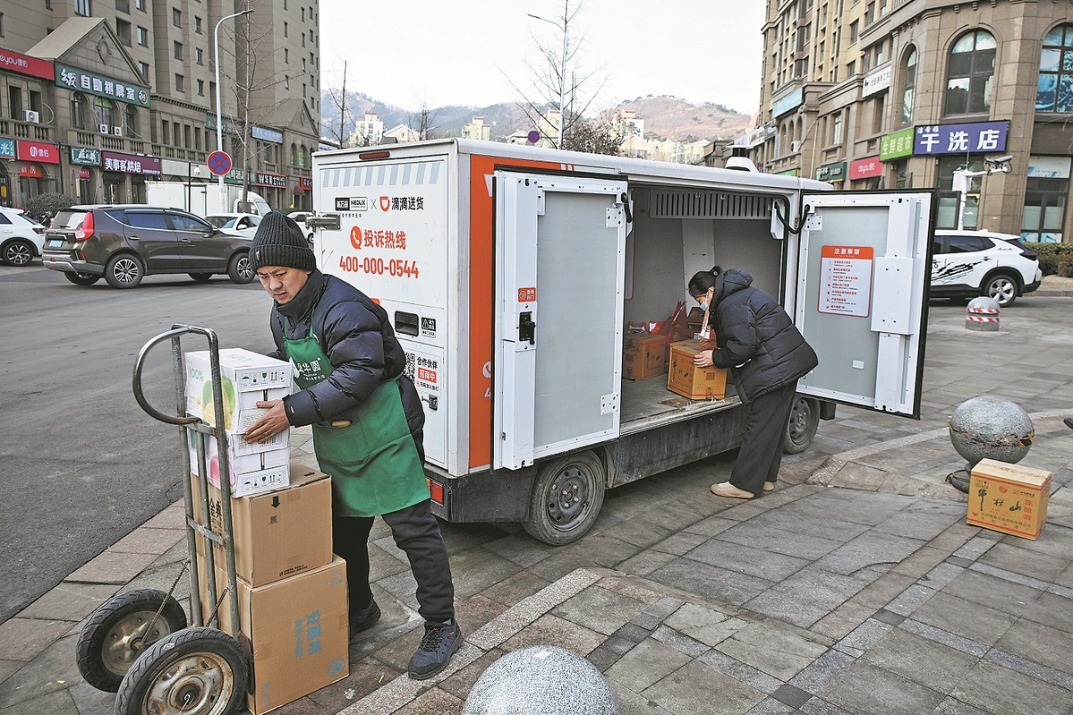
Across Chinese cities and rural regions, a quiet technological revolution is transforming last-mile delivery. On a routine day in Qingdao, a coastal metropolis in eastern China’s Shandong Province, local resident Zhou Li stepped up to a boxy, driverless vehicle parked curbside, scanned a QR code on its exterior, and retrieved her grocery order of cold beer, savory sausage and roasted nuts. Minutes later, the compact autonomous vehicle glided away silently to its next drop-off, its navigation entirely self-directed.
Zhou’s first encounter with unmanned delivery left her stunned, she recalled, adding that the service — priced at just 9.9 yuan ($1.44) for trips up to 30 kilometers — struck her as surprisingly affordable. What once seemed like science fiction has now become a common sight on Qingdao’s public streets, where roughly 1,150 autonomous delivery units currently operate, making the city one of China’s largest hubs for real-world testing and deployment of this technology.
Unlike conventional passenger vehicles, these driverless delivery units have no steering wheel or dedicated driver cabin. Clocking in at roughly half the size of a standard sedan, they rely on sophisticated artificial intelligence systems to map optimal routes, interpret real-time road conditions, detect traffic signals and nearby obstacles, and execute automatic braking or evasive maneuvers to prevent collisions. Today, these vehicles handle a wide range of core logistics tasks across China: moving bulk parcels from central distribution hubs to local sorting stations, delivering temperature-sensitive perishable goods and cold-chain pharmaceuticals on tight schedules, and supporting internal logistics operations within large industrial parks.
Qingdao’s largest fleet operator is Neolix, one of China’s leading domestic developers of autonomous delivery technology. The company launched its pilot service in the port city in June 2025, rolling out vehicles with a 1-ton load capacity, 6-cubic-meter cargo hold, a maximum cruising speed of 45 kilometers per hour and a 200-kilometer battery range on a single charge. According to Neolix Chief Technology Officer Miao Qiankun, the firm has been refining AI-powered visual navigation algorithms since 2021, equipping vehicles with the decision-making capabilities of a veteran human driver while drastically cutting the costs associated with map data collection and real-time updates. As of September 2025, Neolix has deployed more than 10,000 autonomous vehicles globally, partnering with major Chinese courier companies while expanding its footprint to more than 15 countries and regions across Asia, Europe and the Middle East, including Japan, South Korea, Germany and the United Arab Emirates.
Qingdao is far from the only region embracing this innovation. Driverless delivery has moved from experimental testing to routine daily operation across more than 100 Chinese cities, supported by policy backing and growing market demand. In Shenzhen, the southern technology hub in Guangdong Province, 432 autonomous delivery vehicles completed 1.02 million drop-offs in September 2025 alone, generating 8.7 million yuan in operational revenue. In Beijing, leading on-demand delivery platform Meituan has adopted a hybrid human-machine model: autonomous vehicles transport bulk orders from warehouses to neighborhood relay points, where human couriers complete the final short-distance drop-off to customers. Even in remote rural areas of the Xinjiang Uygur Autonomous Region, unmanned vehicles now serve isolated villages located up to 60 kilometers from distribution hubs, where traditional delivery is unprofitable due to the small volume of parcels per trip.
Industry operators highlight the drastic cost savings unlocked by this technology. Compared to traditional human-led delivery models, autonomous fleets can cut overall operating costs by nearly half, according to Yao Lei, a manager at major Chinese express provider Yunda Express. By June 2025, more than 100 Chinese cities had launched official pilot programs permitting autonomous delivery vehicles to operate on public roads. In September, China’s Ministry of Commerce and other national regulatory bodies released new policy guidelines encouraging regions with appropriate infrastructure to accelerate the development of unified operational and safety standards for the emerging sector.
Economics professor Li Tiegang of Shandong University’s School of Economics explained that the key value of low-cost, easily dispatched, high-efficiency autonomous delivery is its ability to solve long-standing pain points in last-mile logistics, most notably rising operational costs and widespread industry labor shortages. Li noted that China’s rapid large-scale adoption of this technology stems from three overlapping factors: mature domestic autonomous driving technology, robust market demand from a fast-growing e-commerce sector, and clear policy support from national and local governments.
The development of intelligent connected vehicles, including autonomous delivery units, is explicitly highlighted as a strategic emerging industry in China’s 14th Five-Year Plan (2026-2030), which also encourages the integration of artificial intelligence across all sectors of the economy to better meet evolving public daily needs. Li emphasized that the rollout of autonomous delivery is not aimed at replacing human workers entirely. Instead, the model centers on collaborative human-machine work: while autonomous systems optimize routine long-distance and bulk transport to improve service efficiency, the transition will also create new job opportunities in vehicle operation, maintenance and fleet dispatch.