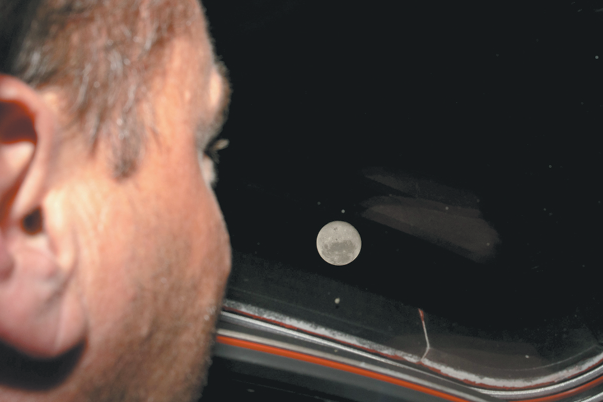
More than 56 years after the Apollo 13 mission set a long-standing cosmic milestone, NASA’s Artemis II crew has rewritten human space exploration history by breaking the record for the farthest distance humanity has ever traveled from our home planet.
The four-person crew — mission commander Reid Wiseman, pilot Victor Glover, mission specialist Christina Koch (all from NASA), and Canadian Space Agency astronaut Jeremy Hansen — officially surpassed Apollo 13’s 400,171-kilometer benchmark at 1:57 pm Eastern Time on Monday (early Tuesday Beijing time). By 7:02 pm the same day, the Orion capsule carrying the astronauts reached its maximum distance from Earth: 406,771 kilometers, a new high-water mark for human spaceflight.
Launched on April 1 from NASA’s Kennedy Space Center in Florida, the 10-day mission kicked off with 25 hours of orbital operations around Earth, before the Orion spacecraft departed for its lunar trajectory on Thursday evening. Early Monday, the craft entered the lunar sphere of influence, the point where the moon’s gravitational pull becomes stronger than Earth’s, setting the stage for its close lunar flyby.
During its approach, the Artemis II capsule came within just 6,550 kilometers of the lunar surface, marking its closest pass of the moon. The mission’s dedicated lunar observation window stretched nearly seven hours, giving the crew a unique, up-close chance to map and study lunar terrain — including portions of the moon’s far side that are permanently hidden from Earth view and have rarely been seen directly by human observers.
At approximately 6:44 pm Monday, Orion passed behind the moon from Earth’s perspective, triggering an expected 40-minute communications blackout between the crew and mission control on Earth. The blackout occurs because the solid lunar body blocks radio signals between the spacecraft and ground-based communication networks, a known part of the mission profile that the team prepared for in advance.
Like the 1970 Apollo 13 mission, Artemis II follows a free-return trajectory around the moon, a path that uses gravitational forces to propel the craft back toward Earth without requiring major additional engine burns. For Apollo 13, this trajectory was an emergency measure: an on-board oxygen tank rupture forced the crew to abort their planned lunar landing and use the free-return path to return safely home. Unlike Apollo 13, however, Artemis II’s mission never included a lunar landing attempt; it was planned from the start as a 10-day demonstration flight to test systems for future lunar missions.
After breaking the distance record, the crew completed their lunar observation activities and have officially begun the journey back to Earth. Orion is scheduled to exit the lunar sphere of influence at approximately 1:25 pm Eastern Time on Tuesday, and the mission is on track to conclude on Friday with a planned splashdown in the Pacific Ocean.
Beyond making new history, the core goal of the Artemis II mission is to test and validate the full suite of technologies and operational capabilities required for future deep space exploration. Key objectives include verifying the performance of Orion’s life-support systems, testing deep space communication and navigation protocols, and letting the crew practice operational procedures that will be critical for upcoming Artemis missions that will include lunar surface landings and the construction of a long-term lunar outpost.