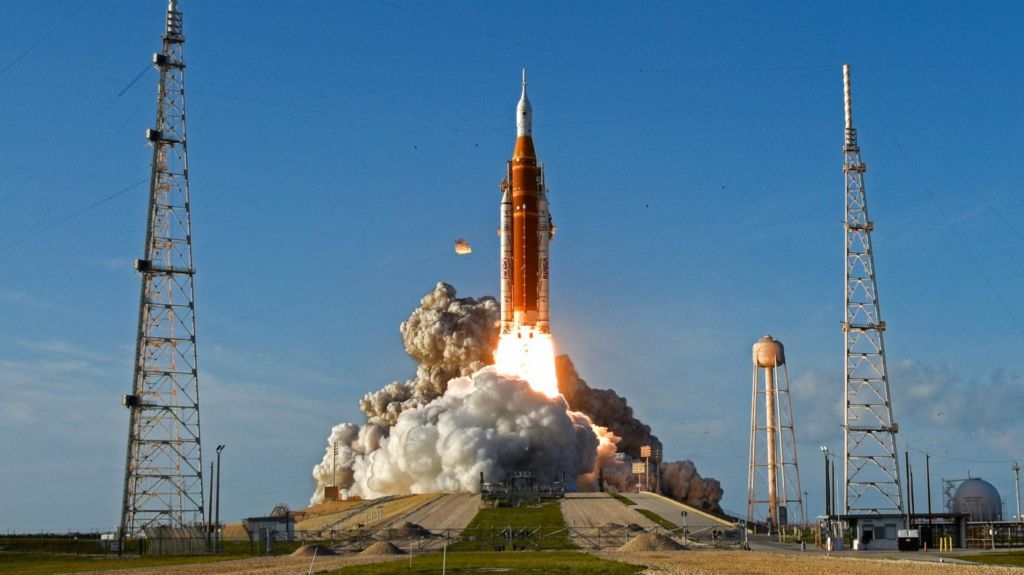
Six days after NASA’s Artemis II mission lifted off from the Kennedy Space Center on April 1, 2026, every key systems test has delivered results far better than even the agency’s most optimistic engineers predicted. This mission marks the first time a crewed Orion capsule has operated in deep space, a real-world trial no ground-based simulator could ever replicate — and its performance so far has already reshaped expectations for the future of U.S. lunar exploration.
Preceding the April launch were two scrapped attempts in February and March, caused by unrelated technical glitches that followed the 2022 uncrewed Artemis I mission. Following those setbacks, NASA Administrator Jared Isaacman issued a blunt assessment of the agency’s previous approach: launching a single complex Space Launch System (SLS) rocket once every three years, treating each vehicle like a one-of-a-kind masterpiece rather than part of an operational program, was no path to sustainable success. His comments reframed the entire Artemis program around a new goal: consistent, frequent launch cadence rather than sporadic, high-stakes single missions.
Against that new standard, Artemis II’s first week has been a resounding success. The SLS, NASA’s most powerful rocket ever built, generated 8.8 million pounds of thrust at liftoff, and every phase of its ascent — from maximum dynamic pressure to main engine cut-off and booster separation — proceeded exactly as planned. Mission controllers described every stage as “nominal,” and two of three planned trajectory corrections en route to the Moon were scrapped entirely: the capsule’s initial flight path was already so precise that no adjustments were needed. “Credit to them – they got it right the first time,” noted Simeon Barber, a space scientist at the Open University.
Approximately 36 hours after launch, the mission passed its most critical early test: a five-minute, 55-second translunar injection burn from Orion’s main engine that set the capsule on a looping path toward the Moon with no further major maneuvers required. Artemis program director Dr. Lori Glaze called the burn “flawless.”
The core objective of Artemis II has always been to test how Orion performs with a human crew of four — commander Reid Wiseman, pilot Victor Glover, mission specialists Christina Koch and Jeremy Hansen — aboard. Unlike simulated tests, a crewed mission reveals how systems adapt to the small, unpredictable needs of human spaceflight: the need for air conditioning, carbon dioxide removal, working restroom facilities, and in-flight water access. The mission has encountered only minor issues: a temporary toilet malfunction, a water dispenser problem that required the crew to collect water in bags as a precaution, and a small redundancy loss in a helium system that was resolved quietly shortly after it was detected.
“ This is all about putting humans in the loop — these pesky humans that press buttons and breathe carbon dioxide and want air conditioning and want to use the toilet. It was all about how the system works with those guys on board,” Barber explained. Engineers have run repeated tests on Orion’s life support and maneuvering systems, even intentionally disabling some thrusters to test the capsule’s response, and all data so far confirms the vehicle is safe enough for future lunar surface missions. Barber summarized, “Orion itself seems to have worked pretty well, actually — certainly all the propulsion stuff, which is the real critical stuff.”
Alongside systems testing, the crew has collected new observational data of the lunar surface and captured breathtaking images from deep space. They documented roughly 35 geological features in real time, tracked color variations that hint at mineral composition, and photographed a deep-space solar eclipse that pilot Victor Glover described as “unreal.” One particularly historic observation captured the 600-mile Orientale basin on the Moon’s far side, the first time humans have viewed the full feature in person. Still, as Oxford University professor Chris Lintott points out, the scientific value of these observations is limited: robotic missions including India’s 2023 Chandrayaan-3 and China’s 2024 Chang’e-6 have already mapped the lunar terrain in far greater detail. For Artemis II, the greatest impact has not come from science, but from inspiration and human connection.
The mission’s most memorable moment came when the crew broke the 56-year distance record for human spaceflight set by the damaged Apollo 13 mission. In an unscripted, emotional transmission to Mission Control, Jeremy Hansen announced the crew was naming a bright lunar crater “Carroll,” in honor of Reid Wiseman’s late wife, mother of their two daughters. After Hansen’s announcement, the crew held 45 seconds of silence before embracing, as Wiseman’s daughters watched from Houston. This moment, experts note, is what will cement Artemis II in public memory much like the Apollo program. Space programs that cannot evoke genuine human emotion do not endure; Apollo is remembered not just for its engineering breakthroughs, but for what it revealed about human courage and curiosity. Artemis II, in that quiet moment, claimed the same legacy.
The mission is not yet complete. Orion is currently on its return trajectory to Earth, scheduled to splash down in the Pacific Ocean near San Diego on April 11. The final, unrivaled test still ahead is atmospheric re-entry: the capsule will hit Earth’s atmosphere at roughly 25,000 miles per hour, a speed and heat load no simulator can replicate. Re-entry became a major point of concern after Artemis I, when unexpected heat shield damage triggered an investigation that delayed the Artemis II mission by more than a year. The outcome of this test will do more to define the mission’s legacy than any image of the lunar surface.
If re-entry proceeds as planned, the early success of Artemis II will send a clear encouraging signal: the SLS rocket works, the Orion capsule works, and the crew can operate systems competently even under the unique pressures of deep space. NASA has also now articulated a clear plan to move toward more frequent launches, breaking from the decades-old pattern of multi-year gaps between missions.
The goal of a crewed lunar landing by 2028, set by the agency and the White House, still remains a challenging stretch. Barber estimates a landing is more likely three to four years away from now, a timeline most experts agree is realistic. But the flawless performance from launch through lunar flyby has shifted the odds of success firmly in the right direction. The question of whether Orion can safely carry humans to the Moon is close to being answered; what remains to be seen is whether the lunar lander development program, the required launch cadence, and long-term political will can keep pace. For now, at least, the core spacecraft has already exceeded all expectations.
At a time of global unrest and widespread uncertainty, much like the 1960s Apollo era, Artemis II has delivered a moment of shared global inspiration. The iconic images of Earth hanging below the lunar horizon, and the quiet emotion of the crater naming ceremony, have reminded audiences worldwide that human exploration can unify people across borders. This is only a test flight, the first step toward a sustained program of lunar exploration that will include multiple landings in the coming years — but it is already a step that has rekindled global optimism for human spaceflight.