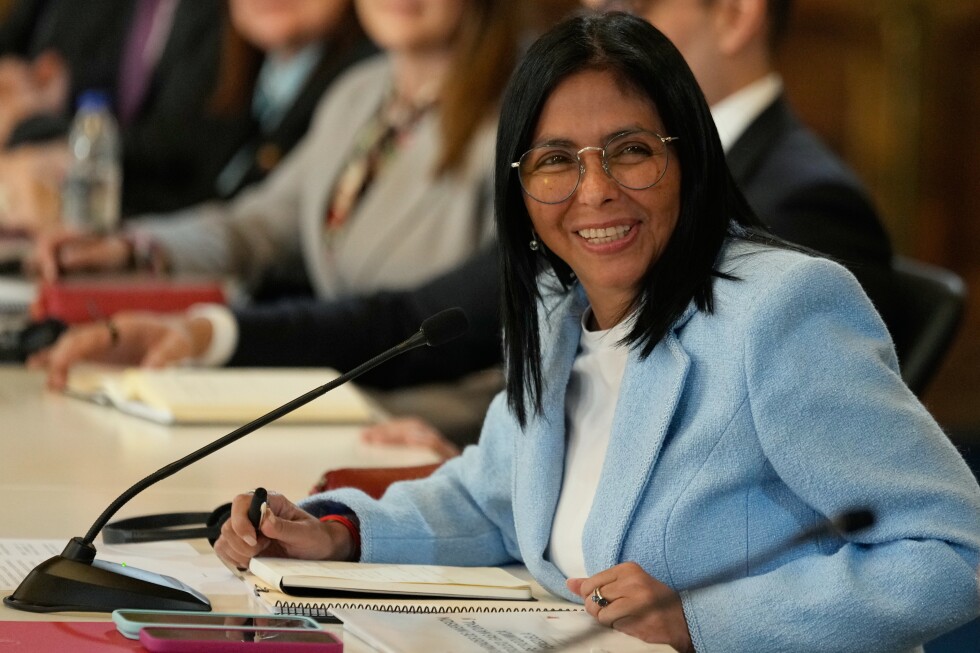
Nearly three months after former Venezuelan President Nicolás Maduro was taken into U.S. custody on drug trafficking charges, Delcy Rodríguez continues to hold the interim presidential role she stepped into, in a move that pushes past the 90-day temporary tenure limit set by Venezuela’s Supreme Tribunal of Justice.
The political standoff began on January 3, when Maduro and his wife Cilia Flores were arrested in Caracas and extradited to New York to face federal drug trafficking charges. Both have formally pleaded not guilty to the allegations. Rodríguez, who was serving as vice president under Maduro, was immediately named acting president by Venezuela’s top court, which framed Maduro’s detention as an illegal forced absence that made it impossible for him to carry out his constitutional duties. The court’s ruling capped her interim term at 90 days, which expired last Friday, leaving her officially past the deadline by Monday when the status of her role was first publicly questioned.
Under Venezuela’s constitution, an interim presidential appointment for a temporary absence can only be extended beyond the initial 90 days by a public vote of the National Assembly. As of Monday, no such vote had been held, and no official public announcement about an extension has been made by the ruling party-led legislative body. If lawmakers were to formally declare the presidency permanently vacant, the constitution requires the National Assembly to trigger a snap general election to select a permanent new head of state.
Venezuela’s government press office has not responded to multiple requests for comment on the current status of Rodríguez’s tenure, leaving political observers to speculate on the path forward.
Ronal Rodríguez, a researcher with the Venezuela Observatory at Bogotá’s Universidad del Rosario, noted that the ruling party has a long track record of adapting constitutional and legal interpretations to maintain hold on power dating back to Maduro’s first term starting in 2013. He argued that a similar workaround for the current deadline would not be unexpected. “They will most likely try to come up with some kind of explanation, such as it being Good Friday or the way the days were counted, but in the end, everything will be validated by a ruling from the Supreme Tribunal of Justice,” he said.
The current political landscape marks a sharp shift from years of U.S. policy toward Venezuela. Washington stopped recognizing Maduro as the country’s legitimate leader back in 2019, one year after he claimed victory in a widely discredited reelection that barred all major opposition candidates and parties from participating. In a surprise move after Maduro’s arrest, the Trump administration opted to partner with Rodríguez, a long-time ruling party figure, rather than back the country’s traditional political opposition.
Since taking on the interim role, Rodríguez has aligned closely with the Trump administration’s phased plan to resolve Venezuela’s long-running political and economic crisis. She has actively courted international investment for the oil-rich nation, opened the country’s critical energy sector to private investment and international arbitration, and removed a number of long-time Maduro loyalists from senior government posts—including the former defense minister and attorney general who were closely aligned with the ex-president.
U.S. President Donald Trump has publicly praised Rodríguez’s leadership in recent weeks. Last month, the U.S. State Department formally recognized her as Venezuela’s “sole Head of State,” and just last week the U.S. Treasury Department lifted all crippling economic sanctions that had been imposed on her for years. Public messaging from Rodríguez and other ruling party leaders has continued to demand the immediate release of Maduro and Flores, labeling their arrest a kidnapping, a narrative that is repeated on public billboards and murals across Caracas.