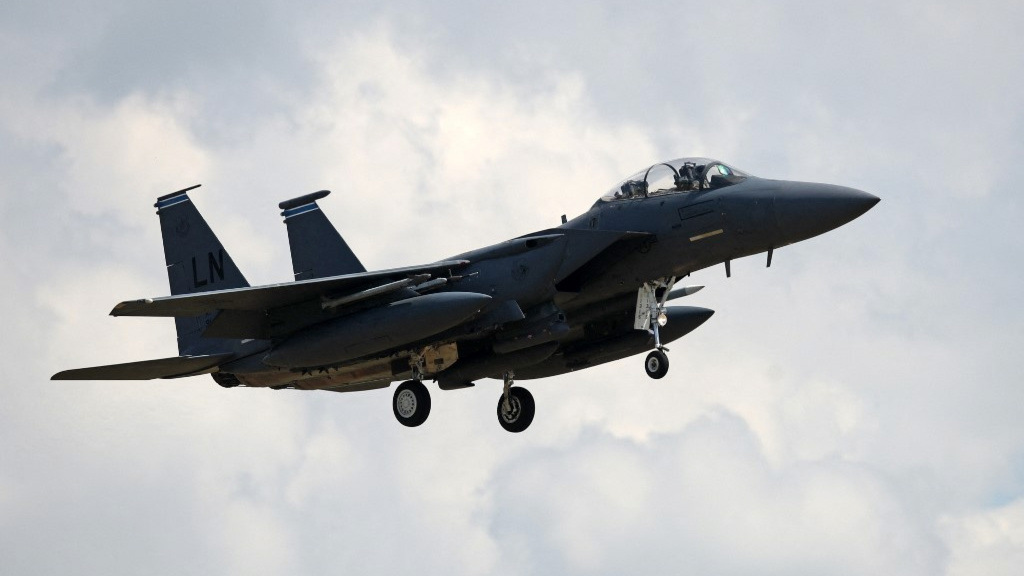
For weeks, public attention has centered on the U.S. use of RAF Fairford in southwest England’s Gloucestershire as a launchpad for bombing missions targeting Iran. Now, a new high-stakes incident has pulled a lesser-known British military installation into the geopolitical crossfire: RAF Lakenheath, a large U.S. Air Force base in eastern England’s Suffolk county.
On Friday, the Islamic Revolutionary Guard Corps (IRGC) announced its air defense systems had intercepted and shot down an American F-35 fighter jet operating over central Iran, claiming the aircraft belonged to a squadron permanently based at RAF Lakenheath. While U.S. military officials later confirmed to media outlets that an American warplane had indeed been downed in Iranian airspace, they corrected the aircraft type, stating it was an F-15E Strike Eagle rather than the stealth fifth-generation F-35. The UK Ministry of Defense has declined all requests for comment from Middle East Eye on the incident and Lakenheath’s operational role.
This is not the first time Iranian officials have claimed a U.S. jet shootdown: in late March, Tehran’s claim of downing an F-35 was immediately denied by Washington. Following Friday’s announcement, Tasnim News Agency, an Iranian outlet with close official ties to the IRGC, published purported photos of the downed aircraft’s wreckage. According to the IRGC, a visible “LN” tail code on the debris confirms the jet was part of the 493rd Fighter Squadron under the 48th Fighter Wing, the permanent U.S. Air Force unit stationed at Lakenheath.
To understand Lakenheath’s role in ongoing U.S. military operations against Iran, it is critical to outline the base’s status. The installation remains property of the UK Ministry of Defense but is leased long-term to the U.S. Air Force, and it hosts the largest American fighter operations on the European continent, centered on the 48th Fighter Wing. Recent weeks have seen a clear and unusual buildup of U.S. air power at the base: five F-35C stealth fighters were spotted landing at Lakenheath on March 24, followed Monday evening by a formation of 12 A-10C Thunderbolt II attack aircraft, commonly nicknamed the “Warthog” for its rugged design. The Warthog is purpose-built as a close air support and “tank buster” platform, and regional military sources report these aircraft have already been used to strike Iranian fast-attack craft and minelaying vessels operating near Iran’s coastline. The U.S. military has refused to confirm or deny these operational reports.
Local anti-war activists monitoring the base added to the picture of heightened activity, stating that on the morning of April 2, they observed more than 20 military aircraft depart Lakenheath in a coordinated launch. A second Suffolk-based base, RAF Mildenhall, which supports global U.S. Air Force logistics and operations, has also seen a sharp spike in activity over the past week. On March 31, two U.S. EA-37B Compass Call electronic warfare aircraft, designed to disrupt enemy communications and air defenses, were photographed landing at Mildenhall.
The growing U.S. use of British bases has come alongside a series of policy shifts from the UK government under Prime Minister Keir Starmer, and growing retaliatory threats from Tehran. In an interview with Times Radio Wednesday, Iranian Ambassador to London Seyed Ali Mousavi confirmed that Tehran is actively evaluating whether to launch retaliatory strikes against British military bases in response to their role in U.S. operations against Iran.
When the U.S.-led campaign against Iran first began, the UK initially blocked American use of the joint UK-U.S. base at Diego Garcia in the Indian Ocean for strike missions. That position changed within 48 hours, when Starmer announced the U.S. would be permitted to use British bases for bomber strikes targeting Iranian missile sites, framing the decision as a purely defensive measure. Two weeks later, Starmer executed a second policy U-turn, approving U.S. use of British bases for broader strikes on Iranian targets to protect commercial shipping transiting the Strait of Hormuz.
Despite Starmer’s repeated concessions to support U.S. military goals, former President and current U.S. leader Donald Trump has repeatedly launched public attacks against the Prime Minister, even going so far as to suggest the decades-long “special relationship” between the two countries is in serious jeopardy.
On Thursday, UK Foreign Secretary Yvette Cooper convened a summit of more than 40 nations in London to coordinate a unified international response to the closure of the Strait of Hormuz, one of the world’s most critical maritime chokepoints. Before the IRGC effectively closed the corridor in early March, roughly 20% of the world’s global oil supply transited the strait annually. Following the summit, Cooper stated that the assembled nations would “comprehensively reject” any attempt by Iran to charge commercial vessels fees for passage through the waterway. She added that Iran must “not be allowed” to “hold the global economy hostage” and confirmed that participating nations had discussed the implementation of new, targeted sanctions intended to pressure Tehran to reverse course.
In a response released Thursday afternoon, Iran’s foreign ministry announced it is working alongside Oman — which declined to attend the London summit — to draft a proposal for a post-war permit system for commercial vessels transiting the strait.
This report was published by Middle East Eye, a media outlet focused on independent, in-depth coverage of the Middle East, North Africa and surrounding regions.