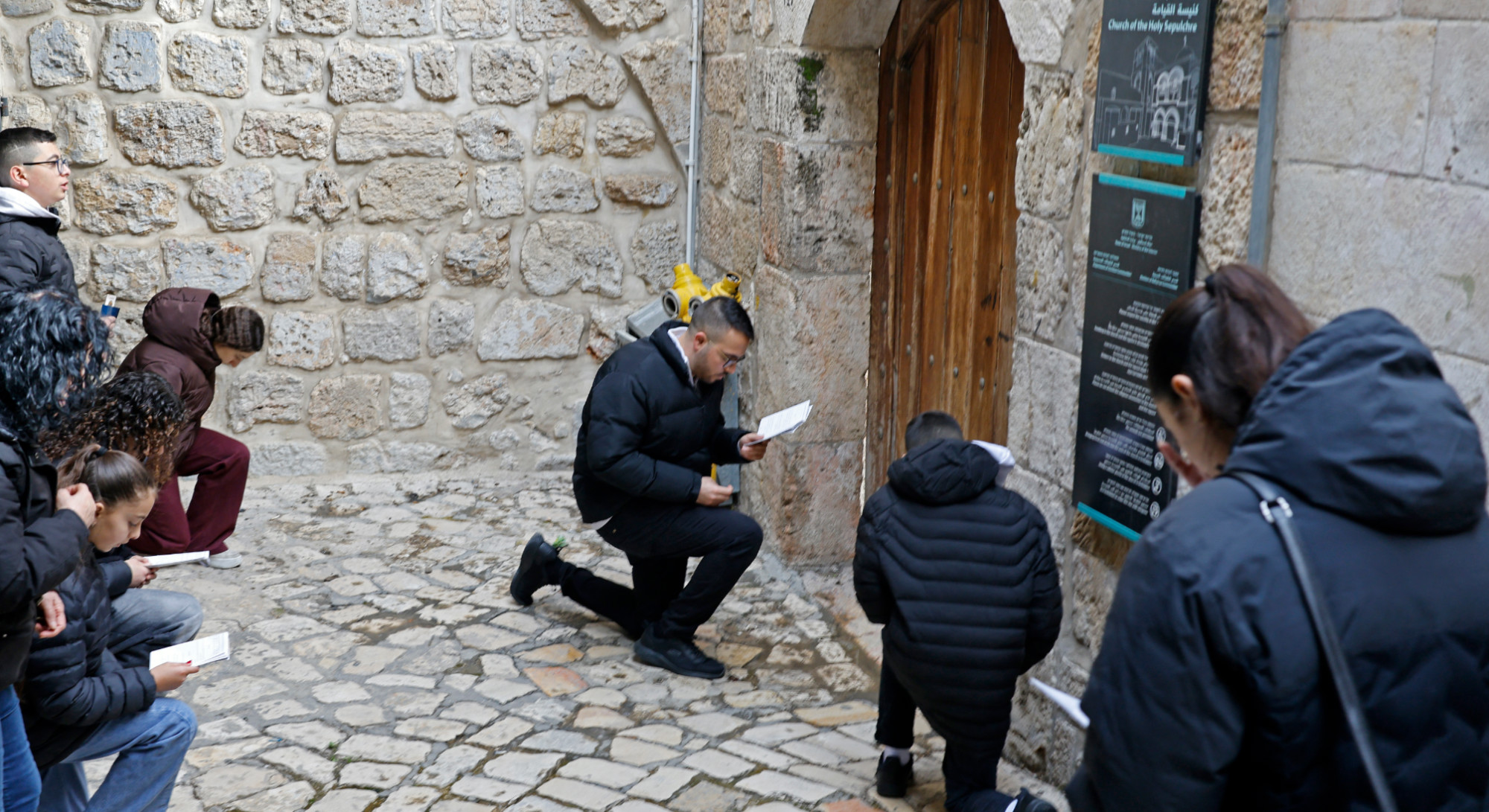
Jerusalem’s holiest Christian site, the Church of the Holy Sepulchre, hosted a dramatically truncated Good Friday service this year, led by the Latin Patriarch of Jerusalem Pierbattista Pizzaballa, after sweeping Israeli access restrictions across the Old City of occupied East Jerusalem barred all public attendance.
Traditionally, the annual Liturgy of the Passion of Christ at the basilica — widely venerated by Christians as the exact location of Jesus Christ’s crucifixion and burial — draws thousands of worshippers from across the globe. This year, however, only roughly 15 clergy members were permitted to participate in the ceremony. The restrictions that shuttered the site to the public also impacted Al-Aqsa Mosque, the third-holiest site in Islam, extending sweeping access limits across all major religious sites in the Old City.
The limited Good Friday service follows a similar scaled-down Holy Thursday gathering led by Pizzaballa at the same church just one day prior. During his remarks at the Good Friday service, the patriarch drew direct links between the restricted worship, rising regional volatility tied to the recent US-Israeli military campaign against Iran, and growing threats to religious freedom in the holy city.
“Outside, the doors of the Holy Sepulchre are closed,” Pizzaballa told the small gathering of clergy. “War has turned this place into a refuge, an inside cut off from an outside weighed down by tension.”
The restrictions on worship come on the heels of a controversial incident that sparked global outcry just weeks earlier, when Israeli forces blocked Pizzaballa from reaching the Church of the Holy Sepulchre for Palm Sunday services. The patriarch and Father Francesco Ielpo, Custos of the Holy Land, were both denied entry to the site — a step that Jerusalem church authorities called unprecedented in centuries. Officials noted that the unprecedented denial of access to senior Catholic leaders set a dangerous precedent and ignored the spiritual sensibilities of more than 2 billion Christians worldwide who turn their focus to Jerusalem during Holy Week.
The incident drew immediate official condemnation from multiple European governments, including France, Spain and Italy. Facing mounting international backlash, Israeli police announced that they would allow a “limited prayer framework” for the Good Friday and Easter observances, though restrictions remained far stricter than in any prior year in recent memory.
Even with the adjusted limited access, many Palestinian Christians have expressed frustration with both the Israeli restrictions and the response from senior church leadership. Speaking to Middle East Eye on condition of anonymity over safety concerns, one Palestinian shopkeeper in the city argued that Pizzaballa should have taken a more public stand against the entry block for Palm Sunday. The shopkeeper said the patriarch should have challenged the blocking Israeli soldiers, and even held open-air prayers in the street if necessary, adding that church leaders were wrong to enter into negotiations with Israeli authorities over access to sites that fall under occupied territory.
Israel has occupied East Jerusalem, including the Old City, since the 1967 Six-Day War, a occupation that the International Court of Justice reaffirmed in a 2024 ruling is illegal under international law. Since the launch of the US-Israeli assault on Iran weeks ago, the Old City has remained almost entirely closed to non-resident visitors. Israeli forces have maintained permanent checkpoints at all entry gates, strictly controlling access to all key religious sites.
Al-Aqsa Mosque has remained fully closed to Muslim worshippers throughout this period, a restriction that was also in place for most of the holy month of Ramadan and during the Eid al-Fitr holiday last month. Israeli officials justify the sweeping access limits by citing public safety concerns linked to potential retaliatory Iranian missile attacks. While debris from intercepted Iranian missiles has caused minor damage in parts of Jerusalem, many Palestinians argue the far-reaching restrictions are actually a deliberate tactic to strengthen Israel’s unilateral control over the occupied Old City, a strategic site with profound global religious significance.
This report was originally published by Middle East Eye, an outlet that provides independent, in-depth coverage of the Middle East, North Africa and surrounding regions.