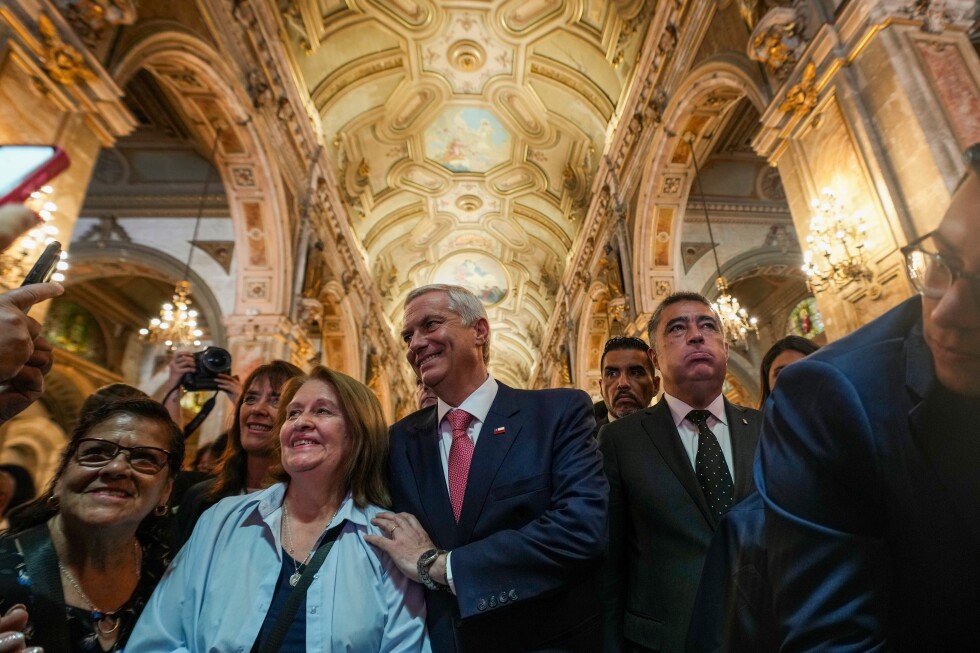
When Chile’s newly inaugurated President José Antonio Kast took office on March 11, he cemented the latest chapter of a growing rightward political shift across Latin America — and brought open, devout religious conservatism to the forefront of the region’s most secular major nation.
The 60-year-old former lawmaker, a father of nine and practicing Catholic deeply embedded in the international Schoenstatt apostolic movement, has built his political brand around unapologetic conservative values that have put progressive advocacy groups on high alert. Kast, who first ran for president in 2021 and lost to Gabriel Boric, secured a 58% majority in his 2025 campaign by centering pledges to crack down on rising crime and deport undocumented immigrants. But his long-held positions on social issues — opposition to abortion, same-sex marriage, and even the sale of emergency contraception dating back to 2009 — have defined concerns about what his presidency will mean for marginalized groups and social progress in Chile.
Kast’s ascent dovetails with a broader regional trend that has brought conservative leaders including El Salvador’s Nayib Bukele and Argentina’s Javier Milei to power in recent years, each riding popular discontent with established left-leaning governance to advance agendas focused on security and economic restructuring. Kast’s policy alignment also overlaps in key areas with that of former U.S. President Donald Trump, whose administration openly welcomed his electoral victory.
To understand how Kast’s faith intersects with his politics, it is necessary to first contextualize Chile’s shifting religious landscape. Across Latin America, Catholic affiliation has plummeted over the past three decades: a 2024 Latinobarómetro report found the regional share of Catholics fell from 80% in 1995 to just 54% in 2024. In Chile, the shift is even starker: only 45% of the population identifies as Catholic today, while 37% claim no religious affiliation and 12% identify as Protestant.
Luis Bahamondes, a religion scholar at the University of Chile, explained that the Catholic Church, once one of Chile’s most trusted institutions in the 1990s, saw public confidence collapse amid widespread social transformation and a string of high-profile sexual abuse scandals. “It became one of the most questioned institutions and one of the least trusted,” Bahamondes noted. Still, he added, conservative social values rooted in religious tradition remain deeply embedded in Chilean culture. Chile was the last Latin American nation to legalize divorce, doing so only in 2004, and resistance to comprehensive school sex education persists today. “There are still concepts that resonate strongly in Chilean society — such as family and marriage — which carry a strong religious weight,” Bahamondes said. “There is often talk of a crisis of Catholicism, but what is in crisis is the institution, not the belief itself.”
That disconnect between institutional Catholicism and persistent personal belief is exactly where Kast’s connection to the Schoenstatt movement resonates. Founded in Germany in 1914 at the outbreak of World War I, Schoenstatt is a Catholic apostolic movement centered on devotion to the Virgin Mary, which first arrived in Chile’s coastal city of Valparaíso in 1947. The movement has since expanded across the country, building more than 20 shrines and counting roughly 10,000 followers, including Kast and his wife.
Rev. Gonzalo Illanes, director of the Schoenstatt movement in Chile, emphasized that the group is not a political organization, but rather a faith formation community built on three core pillars: personal spiritual development, the integration of faith into daily life, and devotion to the Virgin Mary. While the movement shares Kast’s position that life must be protected from conception to natural death, it remains committed to open dialogue with those who hold different views, Illanes said. “Schoenstatt, like the Catholic Church, is not a political movement but a space for formation, faith and transcendence,” he explained. “The challenge is how to move forward. Not to stop talking.”
For Kast’s supporters, his open faith is a key source of confidence, not a cause for concern. Jorge Herrera, a Schoenstatt member and Catholic who voted for Kast, called the new president a capable leader with a clear plan for Chile that the country desperately needed. “He’s a president who gives me a lot of confidence,” Herrera said. “I share his values.” He echoed Schoenstatt’s core belief that every person has a unique divine mission, and noted that while he aligns with Kast’s anti-abortion stance, it was the president’s broader economic and security vision that won his support.
Kast’s appeal even extends to conservative circles beyond Chile’s borders. In Mexico, where a left-leaning national government has overseen abortion decriminalization in more than half of the country’s states, conservative activists see Kast as a welcome model. “It gives me confidence that he publicly acknowledges being inspired by a Christian faith,” said Rodrigo Iván Cortés, president of a Mexican conservative advocacy group. “That does not mean that he wants to impose his faith on others, but simply that he professes it.”
But for progressive and rights advocacy groups, Kast’s inauguration brings well-founded fears of gradual erosion of hard-won social rights. Unlike Argentina’s Milei, who immediately implemented sweeping rollbacks such as a ban on gender-affirming care for minors, Kast is not expected to reverse existing policies overnight. But researchers warn that a slowdown in progress, weakening of supportive public policies, and growing legitimacy for anti-rights rhetoric could still cause lasting harm.
“There are valid reasons for concern, though not necessarily for an immediate rollback as seen with Milei,” said Cristian González Cabrera, an LGBTQ-rights researcher at Human Rights Watch. “The risk with Kast could be more gradual: slowing progress, weakening public policies and legitimizing anti-LGBTQ+ rhetoric.”
For reproductive rights advocates, early signals from Kast’s administration are already worrying. One of his first actions in office was a 3% across-the-board budget cut, and his new cabinet includes openly religious leaders heading the women’s and health ministries. Catalina Calderón, chief advocacy officer at the Women’s Equality Center, pointed to recent cuts to social and reproductive rights programs under Milei in Argentina as a warning sign for Chile. “Across the region, we have seen that when leaders from the political wing to which Kast belongs take office, one of the first things that happens is a rollback of individual rights and women’s rights,” Calderón said. “How that [religious] vision could shape the administration is something that should be watched closely.”