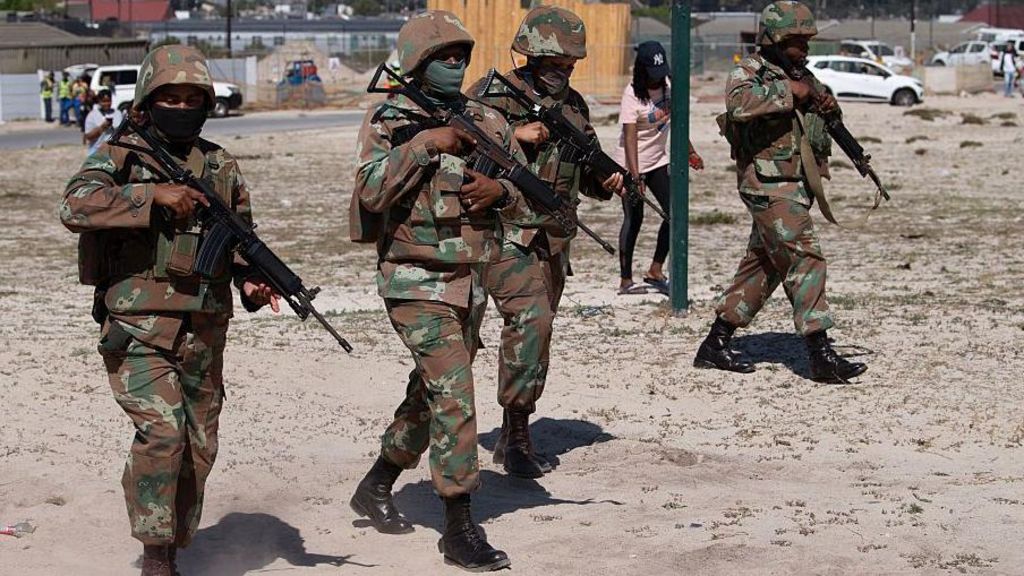
Facing a persistent national crisis of staggering violent crime rates, South Africa has formally rolled out a one-year military deployment across five high-risk provinces to support overstretched local police forces grappling with organized gang activity and unregulated illicit mining. The deployment, first announced by President Cyril Ramaphosa earlier in 2026, will see 2,200 soldiers deployed to the five of the country’s nine provinces that have been hit hardest by widespread criminal violence. An initial advance contingent of troops was sent to targeted high-gang areas in Gauteng province – home to South Africa’s largest city, Johannesburg – back in March, with the main full deployment kicking off across Eastern Cape, Free State, North West and Western Cape starting April 1, 2026, for a 12-month mandate. The core stated goal of the operation is to reestablish public order in communities that have been overwhelmed by persistent lawlessness. But the deployment has already sparked sharp debate over its long-term effectiveness and the appropriateness of using the military for domestic civilian policing.
South Africa’s ongoing crime epidemic has reached alarming levels, with one of the highest intentional homicide rates in the world. The most recent official crime statistics, covering the final quarter of 2025 from October through December, show that an average of 71 people are killed across the country every day. Illicit, unregulated mining and intergenerational gang violence are two of the primary drivers of this bloodshed, particularly in densely populated urban and semi-rural hotspots across the affected provinces.
Interviews with residents of Eldorado Park, a Johannesburg suburb that was part of the initial March deployment and targeted for its chronic gang violence, reveal sharply divided views on the military’s presence. Many locals expressed deep scepticism that the deployment would deliver any lasting change to the dangerous conditions they face daily. Leola Davies, a 74-year-old retired resident, described the suburb as an unlivable “hell-hole”, saying “Sodom and Gomorra have nothing on this place. I stay indoors all day because I just don’t want to be the next victim. Things are getting worse.” Elviena le Roux, a mother of three living in the area, said she fears the military presence will only escalate tensions rather than improve safety, predicting it would “make the violence worse”. Even some residents who welcomed the visible military patrols warned that the current 12-month mandate is not enough to bring permanent change. Ronald Rabie, a 56-year-old father of three, noted that the visible patrols have created a temporary sense of safety for local families, but warned that “Once they leave, things return to chaos – they need to be here permanently.”
This latest deployment marks the third time Ramaphosa has called on the military to assist with domestic security challenges during his presidency. In 2023, more than 3,000 soldiers were deployed for six months to target illicit mining operations across the country. In July 2021, troops were sent into major urban centers to put down deadly widespread rioting that broke out following the arrest of former president Jacob Zuma. Under current South African law, military personnel have very limited authority to arrest civilians, and are required to turn any detained suspects over to police as quickly as possible.
Security analysts and criminologists have raised widespread concerns about the deployment, echoing many residents’ doubts about its long-term impact. Experts point out that the South African military is trained for combat operations, not the community-centered trust-building policing that is required to reduce violent crime over time. The legacy of apartheid also looms large over the deployment: the former white minority apartheid regime regularly used the military to enforce repressive rule over Black South African communities, a history that continues to shape widespread suspicion of uniformed soldiers operating in residential neighborhoods. Guy Lamb, a leading South African criminologist, told the BBC he remains unconvinced the deployment will deliver sustainable improvements in safety. “Soldiers are not designed to engage in policing, but rather to engage in combat and use maximum force,” he explained, warning “There’s danger that they will escalate situations or respond very aggressively in tense situations.”
Lamb pointed to the military’s controversial conduct during the Covid-19 pandemic as a cautionary precedent. At that time, troops were deployed to enforce national lockdown curfews and movement restrictions, and the operation drew widespread international and domestic condemnation after multiple reports emerged of excessive force, unlawful detention, and harassment of ordinary civilians. While national authorities have expressed confidence that the new deployment will reduce crime rates, Lamb argued that without targeted action to address the root causes of violent crime in high-risk communities, any gains will be temporary. “Without a dedicated plan to try and address why crime is so violent in these sort of places, there was a strong likelihood it would flare up again once the soldiers leave,” he said, adding “So we’re likely to see this happening into the foreseeable future, because this plan of addressing what are the root causes of crime in these areas is not in place.”