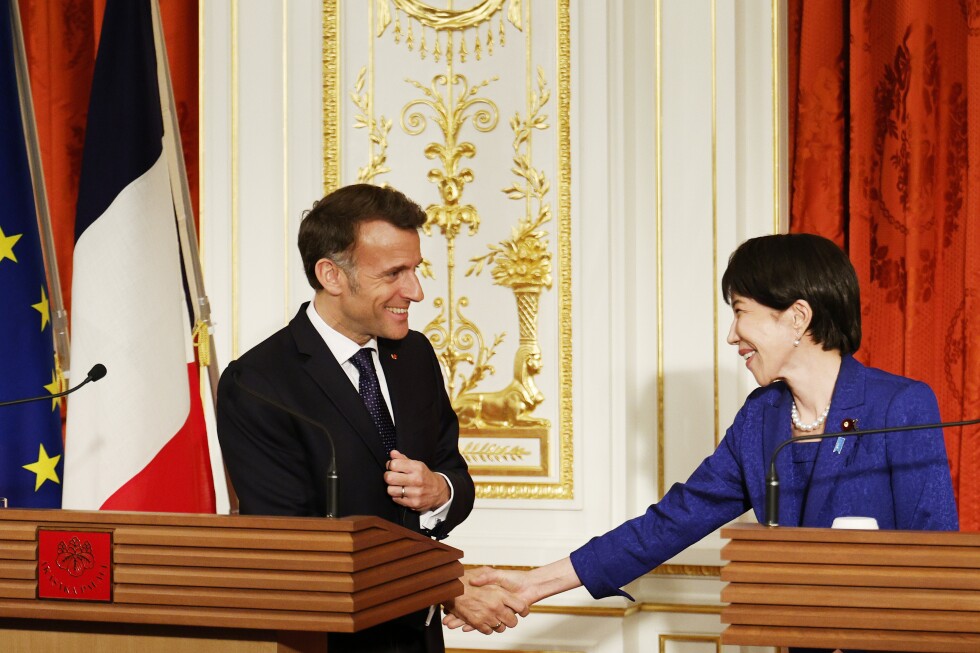
During an official state visit to Tokyo on Wednesday, French President Emmanuel Macron publicly called for an immediate ceasefire to end escalating conflict in the Middle East, alongside joint commitments with Japanese Prime Minister Sanae Takaichi to deepen cross-sector bilateral cooperation spanning defense, critical resources, nuclear energy and space exploration.
Following closed-door bilateral talks, the two leaders outlined shared foundational principles during a joint press conference held at Tokyo’s Akasaka Palace. Macron emphasized that both Paris and Tokyo are united in their commitment to upholding international law, a rules-based global order, and shared democratic values. “This is why … we both advocate for a return to peace, a ceasefire, calm, and free passage through the Strait of Hormuz,” Macron stated. Takaichi echoed this position, noting the two leaders reached consensus on the urgent need to de-escalate regional tensions, guarantee unimpeded access through the strategically critical waterway, and protect global supply chain stability. Amid growing geopolitical uncertainty across the globe, Takaichi noted that strengthening ties and collaboration between Japan and France carries particular strategic weight.
Beyond regional diplomacy, the summit delivered concrete progress on multiple long-standing bilateral cooperation initiatives. A day prior to the leaders’ meeting, Japanese Defense Minister Shinjiro Koizumi and his French counterpart Catherine Vautmir signed a formal road map outlining expanded defense cooperation through 2030, centered on increasing joint military exercises and personnel exchanges across the Indo-Pacific. In a separate signing ceremony, the two nations’ trade ministers formalized an agreement to collaborate on joint rare earths development projects. Rare earth elements are critical components for high-performance heat-resistant magnets used in defense systems and electric vehicle batteries, a market currently dominated by Chinese production. The two leaders also confirmed a new partnership to advance fast reactor technology and nuclear fuel recycling, an area where Japan has faced repeated technical and regulatory setbacks in recent years.
The bilateral summit comes amid a shifting geopolitical landscape in the Indo-Pacific, where Japan and France have steadily ramped up defense cooperation over the past decade. France maintains permanent military forces, civilian populations and economic assets across its Indo-Pacific overseas territories, and has positioned itself as a key security partner for regional democracies seeking to counter balance growing Chinese influence across the region.
Macron’s visit to Japan also unfolded hours after U.S. President Donald Trump made controversial remarks shifting responsibility for security of the Strait of Hormuz to regional consumer nations. “That’s not for us. That’ll be for France and whoever’s using the strait,” Trump stated overnight. The U.S. president has publicly criticized European allies for what he frames as insufficient support for U.S.-backed Israeli military operations, and specifically called out France for being “very unhelpful” in the conflict. Macron did not address Trump’s comments during his prepared remarks at Wednesday’s press conference, where reporters were not given the opportunity to ask questions.
Looking ahead to the final day of Macron’s Tokyo visit on Thursday, he and Takaichi are scheduled to tour a Japanese private firm specializing in innovative space debris removal technology, a reflection of the two nations’ expanding collaboration in the space sector. Following the site visit, Macron will hold a formal courtesy meeting with Japan’s Emperor Naruhito and attend an official palace luncheon, before departing for South Korea to continue his East Asian diplomatic tour.