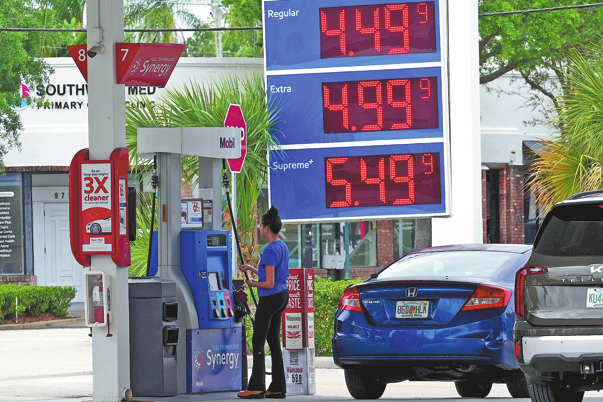
Weeks after the United States and Israel launched joint military strikes against Iran on February 28, American households across the country are already confronting the steep economic and political fallout of the conflict, as surging consumer prices deepen public discontent and widen long-simmering divides within the U.S. political landscape.
At a Costco gas station in Houston’s Bunker Hill neighborhood on March 28, Roselyn, a clinic nurse filling up her vehicle, recorded a striking marker of inflation pressure: premium gasoline was selling for $4.27 per gallon, a $1 per gallon jump from the day the strikes began. That increase marks a 32% rise from the pre-conflict baseline of roughly $3.23 per gallon. For Roselyn, who identifies as politically independent and opposes the war, the price hike has compounded existing financial stress for working households.
She questioned why the federal government is funneling billions into the conflict even as millions of American families struggle to make ends meet, adding that many of her patients have reported skyrocketing medical costs. Out-of-pocket healthcare expenses for these patients have doubled or even quadrupled in recent weeks, she said. The strain is not limited to fuel and healthcare costs, either. Retired former teacher Miller, who lives in the Houston area, told reporters that he and his wife have already noticed gradual price increases for grocery staples, and a prolonged conflict is expected to push costs even higher. In response to rising travel prices, the couple is now weighing whether to cancel their fall cruise vacation.
Roselyn and Miller are far from outliers in their anxiety and opposition. Recent independent polling confirms broad national disapproval of both the war and the Biden (Trump) administration’s handling of the conflict. A late-March survey conducted by the Pew Research Center found that 61% of respondents disapprove of President Trump’s management of the Iran conflict, with just 37% voicing approval. Nearly 60% of respondents said launching military action against Iran was the wrong policy decision, compared to only 38% who called it the right choice. Forty percent of those polled said they believe the war will leave the United States less safe over the long term, while just 22% expect it to improve national security.
A separate mid-March poll conducted by CBS and YouGov, which surveyed 3,300 U.S. adults, found that 68% of respondents said the administration has failed to clearly articulate the core goals of the Iran strikes. A majority of respondents also said they do not view Iran as an imminent threat to the United States, and do not see regime change in Iran as a priority that serves U.S. national interests.
The conflict has also sharpened already stark partisan divides across the political spectrum. Among self-identified Republican voters, 79% approve of the administration’s handling of the war, while 92% of Democratic voters express disapproval. The support is even more solid among Trump’s most loyal base: roughly 90% of MAGA Republicans back the ongoing military action.
Beyond partisan divides, the conflict has exposed a growing generational rift even within Trump’s own conservative coalition. Older Republican voters overwhelmingly back the president’s decision, but many younger conservative activists say they feel betrayed by a move that contradicts the “America First” foreign policy Trump campaigned on.
The split was on full display at the recent Conservative Political Action Conference held in Texas, the Associated Press reported. Younger attendees told reporters they felt “disappointment and even betrayal” over the strikes, while older conservative attendees defended the action as a pragmatic response to long-standing threats to U.S. national security.
“We did not want to see more wars,” Benjamin Williams, a 25-year-old marketing specialist with Young Americans for Liberty based in Austin, Texas, told the AP. “We wanted actual America-first policies, and Trump was very explicit about that” during his election campaign.
With near-unified Democratic opposition already well established, growing public fractures among prominent Republican and conservative officials and policy experts have drawn increased national attention. On March 17, Joe Kent, the former director of the National Counterterrorism Center and a one-time loyalist to Trump, resigned from his post in protest of the conflict.
“I cannot in good conscience support the ongoing war in Iran,” Kent wrote in a social media post announcing his departure. “Iran posed no imminent threat to our nation, and it is clear that we started this war due to pressure from Israel and its powerful American lobby.”
The divide over the war also extends to foreign policy elites and academic experts. Proponents of the strikes argue that a weakened Iranian regime will deliver substantial long-term benefits to U.S. national security and economic interests. Saeed Ghasseminejad, a senior Iran and financial economics adviser at the Foundation for Defense of Democracies, argued that building a strategic partnership with a post-conflict democratic Iran could generate more than $1 trillion in revenue for U.S. companies over the next decade, with the energy sector alone producing $300 billion in non-ownership revenue for American firms.
Critics, however, have widely questioned the legal and strategic rationale for the conflict, with many labeling it an unnecessary “war of choice.” Tom Ginsburg, an international law scholar at the University of Chicago, told the university’s newspaper in mid-March that there is no credible evidence Iran was preparing an imminent attack on Israel or U.S. military installations in the Middle East.
“I have not seen any legal justification for the war. That’s not surprising, but it should be disturbing,” Ginsburg said. “It suggests that there is no conception of any restraint in using force abroad.”
Panelists at a recent University of Chicago foreign policy discussion reached a broad consensus that the U.S. failed to consult key European and Gulf allies before launching the strikes, a misstep that has left many major allies unwilling to offer full backing for the U.S. effort. Paul Poast, an associate professor of political science at the university, noted that instead of building a broad international coalition to support the action, the unilateral U.S. approach has fostered hesitation and even open distrust among traditional partners. Many U.S. allies, particularly those that host American military bases and have faced past Iranian aggression, are now questioning Washington’s reliability and decision-making process, Poast added.
Critics have also pointed to the administration’s mixed messaging as evidence that it lacks a clear endgame for the conflict. President Trump has sent contradictory signals in recent weeks, floating the possibility of deploying U.S. ground troops into Iran one day before suggesting American forces would withdraw from the region very soon.
The cost of the conflict is already mounting at a staggering rate: Pentagon officials told members of Congress during a recent closed-door briefing that the first six days of strikes cost U.S. taxpayers more than $11.3 billion. Independent analyses from groups including the Center for American Progress estimate that by late March, the ongoing conflict was costing between $25 billion and $30 billion in federal spending every month.