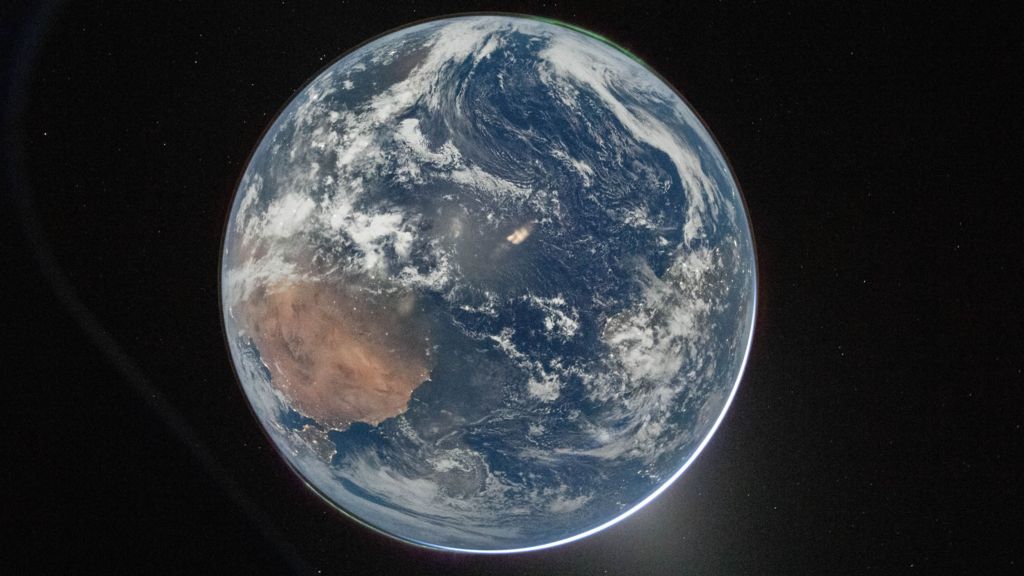
Fifty-four years after the final Apollo lunar mission, NASA’s Artemis II program has delivered a breathtaking new look at our home planet, marking a historic milestone in human deep space exploration. The first crewed mission beyond low Earth orbit since 1972 has reached the halfway point between Earth and the Moon, and NASA has released the first batch of high-resolution Earth photographs captured by the mission’s crew aboard the Orion capsule.
The stunning shots were captured by mission commander Reid Wiseman shortly after the team completed a critical final engine burn that locked the Orion spacecraft onto its trans-lunar trajectory. By 07:00 BST on mission day two, NASA’s real-time tracking dashboard logged the craft at 142,000 miles (228,500 km) from Earth, and just 132,000 miles away from its destination. This milestone was achieved 2 days, 5 hours, and 24 minutes after the mission’s launch from Florida’s Kennedy Space Center, and astronaut Christina Koch shared that the entire crew reacted with a shared outburst of excitement when the milestone was confirmed.
The first released image, dubbed *Hello, World*, offers a striking perspective of Earth that can only be achieved from deep space. The frame captures the deep blue expanse of the Atlantic Ocean, edged by the soft glowing halo of Earth’s atmosphere. The shot is taken during a solar eclipse from the capsule’s perspective, as Earth passes directly between Orion and the Sun, and vivid green auroras are visible at both the north and south poles. Earth appears upside down in the frame, with the western Sahara and Iberian Peninsula visible on the left side of the shot and the eastern coast of South America on the right; the bright celestial body visible in the bottom right corner has been confirmed by NASA as Venus.
A second shot, titled *Artemis II Looking Back at Earth*, was taken through one of Orion’s four primary observation windows, offering a wider panoramic view of our planet hanging in the black of deep space. A third image captures the so-called “terminator” — the sharp dividing line between night and day as it cuts across Earth’s surface. A fourth final shot captures Earth fully eclipsing the Sun, with the warm twinkle of human-made city lights glowing across the dark night side of the planet.
The historic trans-lunar injection burn that set Orion on its path was completed in the early hours of Friday, pulling the craft out of its initial Earth orbit and setting the four-person crew on a more than 200,000-mile journey to the Moon. The mission is following a looping flight path that will carry the crew around the far side of the Moon, with the lunar pass scheduled for April 6, before the craft returns to Earth for a Pacific Ocean splashdown on April 10.
In communications with mission control in Houston, mission specialist Jeremy Hansen shared that immediately after the burn was completed, the entire crew was “glued to the windows” capturing the view, saying “We are getting a beautiful view of the dark side of the Earth, lit by the Moon.” Commander Wiseman even joked with controllers after the shooting session, asking for instructions to clean the spacecraft’s windows after all the pressing and handling from eager astronauts. Wiseman also noted that he initially struggled to adjust his camera settings for the long-distance shot, comparing the challenge to taking a photo of the Moon from a backyard on Earth — but he soon worked through the issue to capture the crisp, vivid images released this week.
To mark the milestone, NASA also released a side-by-side comparison of the 2026 Artemis II view of Earth and an equivalent shot captured by the 1972 Apollo 17 mission, the last human mission to the lunar surface. In a social media post accompanying the comparison, NASA wrote, “We’ve come so far in the last 54 years, but one thing hasn’t changed: our home looks gorgeous from space!”