In the South African township of Tsakane, 84-year-old Gladys Khoza had for years been separated from the simple joy of seeing her family — not due to travel restrictions or distance, but because age-related cataracts had robbed most of her vision. Today, that separation is over. Khoza is one of 133 South Africans who regained their sight during a two-weekend marathon of free cataract surgeries held at two regional hospitals near Johannesburg last month.
When a nurse removed her post-operative bandage one day after the quick procedure, Khoza stared at the newly clear world around her and whispered in delighted disbelief, “Wow!” When the nurse asked if she could make out her form, Khoza replied with a wide grin, “Very well.”
For Khoza, who faced total blindness in one eye and long-standing impairment in the other, the 15-minute routine surgery has transformed her daily quality of life. After months of longing, she can once again visit with loved ones, read her cherished Bible, and enjoy the late-night soap operas she loves — small pleasures millions of people take for granted.
Cataracts, a condition where the eye’s natural lens becomes clouded over, is the world’s leading cause of curable blindness, most commonly affecting older adults. The straightforward surgery replaces the clouded lens with an affordable artificial implant, permanently restoring vision. Yet for patients relying on South Africa’s public health system, even this simple procedure can require years-long waits on official waiting lists. Many of the patients selected for this month’s surgical marathon had been waiting for clear vision since 2019.
For Dr. Tebogo Fakude, one of the volunteer ophthalmologists who participated in the initiative, the work carries deep personal meaning: his own mother lived with blindness before her passing. “Restoring sight is beautiful,” he explained. “It doesn’t just fix a person’s eyes — it alleviates the depression that comes with losing your vision, and it eases the constant feeling that you are a burden to your loved ones.”
Global health data underscores the scale of unaddressed need for this life-changing care. According to the World Health Organization (WHO), more than 2 billion people worldwide live with some form of vision impairment, and half of those cases could be prevented or corrected with accessible treatment. Of the nearly 100 million people globally living with operable cataracts, half still lack access to the surgery they need. A March 2026 study published in *The Lancet* found that the gap is far wider in Africa, where 75% of people with cataracts never receive corrective surgery.
In South Africa, backlogged elective surgery has emerged as a major public health challenge. Government-run public hospitals serve more than 75% of the country’s 62 million residents, but stretched resources force facilities to prioritize emergency and life-saving procedures over routine elective care like cataract removal. Currently, South Africa has a national backlog of more than 240,000 people waiting for cataract surgery, with more than 35,000 people living with cataract-related blindness in Gauteng province alone — the country’s most populous region, where the recent surgery marathon was held. The country sees roughly 300,000 new cataract diagnoses each year, according to Fakude.
To chip away at this growing backlog, South Africa’s Department of Health launched targeted surgical marathons, first held on Nelson Mandela International Day in 2023 to honor the legacy of the country’s first Black democratic president. The initiative has since grown into an ongoing public-private partnership that hosts multiple events annually, focused on clearing backlogs for different high-need procedures. Past marathons have addressed prostate conditions, cleft palate repairs, and gastric issues, with cataracts selected as the latest priority given the scale of unmet need.
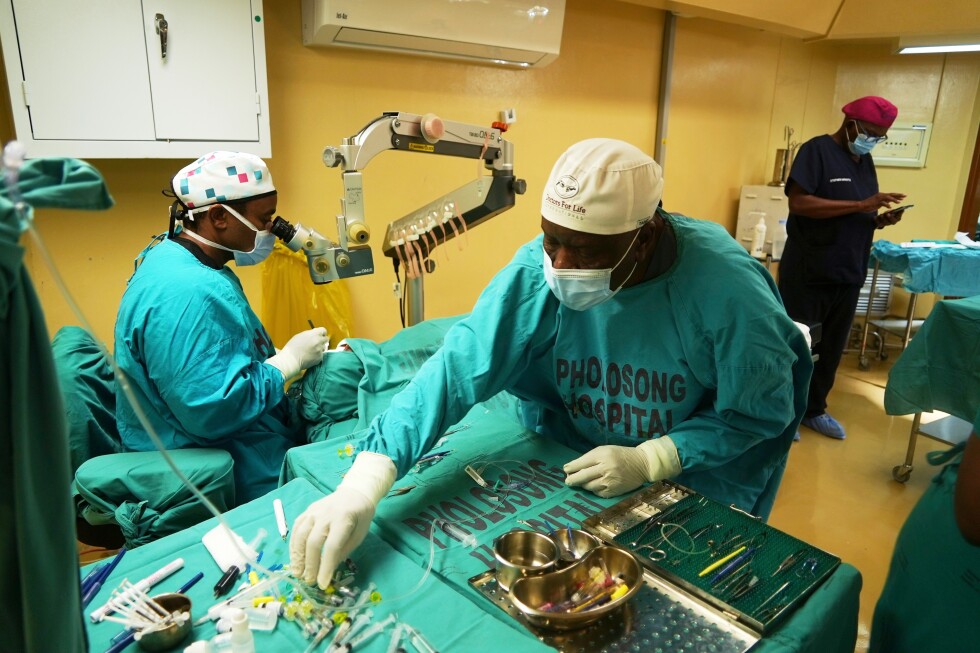
During the recent cataract event, teams of volunteer surgeons worked at a steady pace to treat as many patients as possible. At Pholosong Regional Hospital, a new patient entered the operating theater roughly every 30 minutes, with soothing gospel music playing over speakers to keep the medical team focused and energized. At peak times, two surgeons operated concurrently to speed up the flow of procedures. Surgeons made tiny incisions through a surgical microscope, removed the clouded lens, and inserted the new artificial implant — all in less than 20 minutes per patient. By the end of the two weekends, the team had completed 133 procedures, including 60 on the final weekend alone.
Seventy-two-year-old Molefe Mokoena, who had lived with cataracts for four years before his surgery, shared the widespread excitement among patients. “I want to see my great-grandchildren,” he said. “I want to drive my car again, and I’m just so happy about this second chance.”
The WHO classifies cataract surgery as one of the most cost-effective medical interventions in global health, noting that it does not just restore vision — it restores patients’ independence, dignity, and access to economic and social opportunities. South African health officials have pledged to expand the surgical marathon model to continue clearing backlogs and expand access to life-changing care for low-income and public health patients across the country.