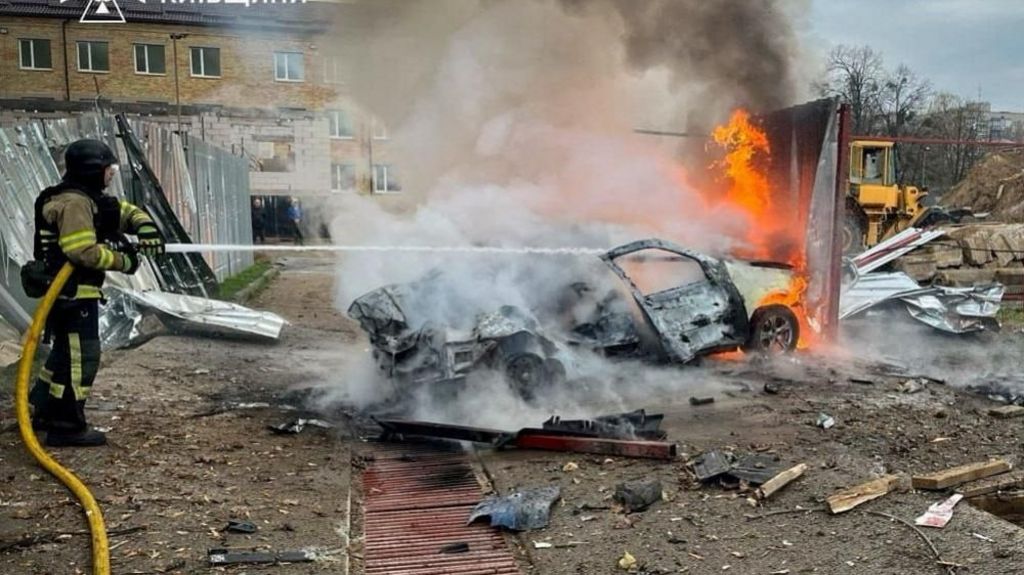
Fresh large-scale missile and drone strikes across multiple Ukrainian regions have sent civilian casualties soaring and thrown a proposed Orthodox Easter truce into tatters, with Ukrainian President Volodymyr Zelensky directly blaming Moscow for choosing deliberate escalation over holiday calm.
The wave of coordinated attacks, carried out with hundreds of aerial weapons, killed at least six civilians and wounded 40 more across the country. Major daytime strikes, once an uncommon tactic in the two-year conflict, have grown increasingly frequent in recent weeks, coinciding with a major stall in US-brokered peace talks after the Trump administration redirected its diplomatic and military focus to the ongoing conflict in the Middle East.
The scope of damage stretched across the nation. In Korosten, located in Ukraine’s Zhytomyr region west of the capital Kyiv, an entire row of residential homes was leveled, forcing emergency rescue teams to dig through rubble for trapped survivors. Footage captured in Kyiv Oblast shows an incoming drone careening directly into a multi-story apartment block before slamming into the structure and igniting a large fire. In northeastern Ukraine’s Kharkiv, one of the country’s largest cities, a woman was killed and multiple other residents suffered critical injuries in what Kharkiv’s mayor described as “one of the biggest” single-day strikes the city has endured since the full-scale invasion began.
The attacks came just days after Zelensky proposed a temporary bilateral truce for the upcoming Orthodox Easter holiday, which is celebrated next weekend by followers in both Ukraine and Russia. “The Russians have only intensified their strikes, turning what should have been silence in the skies into an Easter escalation,” Zelensky wrote in a post on X. The Ukrainian leader added that the truce offer remains open if Moscow agrees to the pause, and he has already communicated this stance to US special envoys Steve Witkoff and Jared Kushner. US-mediated direct peace talks between the two warring sides have already been postponed twice, with Moscow confirming negotiations are currently “on hold.” Zelensky has extended an invitation for the US delegation to visit Kyiv first before traveling to Moscow to restart momentum for diplomatic progress.
In recent days, Ukraine has carried out its own series of long-range deep strikes targeting strategic infrastructure inside Russian territory, with a particular focus on energy facilities along Russia’s northern coast. The key port of Ust-Luga has been hit by repeated drone attacks, forcing Russian authorities to temporarily suspend export operations through the terminal. Over the weekend, a senior advisor to Kyiv’s defense ministry confirmed that an overnight strike hit an industrial plant in Togliatti, southern Russia, that manufactures rubber components for Russian military equipment. Additional Ukrainian strikes targeted a power substation in Taganrog on the Sea of Azov, with falling debris damaging a nearby vessel. Russian local officials confirmed the attack in Togliatti, noting one industrial worker was injured by shrapnel and a nearby residential building sustained structural damage.
While Zelensky aligned with British intelligence assessments that the eastern frontline is currently the most favorable position for Ukraine in 10 months, as Russian ground advance has slowed sharply and the threat of a full Russian breakthrough has receded, the country faces growing headwinds on multiple fronts. Zelensky confirmed Ukraine is currently prioritizing holding existing frontline positions rather than launching large-scale territorial offensives of its own.
Kyiv now faces two critical emerging risks tied to the Middle East conflict. First, a potential war-induced disruption to global oil supplies would drive up fuel prices and create severe scarcity for Ukraine, which relies heavily on diesel to power frontline tanks and military vehicles. Conversely, higher global energy prices benefit Russia, which can generate increased revenue from energy exports to fund its domestic weapons production and military payroll. Second, Ukraine faces a looming potential shortage of US-made defensive interceptor missiles capable of shooting down Russian ballistic missiles, as a large share of the US’s Patriot missile stockpile has been redirected to support operations tied to the Middle East conflict.
“The longer the war in the Middle East continues, the greater the risk that we will receive less weaponry,” Zelensky told journalists in Kyiv. “This is extremely difficult – perhaps one of the most challenging tasks.”