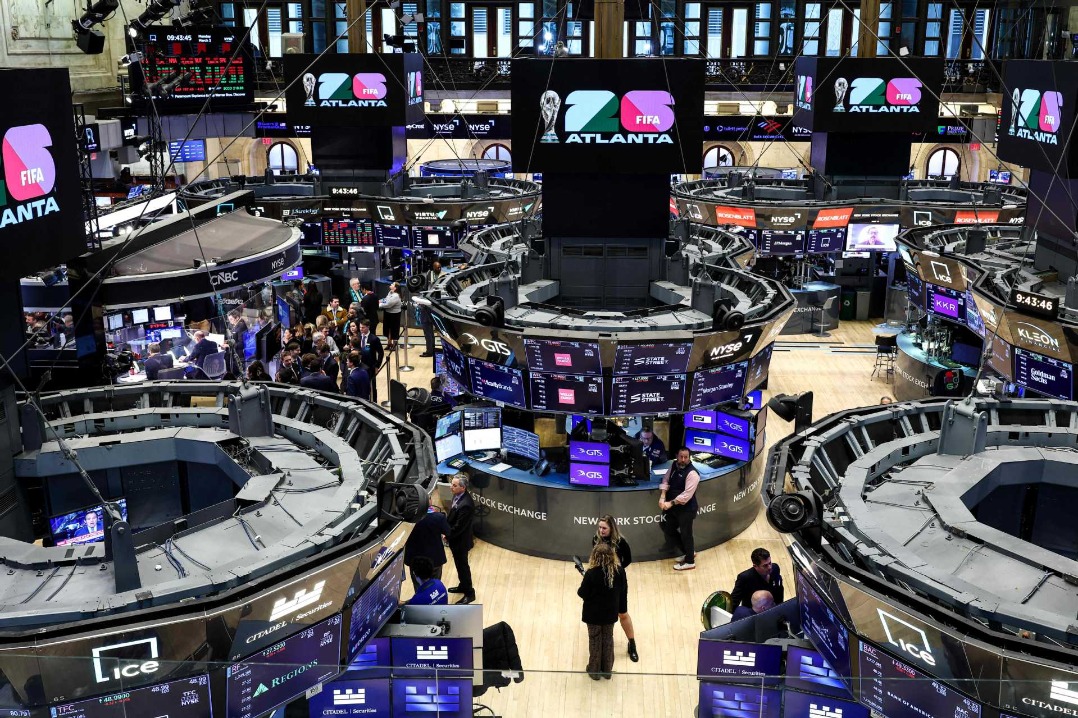
Wall Street registered modest gains during Tuesday’s trading session as investors balanced concerns over escalating oil prices with anticipation for the Federal Reserve’s imminent policy decision.
The Dow Jones Industrial Average advanced 0.1% to close at 46,993.26, while the S&P 500 climbed 0.25% to 6,716.09. The technology-heavy Nasdaq Composite Index outperformed with a 0.47% gain, finishing at 22,479.53.
Market performance displayed sector divergence, with eight of the eleven primary S&P 500 sectors closing positively. Energy and consumer discretionary sectors emerged as frontrunners, posting gains of 1.02% and 1% respectively. Conversely, healthcare and consumer staples sectors faced downward pressure, declining 0.92% and 0.48%.
Commodity markets remained highly volatile as West Texas Intermediate crude futures for April delivery surged 2.9% to settle at $96.21 per barrel. The global benchmark Brent crude followed suit, closing at $103.42 per barrel. This sustained oil price escalation presents complex challenges for central banks contemplating monetary policy normalization.
The Federal Reserve commenced its two-day policy meeting amid significantly tempered expectations for near-term interest rate reductions. Market analytics from the CME FedWatch tool indicate a 99% probability that the central bank will maintain current rate levels.
Corporate developments included Nvidia’s annual developer conference, where CEO Jensen Huang announced multiple strategic partnerships and projected $1 trillion in chip sales through 2027. Despite this optimistic forecast, Nvidia shares declined 0.69%.
Amazon demonstrated strength with a 1.63% ascent following CEO Andy Jassy’s internal comments suggesting artificial intelligence could potentially double Amazon Web Services’ previously projected sales.
Tencent Music Entertainment Group experienced substantial volatility, with its US-listed shares plummeting nearly 25% after reporting disappointing fiscal fourth-quarter results that failed to meet investor expectations.
The airline sector defied rising jet fuel costs, with Delta Air Lines soaring 6.56% after raising its current-quarter revenue outlook and maintaining profit projections. This positive guidance created a ripple effect, boosting American Airlines Group and United Airlines shares by over 3% each on anticipations of strengthened quarterly revenue.