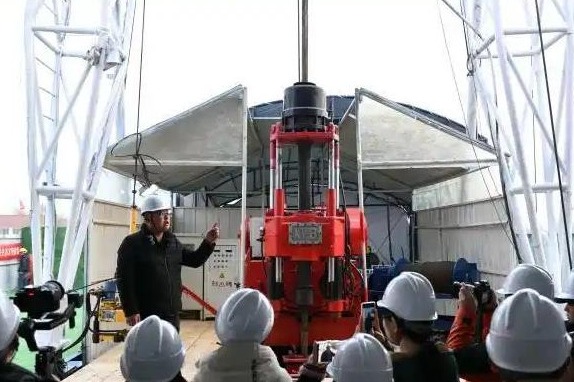
A 30-meter drilling rig stands prominently against the agricultural landscape of Wuchengdaren village in Laizhou, Shandong province, signaling a technological revolution in mineral exploration. This sophisticated apparatus represents the vanguard of China’s ambitious campaign to probe nearly 3 kilometers beneath the Earth’s surface in search of new gold deposits, with core samples expected within six months.
The Shandong Provincial Bureau of Geology and Mineral Resources has initiated a comprehensive exploration program comprising 36 separate projects with a total investment of 76 million yuan ($11 million). This strategic effort aims to augment gold reserves in the Jiaodong peninsula by 20 to 50 metric tons within a single year—a significant undertaking given that the region already contains approximately one-quarter of China’s proven gold reserves, ranking it as the world’s third-largest gold district.
After centuries of extensive mining that exhausted surface and shallow deposits, the bureau has pioneered advanced drilling technologies capable of reaching unprecedented depths. While previous exploration typically stopped at 2,000 meters, the organization now leads 83% of China’s scientific drilling projects exceeding 3,000 meters. Their expertise was demonstrated recently when they established a new global record by achieving full core extraction at 2,843.17 meters during marine scientific drilling operations.
The technological transformation extends beyond mere depth penetration. Modern prospecting begins months before drilling commences, integrating sophisticated geological research with physical detection methods including electrical and magnetic surveys, complemented by chemical analysis. This multi-faceted approach identifies subsurface anomaly zones with remarkable precision.
“We’re fundamentally changing how gold exploration operates,” explained Ma Xiaopeng, deputy director of the exploration engineering division at the bureau’s No. 6 geological team. “Through targeted drilling based on comprehensive data analysis, we can progressively narrow our search parameters. Subsequent laboratory analysis of extracted cores provides critical information about ore body conditions, grade quality, and depth positioning.”
Innovation continues with the adaptation of 2D reflection seismic technology—traditionally land-based—for marine exploration in Laizhou Bay. The most significant advancement, however, comes through digital integration. The bureau is developing comprehensive models that synthesize geological, geophysical, geochemical, and drilling data with artificial intelligence capabilities.
“We’re transitioning gold prospecting from experience-driven operations to intelligence-driven models,” stated Zhang Chengwei, Party secretary and director of the provincial bureau. This shift aligns with Shandong’s implementation plan for high-quality development of the gold industry (2025-2027), jointly issued by ten provincial departments, which specifically emphasizes deep exploration in the Jiaodong region.
The intensified exploration occurs against a backdrop of evolving gold demand dynamics in China. Recent market analysis reveals that demand for gold bars and coins surpassed gold jewelry for the first time last year, while industrial applications—particularly in electronics and renewable energy sectors—show steadily increasing consumption patterns.
“Ensuring national resource and energy security remains the paramount responsibility of our geological and mineral system,” Zhang emphasized, underscoring the strategic importance of these technological advancements for China’s broader economic and security objectives.