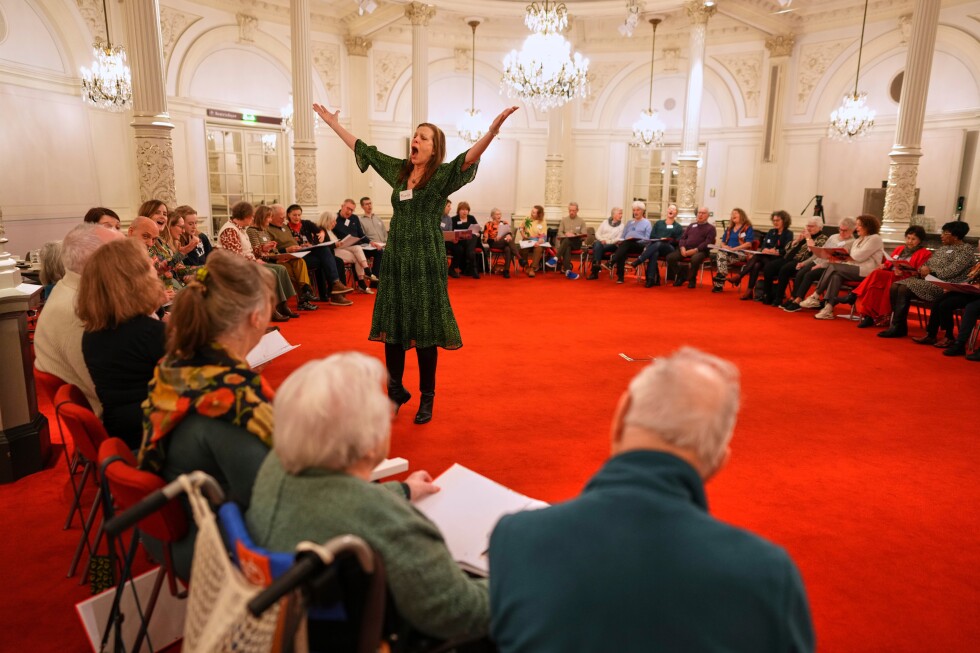
AMSTERDAM — Within the opulent Mirror Hall of Amsterdam’s famed Concertgebouw, a unique chorus resonates, offering a lifeline to individuals grappling with neurological deterioration. Under fourteen glittering crystal chandeliers, opera singer Maartje de Lint leads a ‘singing circle’ specifically designed for seniors with what she terms ‘vulnerable brains,’ many confronting dementia or Parkinson’s disease.
Among them is Megan Worthy, 58, whose rare early-onset dementia is progressively eroding her vision and cognitive functions. For Worthy, who fondly remembers singing in a choir during her youth in Canberra, Australia, the sessions are profoundly evocative. ‘It’s pretty brutal,’ she confessed, referring to her condition. ‘I’m starting to lose everything… and this is really rewarding. It did make me have a lot of memories.’ She attends alongside her daughter, Bronte, in a program that costs participants 20 euros ($23.50) per session.
The initiative, which De Lint and her organization conduct across the Netherlands and Europe, is founded on the principle that singing serves as vital cognitive exercise. Moving through the circle of singers and their caregivers, often kneeling to connect personally, De Lint describes the practice as a form of training. ‘We give people perspective,’ she explained. ‘It’s a training for the brain, for the body, to get more resilient.’
The emotional potency of the hour-long sessions is palpable, with helpers frequently distributing tissues to dab away tears. The repertoire, spanning from Elvis Presley’s ‘Love Me Tender’ to ‘Amazing Grace,’ fosters tender moments of human connection, such as one man gently touching his neighbor’s cheek during a song.
This therapeutic approach is supported by neurobiological science. Brankele Frank, a neurobiologist unaffiliated with the project, affirms that music engages brain regions often spared by neurodegeneration. ‘Their verbal skills often are compromised, but music speaks to parts of the brain that don’t necessarily need verbal skills,’ Frank told The Associated Press. ‘It taps into their emotion, their sense of self, their identity.’
Scientists are increasingly investigating music’s potential benefits for dementia, traumatic brain injuries, and stroke patients, noting its ability to activate multiple brain regions simultaneously, thereby strengthening neural networks governing language, memory, emotion, and movement.
For caregivers like Bronte Henfling, the value extends beyond clinical benefits. The experience of being in a non-medical, uplifting environment provides a crucial sense of normalcy and shared humanity. ‘Just hearing everyone come together and sing… it reminds us that we’re all human,’ she said, ‘which is really pleasing and nice to be a part of.’