A Sudan Airways jet touched down at Khartoum International Airport on February 1, 2026, marking only the second commercial arrival since 2023. The 160 passengers erupted in celebration—hugging, cheering, and capturing selfies—as they stepped onto the tarmac of a capital city shattered by nearly three years of civil war. This symbolic moment occurred just weeks after Prime Minister Kamil Idris declared 2026 would be “the year of peace,” with the military-led government announcing its return to Khartoum.
The scene contrasts starkly with the reality witnessed by BBC reporters months earlier. The airport terminal showed extensive damage, with unexploded munitions littering runways days after the Sudanese army recaptured it from the paramilitary Rapid Support Forces (RSF). Khartoum remains the epicenter of a conflict that erupted in April 2023, transforming government districts into blackened shells and forcing the administration to relocate to Port Sudan on the Red Sea.
The devastation extends throughout the capital: ministries, banks, and office blocks stand burned and hollowed. The presidential palace remains too damaged for use, while the British embassy bears pockmarked bulletproof glass testimony to intense firefights. The UN describes Sudan as plunged into “an abyss of unfathomable proportions,” with widespread destruction, famine, and human rights violations affecting millions.
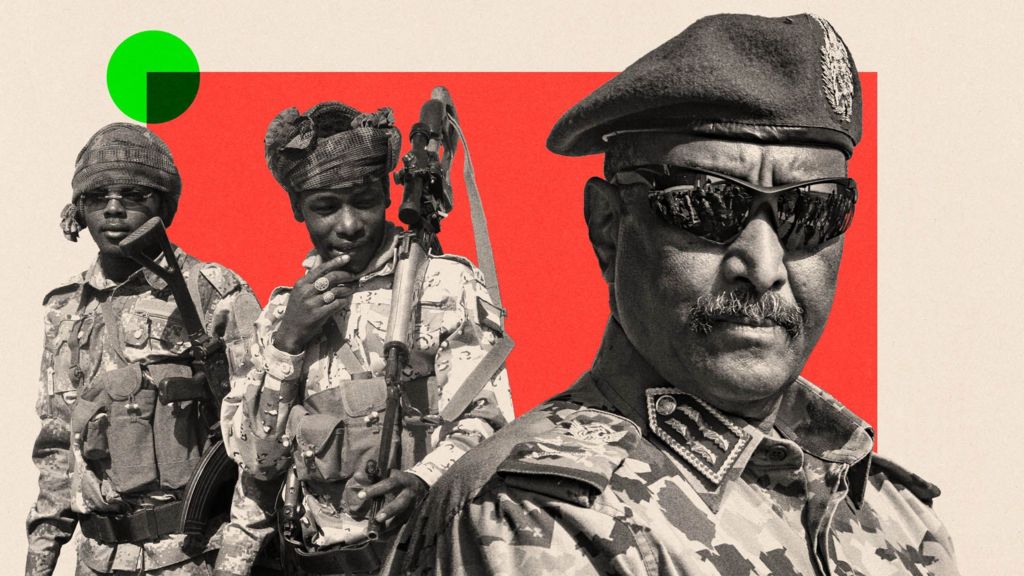
This conflict represents a fundamental power struggle between the Sudanese Armed Forces (SAF) and the RSF—a paramilitary force originally created by ousted dictator Omar al-Bashir as his personal guard. Following Bashir’s 2019 removal, tensions between RSF leader Gen Mohamed Hamdan Dagalo (Hemedti) and army chief Gen Abdel Fattah al-Burhan erupted into full-scale warfare.
The war has weaponized longstanding ethnic divisions, particularly between nomadic Arabs from the south and west (core RSF supporters) and Nile Valley Arabs from urban areas (traditional ruling class). In Darfur, RSF Arab militias have committed atrocities against non-Arab populations that UN experts say show “hallmarks” of genocide.
International dimensions complicate the conflict further. Documented evidence suggests the United Arab Emirates supplies weapons to the RSF—a claim Abu Dhabi officially denies. Meanwhile, Sudan’s military employs Turkish and Iranian drones while receiving backing from Egypt, Qatar, and Saudi Arabia.
Diplomatic efforts led by the Quad nations (US, Saudi Arabia, UAE, and Egypt) face significant obstacles. While the RSF has verbally accepted a peace roadmap beginning with a humanitarian truce, neither side has formally responded, and fighting has intensified rather than diminished. Army chief Burhan insists he cannot agree to any plan unless the RSF accepts surrender conditions.
The conflict has created the world’s worst humanitarian crisis, with 25 million facing acute food shortages and 12 million displaced. Analysts fear even a ceasefire would be temporary without addressing fundamental issues: the military’s economic control, representation for marginalized regions, and accountability for widespread atrocities.
With both sides viewing the conflict as existential and foreign powers continuing their support, many experts predict a prolonged war. Some officials compare the situation to America’s 20-year conflict in Afghanistan, while analysts warn of potential “balkanization” of Sudan if fighting continues for another decade or more—a scenario with devastating implications for the entire region.