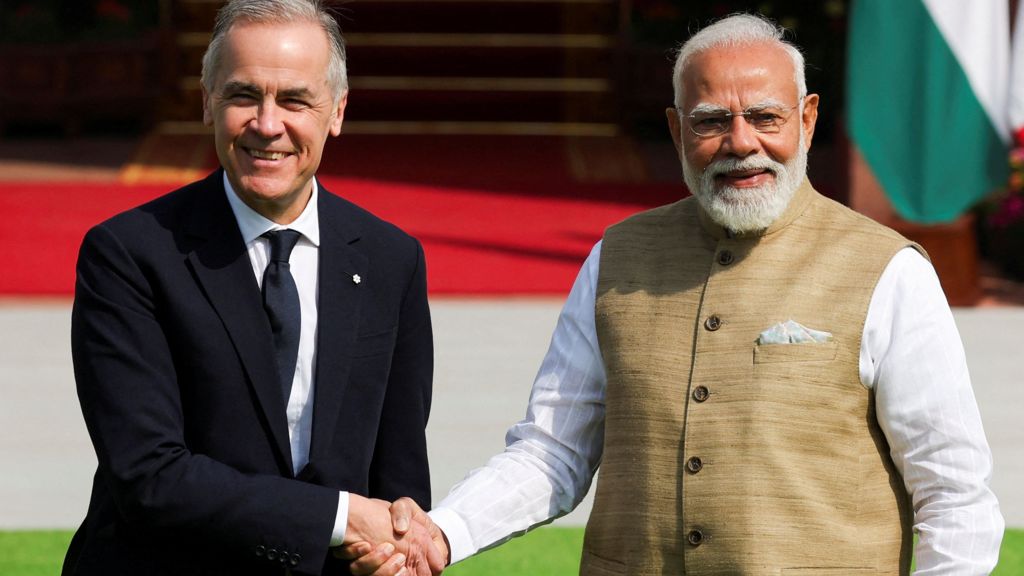
In a significant diplomatic turnaround, India and Canada have unveiled a comprehensive suite of agreements aimed at revitalizing their bilateral relationship, previously marred by serious tensions. The cornerstone of this renewed partnership is a landmark 10-year civil nuclear energy deal, announced following high-level talks in New Delhi between Indian Prime Minister Narendra Modi and his Canadian counterpart, Mark Carney.
The two leaders pledged to deepen cooperation across multiple strategic sectors, including defense technology, critical minerals, space exploration, and advanced education. A particularly ambitious goal set was the conclusion of a long-pending free trade agreement, dubbed the Comprehensive Economic Partnership Agreement, by the end of 2026. This move is strategically viewed as a mutual effort to mitigate exposure to punitive trade tariffs imposed by the United States.
This diplomatic reset follows a period of severe strain triggered in 2023 when former Canadian Prime Minister Justin Trudeau alleged potential Indian government links to the assassination of Sikh separatist Hardeep Singh Nijjar on Canadian soil—an accusation India vehemently denied. The fallout led to a near-complete breakdown in relations, involving reciprocal expulsions of diplomats and suspension of visa services.
Since assuming office last year, Prime Minister Carney has adopted a pragmatic approach, consciously moving past the allegations. His government has stated it believes India is not currently linked to violent threats in Canada, though the Nijjar case remains before the courts. This shift has enabled a cautious but rapid rebuilding of ties, with Carney noting that governmental engagement in the past year has surpassed the total of the previous two decades.
Beyond nuclear energy, the partnership will focus on joint development of small modular reactors, collaboration in artificial intelligence, supercomputing, semiconductor manufacturing, and a jointly hosted renewable energy summit. Both leaders emphasized the countries’ long-standing people-to-people connections, with Canada hosting one of the largest Indian diasporas globally.
Analysts interpret this reconciliation as a pragmatic response to contemporary geopolitical realignments. For India, it represents a strategic step toward diversifying trade partnerships and reducing energy dependence on Russia. For Canada, it is part of a broader strategy to diversify its trade relationships and attract new investments, with Carney’s trip continuing to Australia and Japan.