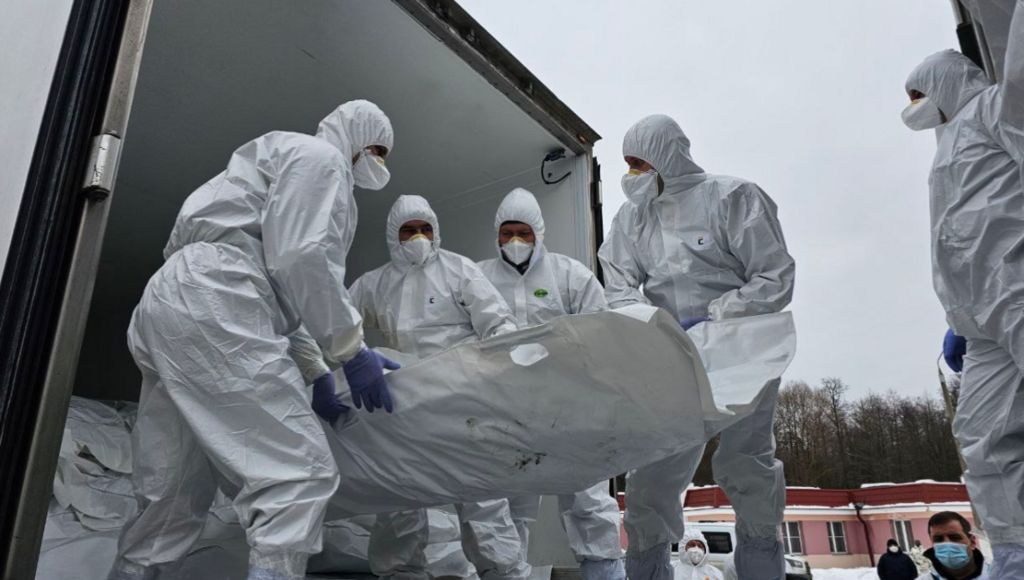
Amidst a backdrop of renewed hostilities and diplomatic stagnation, Russia and Ukraine have conducted a significant exchange of soldiers’ remains. Vladimir Medinsky, a senior aide to Russian President Vladimir Putin, announced via Telegram that Russia has transferred the remains of 1,000 Ukrainian soldiers and received 35 in return, though Ukraine has not officially confirmed the operation. This grim transaction occurs as another round of peace talks, mediated by U.S. President Donald Trump’s envoys, is set to commence in Geneva.
The negotiations, which have previously included figures like Steve Witkoff and Jared Kushner, have yet to yield a breakthrough in the five-year conflict. The latest diplomatic effort was immediately preceded by a severe escalation, with President Volodymyr Zelensky reporting that Russia launched 420 drones and 39 missiles across six Ukrainian regions, injuring dozens.
The body exchange is executed under the framework of the Istanbul Agreement from June 2025, a pact wherein both nations committed to returning up to 6,000 remains each, alongside all severely wounded, ill, and POWs under the age of 25. While such exchanges have occurred periodically throughout the war, this latest event highlights a persistent and unexplained discrepancy: Russia has consistently repatriated fewer bodies to Ukraine than it has received. Both sides have traded accusations over violating the agreement’s terms, with Moscow alleging Ukrainian non-compliance and Kyiv criticizing Russia’s irregular and sometimes inaccurate returns.
This asymmetry may be partly tactical; Russian forces, often on the offensive, potentially have greater access to recover remains from the battlefield. The human cost of the war remains staggering and heavily disputed. President Zelensky recently acknowledged 55,000 Ukrainian military fatalities—a figure Western analysts consider a significant underestimate. Conversely, the BBC has confirmed nearly 186,000 Russian military deaths from public sources, with the actual toll believed to be substantially higher.
On the diplomatic front, President Zelensky expressed cautious optimism following a phone call with Donald Trump, stating that the Geneva talks could pave the way for high-level trilateral negotiations in March. Zelensky emphasized that this top-down approach, which Trump reportedly supports, is ‘the only way to resolve all the complex and sensitive issues.’ However, a major obstacle remains, as Putin continues to refuse direct engagement with Zelensky, whom he deems illegitimate due to the suspension of Ukrainian presidential elections under the martial law imposed after Russia’s invasion.