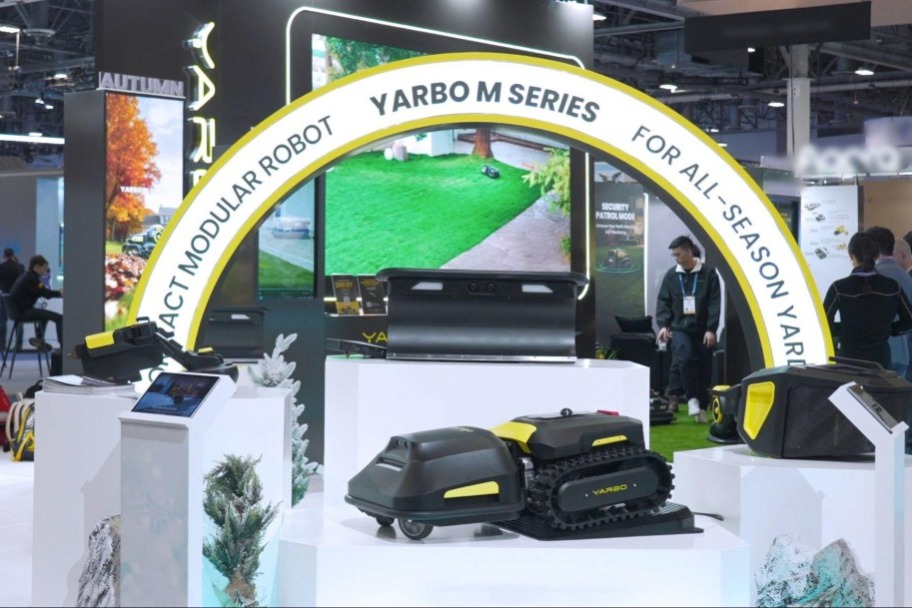
At CES 2026, Chinese smart cleaning manufacturers demonstrated a strategic shift toward premium market penetration, showcasing cutting-edge robotic systems that redefine home and yard maintenance. These innovations signal China’s evolution from cost competitors to technology leaders in the global robotics sector.
Leading this charge is Yarbo, whose modular autonomous system features a core unit with interchangeable attachments capable of handling diverse tasks from lawn mowing to snow removal. Co-founder Huang Zhiliang emphasized their decade-long development journey: ‘Our new Yarbo M Series represents accumulated expertise and user feedback, delivering solutions that save both time and money for property owners.’
The premium pricing strategy—ranging from $5,000 to $10,000—targets European and American middle-class consumers with large properties. Huang attributes market readiness to rising labor costs and shrinking workforces in Western markets, making robotic alternatives increasingly economically viable.
Critical to this technological advancement is China’s manufacturing ecosystem, which has dramatically reduced component costs. Lidar sensors, once exceeding $10,000 for automotive use, now cost between $1,000 and $2,000, enabling sophisticated navigation in consumer products. Huang noted: ‘China’s supply chain strengths allow us to create superior products at lower costs, delivering exceptional value globally.’
Dreame Technology showcased this technological integration with their lidar-equipped robotic pool cleaner capable of precision cleaning on steps, ledges, and pool surfaces. Global Marketing Director Wu Tao explained: ‘Lidar enables unprecedented precision in autonomous path planning. Previously missed particles are now consistently captured.’
The company is developing a fully autonomous system featuring a base station that serves as both charger and launch platform. Wu revealed: ‘Our goal is minimal human intervention—the robot will self-deploy, complete cleaning cycles, and return to its station independently.’
Early CES reception has been overwhelmingly positive, particularly toward the autonomous base station concept. Wu observed that many US competitors still rely on primitive cable systems, lacking advanced navigation capabilities. He acknowledged, however, that American firms still lead in certain specialized areas.
CES 2026, featuring thousands of exhibitors from 155 countries, provided a global stage for demonstrating how Chinese innovation is reshaping the smart cleaning industry through AI integration and supply chain advantages.