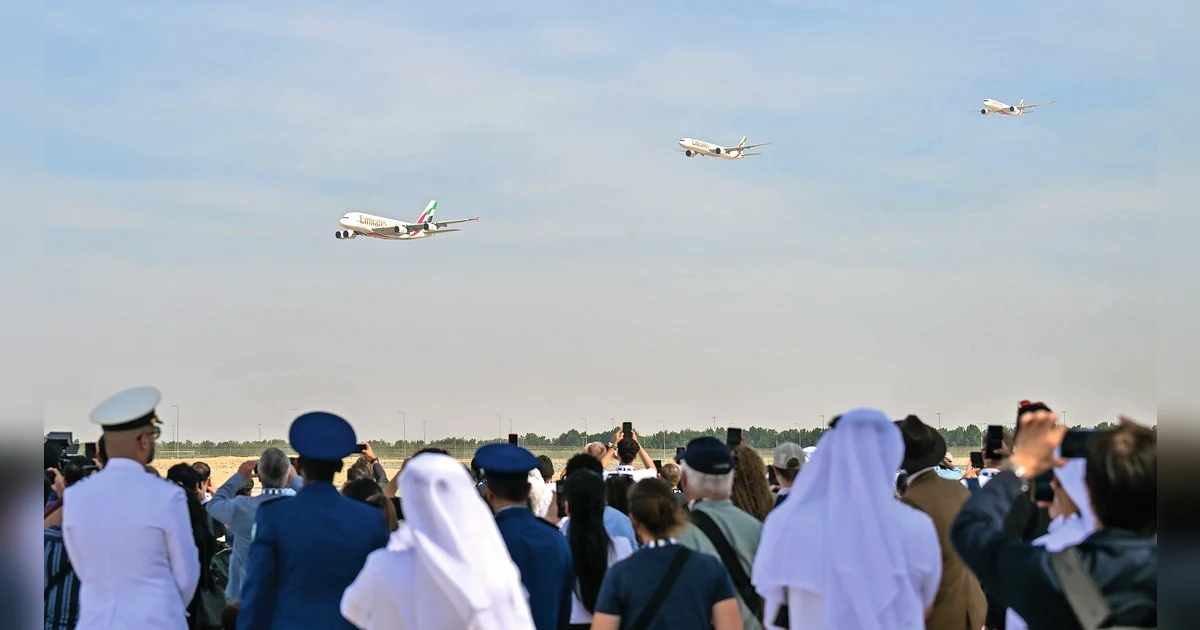
The recently concluded 19th Dubai Airshow has positioned the United Arab Emirates for unprecedented aviation growth, with record-breaking aircraft orders and massive infrastructure investments setting the stage for global industry leadership. Aviation experts confirm the event has established new benchmarks for the industry, with implications stretching far beyond the November 2027 edition.
Dubai International Airport (DXB) is poised to achieve a historic milestone in 2026 by becoming only the second airport globally, after Atlanta International, to handle 100 million passengers. This achievement contributes to projected UAE-wide passenger traffic of approximately 160 million next year. Current statistics reveal robust growth, with UAE airports collectively handling 147.8 million travelers in 2024, representing a 10.7% year-on-year increase from the previous year.
The aviation expansion is underpinned by massive fleet investments unveiled at the Airshow. Emirates’ landmark $40 billion Boeing 777X order and flydubai’s acquisition of over 300 Airbus A321neo and Boeing 737 MAX aircraft demonstrate the region’s aggressive growth strategy. These developments are complemented by multi-billion dollar airport expansion projects designed to ultimately handle more than 300 million passengers annually.
Critical to this growth is the development of Dubai World Central (DWC), which will eventually provide capacity for up to 260 million passengers with five runways. Industry expert John Strickland of JLS Consulting emphasized Dubai’s strategic geographic advantage, noting its ability to service global traffic flows while maintaining a strong point-to-point market that reduces reliance on transfer traffic compared to competitors.
Aviation analysts highlight several factors driving UAE aviation’s resilience and competitive edge. Saj Ahmad, Chief Analyst at StrategicAero Research, identified Emirates’ hub connectivity capabilities, superior product offerings across UAE carriers, and streamlined airport operations free from excessive bureaucracy as key differentiators from US and European competitors.
The UAE’s aviation success story extends beyond infrastructure and equipment. Andrew Charlton of Aviation Advocacy cited location advantages, progressive competition attitudes, and embrace of future technologies as fundamental to market resilience. The upcoming Dubai World Airport project represents a blank canvas for reimagining the entire passenger experience from start to finish.
As the UAE aims to host 40 million visitors by 2031, the aviation sector’s growth appears inextricably linked to broader economic development. The country’s remarkable post-pandemic recovery across real estate, financial markets, employment, and transport sectors creates a virtuous cycle that continues to attract global travelers and businesses alike.
The Dubai Airshow’s emergence as the premier venue for aviation deals signals a broader shift in industry dynamics, with manufacturers and airlines increasingly choosing Dubai over traditional European venues for major announcements. This transition reflects the region’s growing influence in shaping the future of global aviation.