KYIV, Ukraine — As Russia’s full-scale invasion of Ukraine enters its fifth year of brutal conflict, Ukrainian President Volodymyr Zelenskyy has announced a unprecedented reciprocal proposal: a temporary halt to cross-border attacks on energy facilities from both sides, timed to coincide with the upcoming Orthodox Easter holiday this weekend. In a public address delivered late Monday, Zelenskyy confirmed the offer was formally transmitted to Russian authorities through Washington, which has served as a mediator for indirect talks between Moscow and Kyiv.
“If Russia agrees to end its strikes against our energy infrastructure, Ukraine will stand by the same commitment,” Zelenskyy stated. To date, the Kremlin has not issued any public response to the proposal. This call for a limited holiday truce comes amid a long track record of failed ceasefire attempts between the two warring nations. Last Orthodox Easter, Russian President Vladimir Putin unilaterally announced a 30-hour ceasefire, but the agreement collapsed within hours as both sides traded accusations of immediate violations. A year ago, Moscow also rejected a 30-day unconditional truce put forward by the U.S. and Ukraine, framing the offer as unconstructive and continuing to push for a sweeping negotiated settlement that meets its core demands. Even so, Russia has unilaterally declared multiple short-term ceasefires over the past years of conflict.
Despite extending the offer, Zelenskyy made clear he holds little optimism that the Kremlin will accept the proposal. He pointed to current global energy market conditions, noting that Russia is reaping greater financial benefits from elevated international oil prices driven by ongoing conflict in Iran, giving it little incentive to pause strikes that undermine Ukraine’s energy stability. Beyond the truce proposal, Zelenskyy also reiterated growing concerns that a prolonged U.S.-Israeli military campaign in Iran will divert international attention and erode critical American support for Ukraine’s war effort. So far, U.S.-mediated indirect talks between the two nations have stalled on all core sticking points, with Washington’s policy bandwidth largely absorbed by the escalating Middle East crisis. Meanwhile, Ukrainian and Russian forces remain entrenched in brutal, ongoing clashes along a roughly 1,000-mile front line stretching across eastern and southern Ukraine.
For months, both sides have targeted each other’s critical energy infrastructure as a core military strategy. Russia has launched sustained, large-scale attacks on Ukraine’s power grid in a deliberate campaign to break civilian morale ahead of the cold winter and spring months. In response, Ukraine has ramped up its own long-range drone strikes against Russian oil facilities, aiming to cut into the export revenue that funds Moscow’s war machine. A new assessment published late Monday by the Institute for the Study of War (ISW), a Washington-based think tank specializing in conflict analysis, confirms Ukraine’s expanding drone campaign is yielding tangible results. The report notes that Ukraine is successfully exploiting gaps in Russia’s overstretched air defense network, causing significant damage to Russia’s oil export capacity. “Russia’s vast geographic territory creates enormous defensive challenges, particularly when the country still relies heavily on legacy air defense systems to intercept Ukrainian drone salvos,” the ISW assessment added.
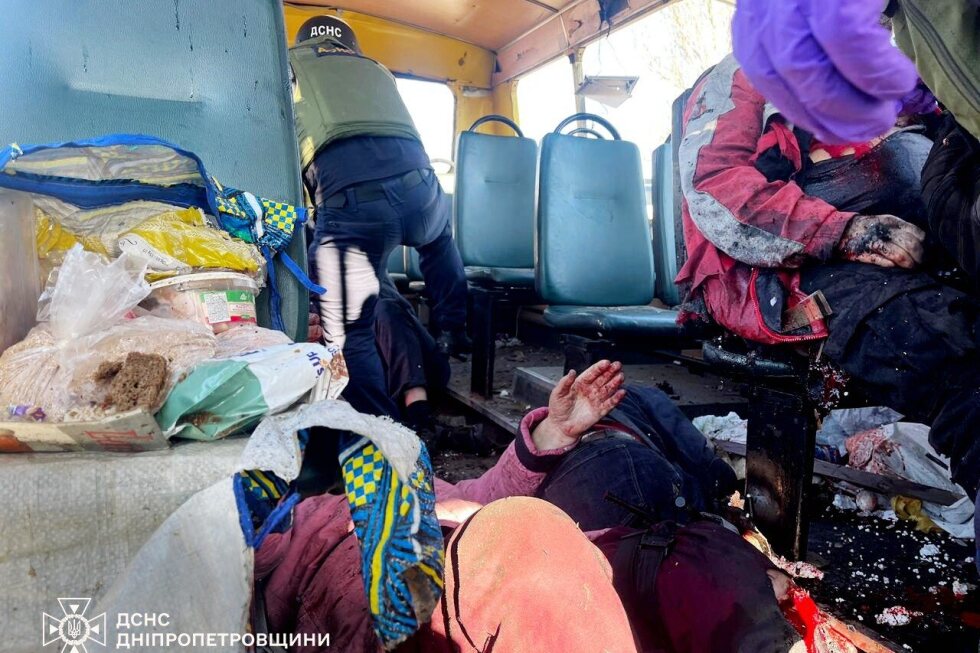
Alongside attacks on energy infrastructure, Russian forces have continued to target civilian and public transportation networks across Ukraine, including the country’s critical rail links that serve both civilian and military supply purposes. On Tuesday morning, a Russian drone struck a civilian bus as it pulled into a stop in the southeastern Ukrainian city of Nikopol during morning rush hour, killing four civilians and wounding 15 more. Ukrainian Interior Minister Ihor Klymenko confirmed the attack in an online post, emphasizing that the strike was a deliberate tactic targeting ordinary civilians. “This brutal attack on regular civilian transportation happened during rush hour, when people were simply heading to their jobs,” Klymenko wrote. “This is no accident — this is Russia’s deliberate strategy: targeted strikes on innocent civilians.”
Additional Russian attacks across southern and eastern Ukraine pushed Tuesday’s civilian death toll even higher. Ukrainian authorities reported three people killed and three more injured in a strike on a residential building in the southern city of Kherson. Near the eastern city of Synelnykove, an 11-year-old boy was killed in a separate drone strike, bringing the total number of civilian fatalities reported on Tuesday to eight. Following Tuesday’s wave of drone and artillery strikes, Ukrainian military and civil defense officials confirmed widespread power outages across multiple regions in eastern and southern Ukraine, a disruption that echoes the widespread energy cuts that upended civilian life across the country through the winter months.