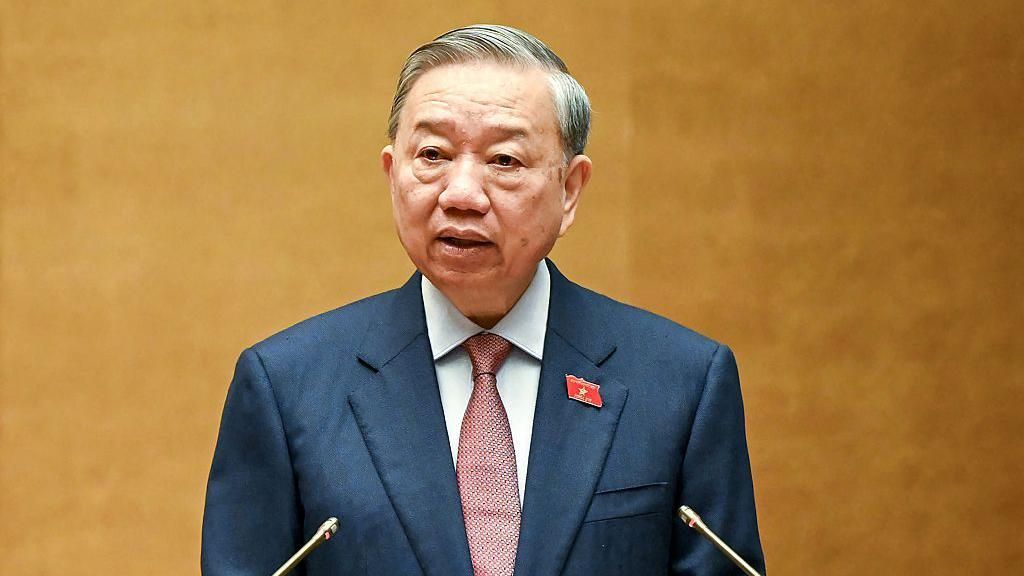
In a historic shift for Vietnam’s governing structure, To Lam has secured election as the country’s new president by the Communist Party-dominated National Assembly, giving him simultaneous control of the two most powerful positions in the nation – the top role in the Communist Party and the head of state office. The unanimous vote from the 500-member legislative body, which convened this week following the January Communist Party Congress that sets the country’s core strategic direction, cements To Lam’s status as the most influential Vietnamese leader in decades.
To Lam’s rapid ascent to the apex of Vietnamese politics unfolded over the past 10 years, rooted in his tenure as the country’s high-profile Minister of Public Security. In that role, he led a sweeping nationwide anti-corruption campaign that sidelined and removed dozens of potential political rivals. He first stepped into the dual leadership roles on an interim basis in 2024, following the resignation of former president Vo Van Thuong and the passing of long-time party chief Nguyen Phu Trong. Now, he has secured a full five-year mandate to hold both top posts.
For decades, the Communist Party of Vietnam has centered its governance model on collective leadership, splitting authority across a set of senior national positions known as the “five pillars” to avoid excessive concentration of power in a single figure. To Lam’s consolidation of the two top roles has drawn international comparisons to China, where President Xi Jinping has also centralized authority in his own hands. When To Lam retained his position as Communist Party General Secretary in January, Xi Jinping extended immediate congratulations, noting that both sides would work to deepen the long-standing traditional friendship between the two neighboring socialist nations. While the two ruling parties maintain close bilateral ties, historical anti-Chinese sentiment remains present among segments of the Vietnamese public.
Despite these parallels, some regional experts emphasize that key checks on power remain in place in Vietnam’s political system. Carl Thayer, Emeritus Professor at the University of New South Wales, explained that Vietnam’s Central Committee retains a stronger role in overseeing the party’s General Secretary compared to China’s governing structure. “To Lam is the first among equals, but he’s also answerable to the Politburo,” Thayer noted, pointing to the 19-member committee that includes other senior influential leaders. “There’s still a balance. But To Lam has shown that he can work collectively and build coalitions,” he added.
Looking ahead, the most critical test of To Lam’s leadership will come not from internal party politics, but from his ability to deliver on the ambitious economic goals he has laid out for his administration, against a backdrop of persistent global economic uncertainty. To Lam has already outlined a sweeping reform agenda designed to lift Vietnam to upper-income country status within the next 20 years. He has set an ambitious target of sustaining annual economic growth above 7-10% while continuing his predecessor’s aggressive anti-corruption campaign, dubbed the “blazing furnace” which has already disciplined or removed tens of thousands of public officials across all levels of government.